Chen Xiaotong, Gu Junxiang, Sun Le, Li Wenya, Guo Lili, Gu Zhiyang, Wang Litong, Zhang Yan, Zhang Wangwang, Han Baoqin, Chang Jing
College of Marine Life Science, Ocean University of China, Qingdao, 266003, PR China.
Laboratory for Marine Drugs and Bioproducts, Pilot National Laboratory for Marine Science and Technology (Qingdao), Qingdao, 266235, PR China.
Bioact Mater. 2021 Mar 9;6(10):3025-3035. doi: 10.1016/j.bioactmat.2021.02.028. eCollection 2021 Oct.
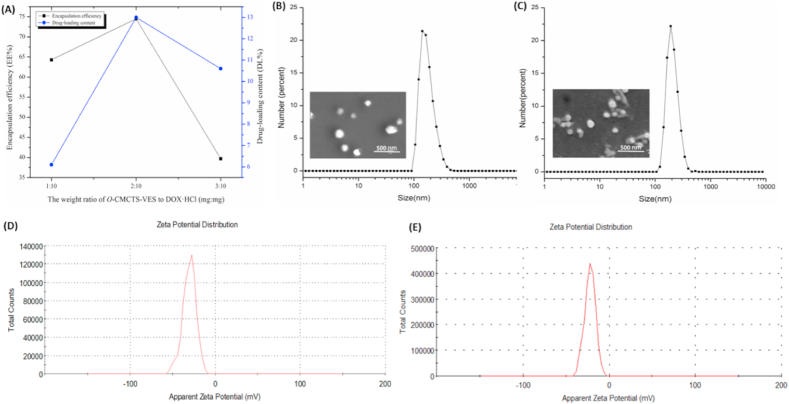
Nanocarriers have emerged as a promising cancer drug delivery strategy. Multi-drug resistance caused by overexpression of multiple-drug excretion transporters in tumor cells is the major obstacle to successful chemotherapy. Vitamin E derivatives have many essential functions for drug delivery applications, such as biological components that are hydrophobic, stable, water-soluble enhancing compounds, and anticancer activity. In addition, vitamin E derivatives are also effective mitocan which can overcome multi-drug resistance by binding to P glycoproteins. Here, we developed a carboxymethyl chitosan/vitamin E succinate nano-micellar system (-CMCTS-VES). The synthesized polymers were characterized by Fourier Transform IR, and H NMR spectra. The mean sizes of -CMCTS-VES and DOX-loaded nanoparticles were around 177 nm and 208 nm. The drug loading contents were 6.1%, 13.0% and 10.6% with the weight ratio of DOX to -CMCTS-VES corresponding 1:10, 2:10 and 3:10, and the corresponding EEs were 64.3%, 74.5% and 39.7%. Cytotoxicity test, hemolysis test and histocompatibility test showed that it had good biocompatibility and . Drug release experiments implied good pH sensitivity and sustained-release effect. The DOX/-CMCTS-VES nanoparticles can be efficiently taken up by HepG2 cancer cells and the tumor inhibition rate is up to 62.57%. In the study by using H22 cells implanted Balb/C mice, DOX/-CMCTS-VES reduced the tumor volume and weight efficiently with a TIR of 35.58%. The newly developed polymeric micelles could successfully be utilized as a nanocarrier system for hydrophobic chemotherapeutic agents for the treatment of solid tumors.
纳米载体已成为一种很有前景的癌症药物递送策略。肿瘤细胞中多种药物排泄转运蛋白的过表达所导致的多药耐药性是成功化疗的主要障碍。维生素E衍生物在药物递送应用中具有许多重要功能,例如作为疏水性、稳定性、水溶性增强化合物和抗癌活性的生物成分。此外,维生素E衍生物还是有效的丝裂霉素,可通过与P糖蛋白结合来克服多药耐药性。在此,我们开发了一种羧甲基壳聚糖/琥珀酸维生素E纳米胶束系统(-CMCTS-VES)。通过傅里叶变换红外光谱和核磁共振氢谱对合成的聚合物进行了表征。-CMCTS-VES和载有阿霉素的纳米颗粒的平均尺寸分别约为177nm和208nm。当阿霉素与-CMCTS-VES的重量比分别为1:10、2:10和3:10时,载药量分别为6.1%、13.0%和10.6%,相应的包封率分别为64.3%、74.5%和39.7%。细胞毒性试验、溶血试验和组织相容性试验表明其具有良好的生物相容性。药物释放实验表明其具有良好的pH敏感性和缓释效果。阿霉素/-CMCTS-VES纳米颗粒可被肝癌细胞HepG2有效摄取,肿瘤抑制率高达62.57%。在使用接种了H22细胞的Balb/C小鼠进行的研究中,阿霉素/-CMCTS-VES有效地减小了肿瘤体积和重量,肿瘤抑制率为35.58%。新开发的聚合物胶束可成功用作疏水性化疗药物的纳米载体系统,用于治疗实体瘤。