Yorifuji Takashi, Kashima Saori, Tani Yasunari, Yamakawa Junji, Doi Hiroyuki
Department of Human Ecology, Graduate School of Environmental and Life Science, Okayama University, Okayama, Japan.
Department of Public Health and Health Policy, Graduate School of Biomedical and Health Sciences, Hiroshima University, Hiroshima, Japan.
Environ Epidemiol. 2019 May 20;3(3):e051. doi: 10.1097/EE9.0000000000000051. eCollection 2019 Jun.
A number of studies have linked long-term exposure to particulate matter with aerodynamic diameter <2.5 µm (PM) with mortality, but most of these studies were conducted in Europe and North America. Studies in Asian countries had been conducted at relatively high exposures. We evaluated the association of long-term exposure to PM and natural-cause and cause-specific mortality in Japan, where PM levels are relatively low compared with levels in other Asian countries.
A cohort of 75,531 participants underwent basic health checkups in Okayama City in 2006 or 2007. We followed the participants until the end of 2016. Average PM levels from 2006 to 2010 were obtained and assigned to the participants by geographical location. We used the Cox proportional hazard models to estimate hazard ratios for a 5-μg/m increase in PM levels for natural-cause or cause-specific mortality, adjusting for potential confounders.
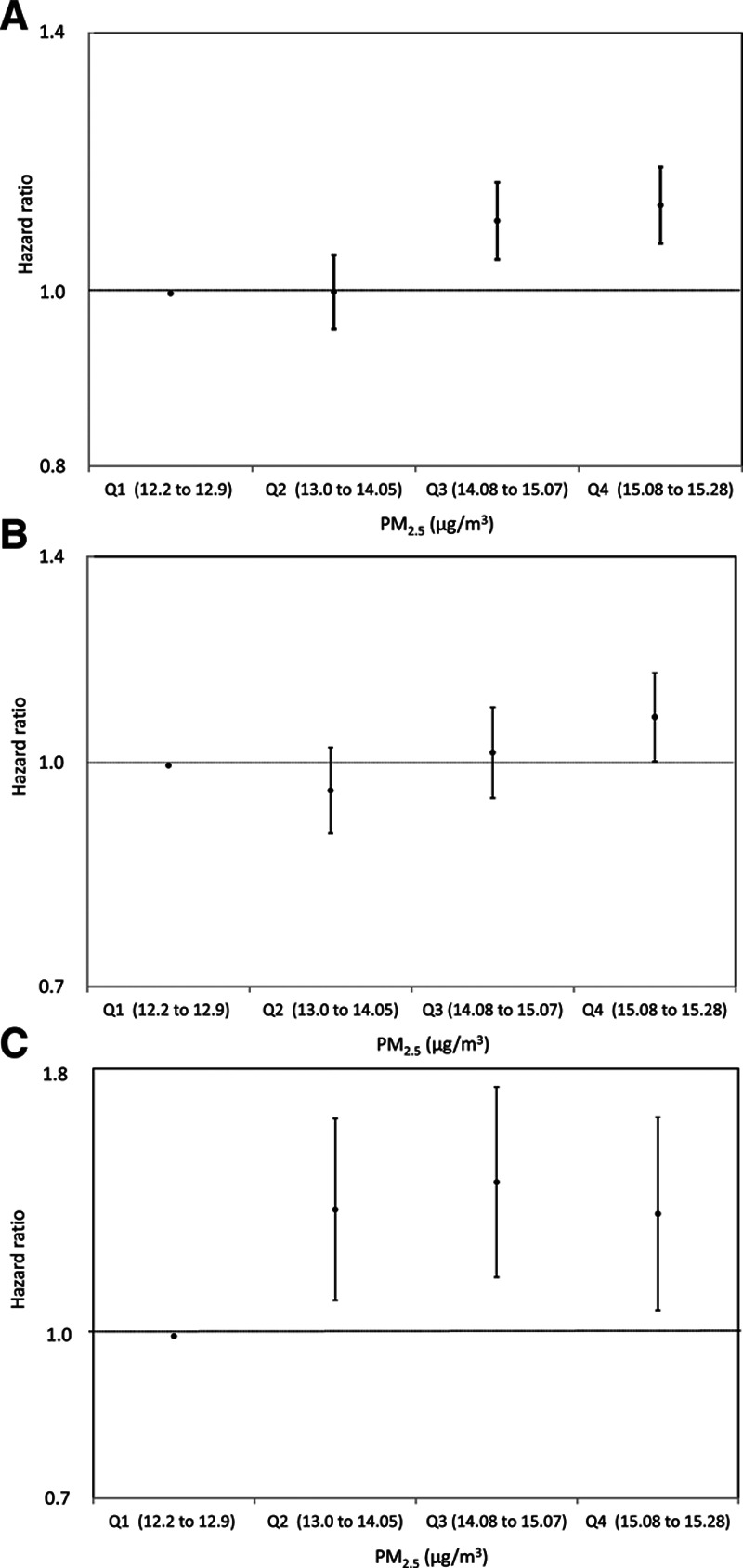
PM exposure was associated with increased risk of mortality; the hazard ratios were 1.29 (95% confidence interval = 1.18, 1.41) for mortality from natural causes, 1.16 (1.02, 1.32) for cardiorespiratory mortality, and 1.63 (1.13, 2.34) for lung cancer mortality. PM exposure was more strongly associated with cardiorespiratory mortality from hypertension, pneumonia and influenza, and chronic obstructive pulmonary disease than with ischemic heart disease or cerebrovascular disease. Elderly participants and smokers tended to have higher effect estimates.
Long-term exposure to PM can increase the risk of natural-cause, cardiorespiratory, and lung cancer mortality in Japan.
多项研究已将长期暴露于空气动力学直径小于2.5微米的颗粒物(PM)与死亡率联系起来,但这些研究大多在欧洲和北美进行。亚洲国家的研究是在相对较高的暴露水平下开展的。我们评估了日本长期暴露于PM与自然原因及特定病因死亡率之间的关联,日本的PM水平与其他亚洲国家相比相对较低。
2006年或2007年,一组75531名参与者在冈山市接受了基本健康检查。我们对参与者进行随访直至2016年底。获取2006年至2010年的平均PM水平,并根据地理位置将其分配给参与者。我们使用Cox比例风险模型来估计PM水平每增加5微克/立方米时自然原因或特定病因死亡率的风险比,并对潜在混杂因素进行调整。
暴露于PM与死亡风险增加相关;自然原因死亡的风险比为1.29(95%置信区间=1.18,1.41),心肺疾病死亡的风险比为1.16(1.02,1.32),肺癌死亡的风险比为1.63(1.13,2.34)。与缺血性心脏病或脑血管疾病相比,PM暴露与高血压、肺炎和流感以及慢性阻塞性肺疾病导致的心肺疾病死亡的关联更强。老年参与者和吸烟者的效应估计值往往更高。
在日本,长期暴露于PM可增加自然原因、心肺疾病和肺癌死亡的风险。