Schwalm Jon-David, McCready Tara, Lear Scott A, Lamelas Pablo, Garis Len, Musa Hadi, Vincent Kaitey, Islam Shofiqul, Attaran Amir, McKee Martin, Yusuf Salim
Population Health Research Institute, Hamilton Health Sciences, McMaster University, Hamilton, Ontario, Canada.
Faculty of Health Sciences, Simon Fraser University, Burnaby, British Columbia, Canada.
CJC Open. 2020 Oct 13;3(3):267-275. doi: 10.1016/j.cjco.2020.10.006. eCollection 2021 Mar.
There is a gap between evidence and practice in the management of cardiovascular (CV) risk. Previous research indicated benefits from community-based, multi-faceted interventions to screen, diagnose, and manage CV risk in people with hypertension.
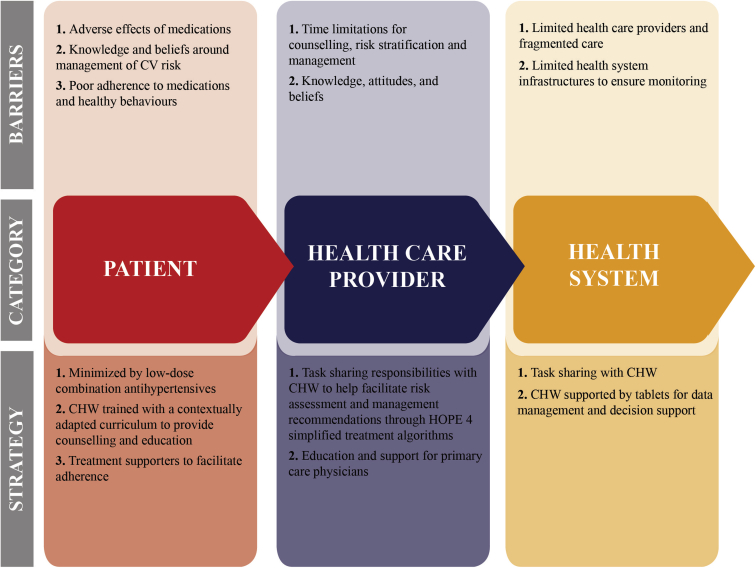
The Heart Outcomes Prevention and Evaluation 4 Canada pilot study (HOPE 4) was a quasi-experimental pre-post interventional study, involving one community each in Hamilton, Ontario and Surrey, British Columbia, Canada. Individuals aged ≥50 years with newly diagnosed or poorly controlled hypertension were included. The intervention was comprised of: (i) simplified diagnostic/treatment algorithms implemented by community health workers (firefighters in British Columbia and community health workers in Ontario) guided by decision support and counselling software; (ii) recommendations for evidence-based CV medications and lifestyle modifications; and (iii) support from family/friends to promote healthy behaviours. The intervention was developed as part of the international Heart Outcomes Prevention and Evaluation 4 Canada pilot study trial and adapted to the Canadian context. The primary outcome was the change in Framingham Risk Score 10-year CV disease risk estimate between baseline and 6 months.
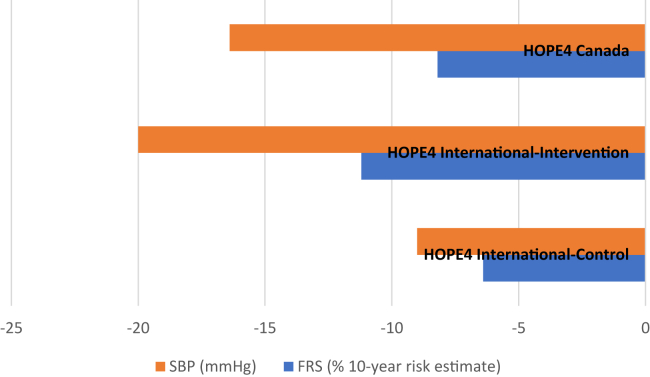
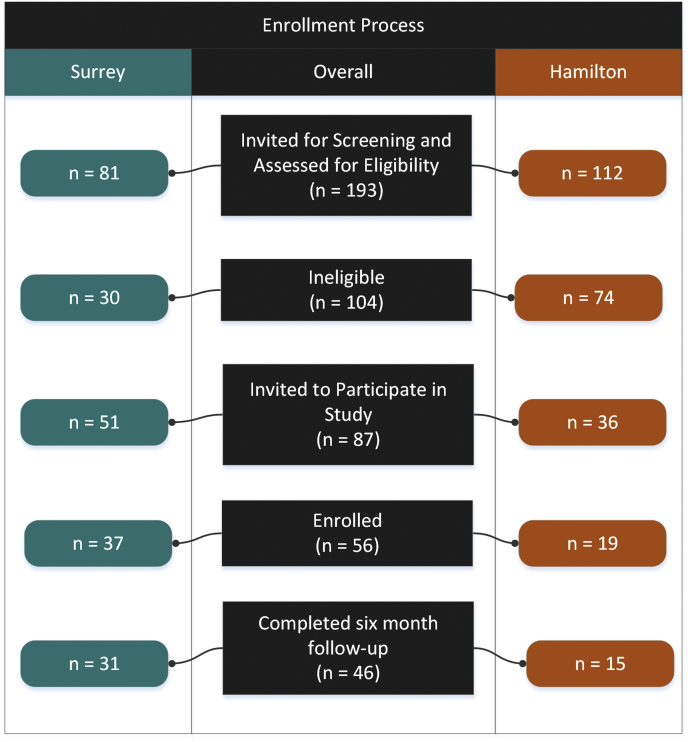
Between 2016 and 2017, a total of 193 participants were screened, with 37 enrolled in Surrey, and 19 in Hamilton. Mean age was 69 years (standard deviation 11), with 54% female, 27% diabetic, and 73% with a history of hypertension. An 82% follow-up level had been obtained at 6 months. Compared to baseline, there were significant improvements in the Framingham Risk Score 10-year risk estimate (30.6% vs 24.7%, < 0.01), and systolic blood pressure (153.1 vs 136.7 mm Hg, < 0.01). No significant changes in lipids or healthy behaviours were noted.
A comprehensive approach to health care delivery, using a community-based intervention with community health workers, supported by mobile-health technologies, has the potential to significantly reduce cardiovascular risk, but further evaluation is warranted.
心血管(CV)风险管理方面的证据与实践之间存在差距。先前的研究表明,基于社区的多方面干预措施对筛查、诊断和管理高血压患者的心血管风险有益。
加拿大心脏结局预防与评估4试点研究(HOPE 4)是一项准实验性前后对照干预研究,在加拿大安大略省汉密尔顿市和不列颠哥伦比亚省萨里市各选取一个社区。纳入年龄≥50岁、新诊断或血压控制不佳的高血压患者。干预措施包括:(i)由社区卫生工作者(不列颠哥伦比亚省的消防员和安大略省的社区卫生工作者)在决策支持和咨询软件的指导下实施简化的诊断/治疗算法;(ii)基于证据的心血管药物和生活方式改变的建议;(iii)家人/朋友的支持以促进健康行为。该干预措施是作为国际加拿大心脏结局预防与评估4试点研究试验的一部分开发的,并根据加拿大的情况进行了调整。主要结局是基线至6个月期间弗雷明汉风险评分10年心血管疾病风险估计值的变化。
2016年至2017年期间,共筛查了193名参与者,其中37名在萨里市登记,19名在汉密尔顿市登记。平均年龄为69岁(标准差11),女性占54%,糖尿病患者占27%,有高血压病史的占73%。6个月时的随访率为82%。与基线相比,弗雷明汉风险评分10年风险估计值有显著改善(30.6%对24.7%,<0.01),收缩压也有显著改善(153.1对136.7 mmHg,<0.01)。脂质或健康行为方面未发现显著变化。
采用基于社区的干预措施并配备社区卫生工作者,同时借助移动健康技术的综合医疗服务提供方式,有可能显著降低心血管风险,但仍需进一步评估。