Rojas Paulina Henriquez, Sivaraju Adithya, Quraishi Imran H, Vanderlind Michael, Rofes Adrià, Połczynska-Bletsos Monika M, Spencer Dennis D, Hirsch Lawrence J, Benjamin Christopher F A
Comprehensive Epilepsy Center, Department of Neurology, Yale University School of Medicine, New Haven, CT, USA.
Department of Neurolinguistics and Language Development, University of Groningen, Groningen, the Netherlands.
Epilepsy Behav Rep. 2021 Feb 11;15:100433. doi: 10.1016/j.ebr.2021.100433. eCollection 2021.
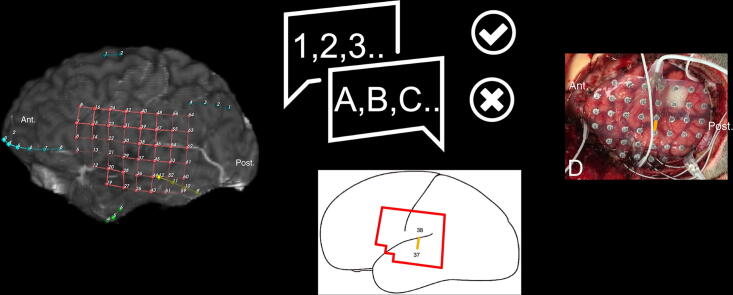
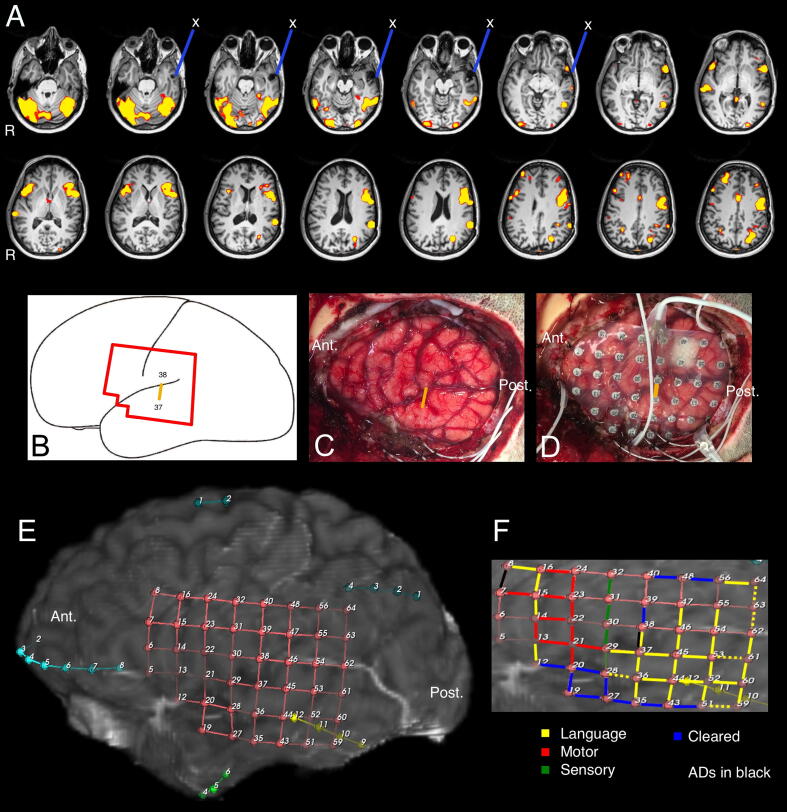
Neurosurgery has the potential to cure patients with drug-resistant focal epilepsy, but carries the risk of permanent language impairment when surgery involves the dominant hemisphere of the brain. This risk can be estimated and minimized using electrical stimulation mapping (ESM), which uses cognitive and linguistic tasks during cortical ESM to differentiate "eloquent" and "resectable" areas in the brain. One such task, counting, is often used to screen and characterize language during ESM in patients whose language abilities are limited. Here we report a patient with drug-resistant epilepsy arising from the language-dominant hemisphere using fMRI. Our patient experienced loss of the ability to recite or write the alphabet, but not to count, during ESM of the dominant left posterior superior temporal gyrus. This selective impairment extended to both spoken and written production. We suggest the need for caution when using counting as a sole means to screen language function and as a method of testing low functioning patients using ESM.
神经外科手术有治愈耐药性局灶性癫痫患者的潜力,但当手术涉及大脑优势半球时,会有永久性语言障碍的风险。这种风险可以通过电刺激图谱(ESM)进行评估并降至最低,该方法在皮质电刺激图谱过程中利用认知和语言任务来区分大脑中的“明确功能区”和“可切除区”。在语言能力有限的患者的电刺激图谱检查中,诸如计数这样的一项任务常被用于筛查和描述语言功能。在此,我们报告一名通过功能磁共振成像(fMRI)发现耐药性癫痫起源于语言优势半球的患者。在对优势侧左后颞上回进行电刺激图谱检查时,我们的患者出现了背诵或书写字母能力丧失,但计数能力未丧失的情况。这种选择性损伤扩展到了口语和书面表达。我们建议,在将计数作为筛查语言功能的唯一手段以及作为使用电刺激图谱检查低功能患者的一种测试方法时需谨慎。