Liu Xiaoqing, Ma Xuhui, Wang Hao, Li Suzhen, Yang Wenzhu, Nugroho Ramdhan Dwi, Luo Lili, Zhou Xiaojin, Tang Chaohua, Fan Yunliu, Zhao Qingyu, Zhang Junmin, Chen Rumei
Crop Functional Genome Research Center, Biotechnology Research Institute, Chinese Academy of Agricultural Sciences, Beijing, China.
State Key Laboratory of Animal Nutrition, Institute of Animal Sciences, Chinese Academy of Agricultural Sciences, Beijing, China.
Plant Biotechnol J. 2021 Sep;19(9):1812-1823. doi: 10.1111/pbi.13593. Epub 2021 May 4.
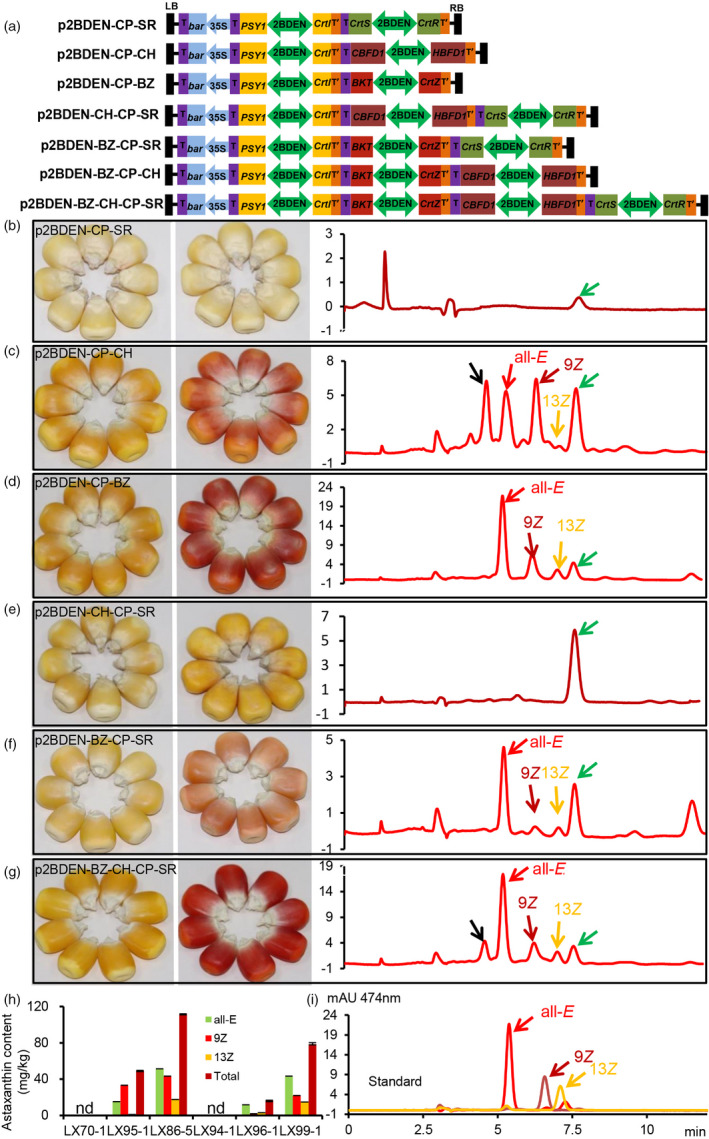
Production of the high-value carotenoid astaxanthin, which is widely used in food and feed due to its strong antioxidant activity and colour, is less efficient in cereals than in model plants. Here, we report a new strategy for expressing β-carotene ketolase and hydroxylase genes from algae, yeasts and flowering plants in the whole seed using a seed-specific bidirectional promoter. Engineered maize events were backcrossed to inbred maize lines with yellow endosperm to generate progenies that accumulate astaxanthin from 47.76 to 111.82 mg/kg DW in seeds, and the maximum level is approximately sixfold higher than those in previous reports (16.2-16.8 mg/kg DW) in cereals. A feeding trial with laying hens indicated that they could take up astaxanthin from the maize and accumulate it in egg yolks (12.10-14.15 mg/kg) without affecting egg production and quality, as observed using astaxanthin from Haematococcus pluvialis. Storage stability evaluation analysis showed that the optimal conditions for long-term storage of astaxanthin-rich maize are at 4 °C in the dark. This study shows that co-expressing of functional genes driven by seed-specific bidirectional promoter could dramatically boost astaxanthin biosynthesis in every parts of kernel including embryo, aleurone layer and starch endosperm other than previous reports in the starch endosperm only. And the staple crop maize could serve as a cost-effective plant factory for reliably producing astaxanthin.
高价值类胡萝卜素虾青素因其强大的抗氧化活性和色泽而广泛应用于食品和饲料中,在谷物中生产虾青素的效率低于模式植物。在此,我们报告了一种新策略,即使用种子特异性双向启动子在整个种子中表达来自藻类、酵母和开花植物的β-胡萝卜素酮酶和羟化酶基因。将转基因玉米事件与具有黄色胚乳的自交玉米品系回交,以产生种子中虾青素积累量为47.76至111.82毫克/千克干重的后代,其最高水平比之前谷物中的报道(16.2 - 16.8毫克/千克干重)高出约六倍。一项对蛋鸡的饲养试验表明,它们可以从玉米中摄取虾青素并在蛋黄中积累(12.10 - 14.15毫克/千克),且不影响产蛋量和蛋品质,这与使用雨生红球藻来源的虾青素时观察到的情况相同。储存稳定性评估分析表明,富含虾青素的玉米长期储存的最佳条件是在4℃黑暗环境中。这项研究表明,由种子特异性双向启动子驱动的功能基因共表达能够显著提高包括胚、糊粉层和淀粉胚乳在内的籽粒各部分的虾青素生物合成,而不仅仅是像之前报道的那样仅在淀粉胚乳中。并且主粮作物玉米可作为可靠生产虾青素的经济高效的植物工厂。