Larsson-Rosenquist Foundation Mother-Milk-Infant Center of Research Excellence, University of California San Diego, La Jolla, CA, United States of America.
Department of Education Studies, University of California San Diego, La Jolla, CA, United States of America.
PLoS One. 2021 Mar 29;16(3):e0249302. doi: 10.1371/journal.pone.0249302. eCollection 2021.
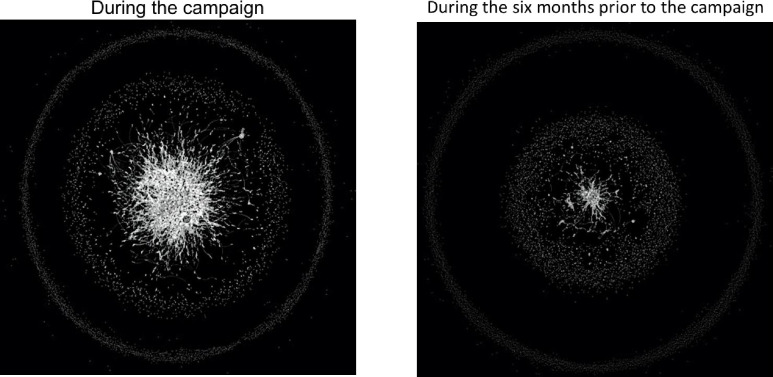
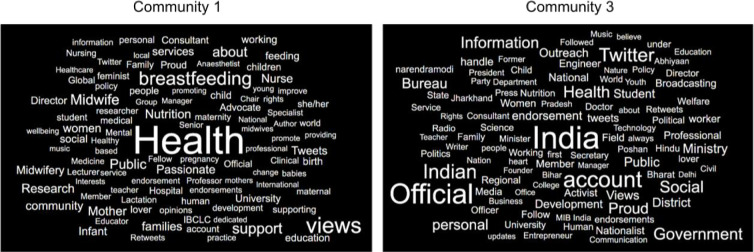
Using Twitter to implement public health awareness campaigns is on the rise, but campaign monitoring and evaluation are largely dependent on basic Twitter Analytics. To establish the potential of social network theory-based metrics in better understanding public health campaigns, we analyzed real-time user interactions on Twitter during the 2020 World Breastfeeding Week (WBW) as an exemplar case. Social network analysis (SNA), including community and influencer identification, as well as topic modeling were used to compare the activity of n = 29,958 campaign participants and n = 10,694 reference users from the six-months pre-campaign period. Users formed more inter-connected relationships during the campaign, retweeting and mentioning each other 46,161 times compared to 10,662 times in the prior six months. Campaign participants formed identifiable communities that were not only based on their geolocation, but also based on interests and professional background. While influencers who dominated the WBW conversations were disproportionally members of the scientific community, the campaign did mobilize influencers from the general public who seemed to play a "bridging" role between the public and the scientific community. Users communicated about the campaign beyond its original themes to also discuss breastfeeding within the context of social and racial inequities. Applying SNA allowed understanding of the breastfeeding campaign's messaging and engagement dynamics across communities and influencers. Moving forward, WBW could benefit from improving targeting to enhance geographic coverage and user interactions. As this exemplar case indicates, social network theory and analysis can be used to inform other public health campaigns with data on user interactions that go beyond traditional metrics.
利用 Twitter 开展公共卫生宣传活动的做法日渐增多,但宣传监测和评估在很大程度上依赖于基本的 Twitter 分析工具。为了确定基于社交网络理论的指标在更好地理解公共卫生宣传活动方面的潜力,我们以 2020 年世界母乳喂养周(WBW)为例,分析了 Twitter 上的实时用户互动情况。采用社交网络分析(SNA),包括社区和影响者识别以及主题建模,对 29958 名参与宣传活动的用户和 10694 名在宣传活动前六个月的参考用户的活动进行了比较。与前六个月的 10662 次相比,用户在宣传活动期间建立了更多相互关联的关系,共转发和提及对方 46161 次。宣传活动参与者形成了可识别的社区,这些社区不仅基于他们的地理位置,还基于兴趣和专业背景。虽然主导 WBW 对话的影响者不成比例地来自科学界,但该宣传活动确实动员了来自普通公众的影响者,他们似乎在公众和科学界之间发挥了“桥梁”作用。用户在宣传活动之外的主题之外也讨论了母乳喂养问题,例如将其置于社会和种族不平等的背景下。应用 SNA 可以了解整个社区和影响者的母乳喂养宣传活动的信息传递和参与动态。展望未来,WBW 可以通过改进目标定位来提高地理覆盖范围和用户互动。正如这个示例案例所表明的那样,社交网络理论和分析可以利用用户交互数据为其他公共卫生宣传活动提供信息,这些数据超越了传统指标。