Department of Electrical and Computer Engineering, Sungkyunkwan University, Suwon, Republic of Korea.
Biomedical Engineering Research Center, Smart Healthcare Research Institute, Samsung Medical Center, Sungkyunkwan University School of Medicine, Seoul, Republic of Korea.
Biosens Bioelectron. 2021 Jun 15;182:113168. doi: 10.1016/j.bios.2021.113168. Epub 2021 Mar 18.
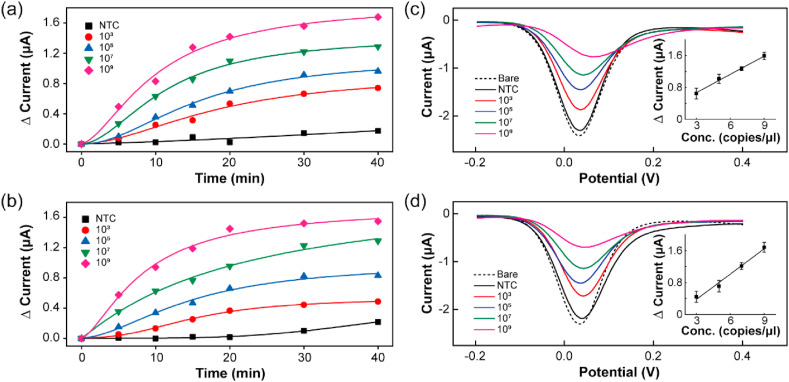
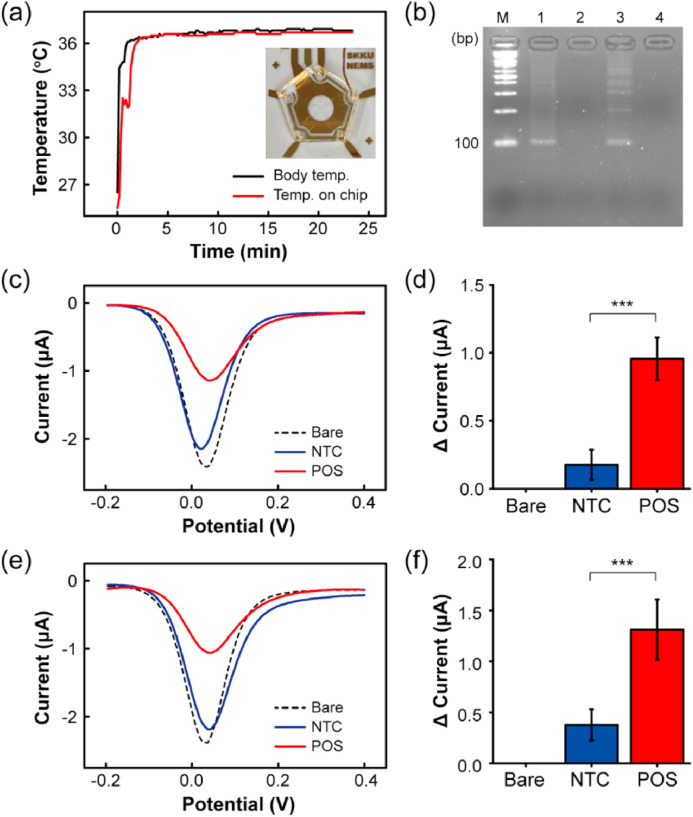
We report an electrochemical biosensor combined with recombinase polymerase amplification (RPA) for rapid and sensitive detection of severe acute respiratory syndrome coronavirus 2. The electrochemical biosensor based on a multi-microelectrode array allows the detection of multiple target genes by differential pulse voltammetry. The RPA reaction involves hybridization of the RPA amplicon with thiol-modified primers immobilized on the working electrodes, which leads to a reduction of current density as amplicons accumulate. The assay results in shorter "sample-to-answer" times than conventional PCR without expensive thermo-cycling equipment. The limits of detection are about 0.972 fg/μL (RdRP gene) and 3.925 fg/μL (N gene), which are slightly lower than or comparable to that of RPA assay results obtained by gel electrophoresis without post-amplification purification. The combination of electrochemical biosensors and the RPA assay is a rapid, sensitive, and convenient platform that can be potentially used as a point-of-care test for the diagnosis of COVID-19.
我们报告了一种电化学生物传感器,结合重组酶聚合酶扩增(RPA),用于快速灵敏地检测严重急性呼吸综合征冠状病毒 2。基于多微电极阵列的电化学生物传感器允许通过差分脉冲伏安法检测多个靶基因。RPA 反应涉及 RPA 扩增子与固定在工作电极上的巯基修饰引物的杂交,这导致随着扩增子的积累电流密度降低。与没有昂贵的热循环设备的常规 PCR 相比,该测定的“样品到答案”时间更短。检测限约为 0.972 fg/μL(RdRP 基因)和 3.925 fg/μL(N 基因),略低于或可与未经扩增后纯化的凝胶电泳获得的 RPA 测定结果相媲美。电化学生物传感器和 RPA 测定的结合是一种快速、灵敏、方便的平台,可潜在地用作 COVID-19 诊断的即时护理测试。