Sohail Muhammad U, Al Khatib Hebah A, Al Thani Asmaa A, Al Ansari Khalid, Yassine Hadi M, Al-Asmakh Maha
Proteomics Core, Weill Cornell Medicine-Qatar, P.O. Box 24811, Doha, Qatar.
Biomedical Research Center, Qatar University, P.O. Box 2713, Doha, Qatar.
Gut Pathog. 2021 Mar 29;13(1):21. doi: 10.1186/s13099-021-00411-x.
Rotavirus (RV) is a leading cause of pediatric diarrhea and mortality worldwide. The virus causes acute gastroenteritis characterized by moderate to severe vomiting, diarrhea, dehydration, and fever. Microbial dysbiosis caused by RV infection may significantly influence disease prognosis and the development of other chronic diseases. The gut microbiome plays a vital role in enteric immune response for rotavirus vaccine (RVV) that requires further elucidations. The current study evaluates the gut microbiome of RV positive children and compares gastroenteritis manifestation in children admitted to the Pediatric Emergency Centre, Hamad Medical Cooperation, Doha, Qatar. Stool samples were collected from thirty-nine RV positive and eight healthy control children. 16S rRNA sequence was performed using the Illumina MiSeq platform.
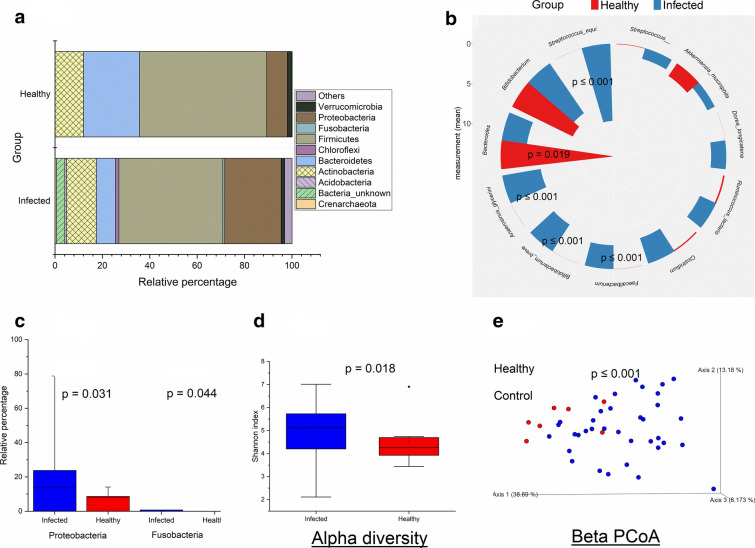
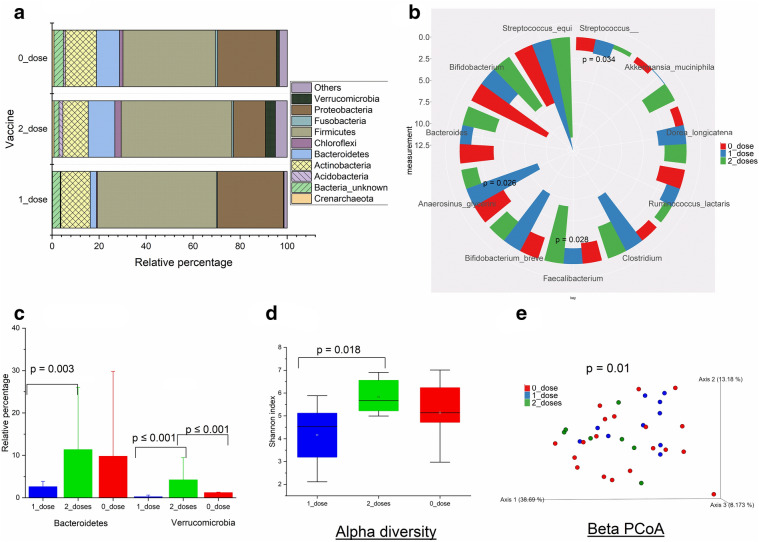
The data demonstrated a significant increase in microbiome diversity denoted by higher relative abundances of phylum Proteobacteria (p = 0.031), Fusobacteria (p = 0.044) and genus Streptococcus (p ≤ 0.001) in the infected group relative to the control. Similarly, district clustering pattern (PERMANOVA p = 0.01) and higher species richness (Shannon entropy p = 0.018) were observed in the children who received two RVV doses compared with the non-vaccinated or single-dose groups. These microbiome changes were represented by over-abundance of phylum Bacteroidetes (p = 0.003) and Verrucomicrobia (p ≤ 0.001), and lower expression of family Enterobacteriaceae in two RVV doses group. However, microbiome composition was not associated with diarrhea, vomiting, and other parameters of gastroenteritis.
The observations assert significant microbial signatures of RVV, which is dose-dependent, and suggest manipulating these microbes as a novel approach for improving RVV efficacy. Further studies are warranted to investigate the immune status of these patients and mechanistic investigation to enhance RVV seroconversion.
轮状病毒(RV)是全球小儿腹泻和死亡的主要原因。该病毒引起急性肠胃炎,其特征为中度至重度呕吐、腹泻、脱水和发热。RV感染引起的微生物失调可能会显著影响疾病预后以及其他慢性疾病的发展。肠道微生物群在轮状病毒疫苗(RVV)的肠道免疫反应中起着至关重要的作用,这需要进一步阐明。本研究评估了RV阳性儿童的肠道微生物群,并比较了卡塔尔多哈哈马德医疗合作组织儿科急诊中心收治的儿童的肠胃炎表现。从39名RV阳性儿童和8名健康对照儿童中采集粪便样本。使用Illumina MiSeq平台进行16S rRNA测序。
数据显示,与对照组相比,感染组中变形菌门(p = 0.031)、梭杆菌门(p = 0.044)和链球菌属(p≤0.001)的相对丰度更高,表明微生物群多样性显著增加。同样,与未接种疫苗或单剂量组相比,接受两剂RVV的儿童中观察到区域聚类模式(PERMANOVA p = 0.01)和更高的物种丰富度(香农熵p = 0.018)。这些微生物群变化表现为两剂RVV组中拟杆菌门(p = 0.003)和疣微菌门(p≤0.001)的丰度过高,以及肠杆菌科家族的表达较低。然而,微生物群组成与腹泻、呕吐和肠胃炎的其他参数无关。
这些观察结果证实了RVV存在显著的微生物特征,且具有剂量依赖性,并建议将操纵这些微生物作为提高RVV疗效的新方法。有必要进一步研究这些患者的免疫状态,并进行机制研究以提高RVV血清转化率。