Department of Social/Behavioral Sciences, St. Petersburg College, 2465 Drew St, ES313D, Clearwater, FL, 33765, USA.
Department of Economics, University of South Florida, Tampa, FL, USA.
Patient. 2021 May;14(3):339-345. doi: 10.1007/s40271-021-00509-z. Epub 2021 Mar 30.
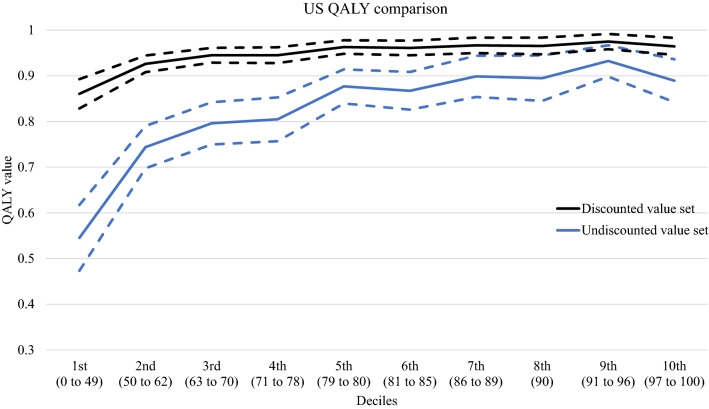
In economic evaluations, quality-adjusted life-years (QALYs) can serve as a unit of measurement for disease burden. Obtaining QALY values for COVID-19 presents a challenge owing to the availability of two US EQ-5D-5L value sets and the potentially asymptomatic presentation of the disease. The first value set was completed allowing for the discounting of future health outcomes while the second value set is undiscounted.
The objective of this study was to compare the distribution of QALY values using a national survey and the two published value sets; and to estimate the association between COVID-19 outcomes and QALY losses.
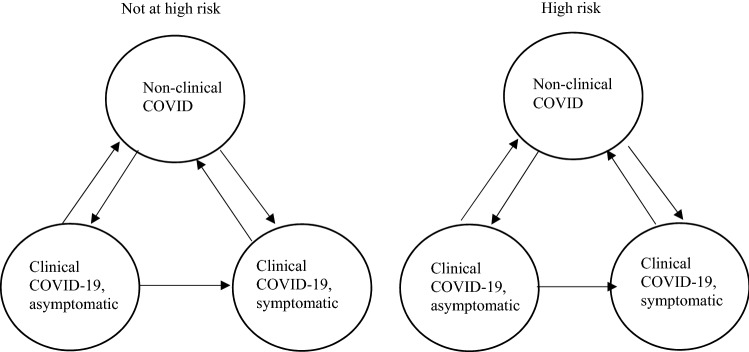
Between 9 and 11 November, 2020, 1153 US adults completed the EQ-5D-5L instrument (five items and a visual analog scale) as well as self-reported their demographics, COVID-19 symptoms, and memberships to populations that are at risk of COVID-19 infection. The two US value sets were applied to the EQ-5D-5L responses to produce QALY values. We estimated the mean QALYs by visual analog scale decile and a generalized linear model of COVID-19 outcomes.
The discounted values are higher than the undiscounted values for each visual analog scale decile owing to methodological differences. Persons at increased risk, with a fever in the past day, and with one or more other symptoms have significantly greater QALY losses (p < 0.01). Overall, non-institutionalized individuals at risk of symptomatic clinical COVID-19 equal 0.68 for the 2016 value set (95% confidence interval 0.49-0.87) and 0.10 for the 2017 value set (95% confidence interval - 0.31 to 0.51) QALYs.
Multiple studies have shown that decision makers discount future health outcomes, which increase QALY values. This study confronts the practical implications of these methodological advances for use in COVID-19 economic evaluations. Health economists will be able to use the QALY values in this study to better evaluate health interventions against COVID-19.
在经济评估中,质量调整生命年(QALY)可作为衡量疾病负担的单位。由于有两种美国 EQ-5D-5L 值集和疾病潜在的无症状表现,因此获得 COVID-19 的 QALY 值具有挑战性。第一个值集允许对未来的健康结果进行贴现,而第二个值集则不贴现。
本研究的目的是比较使用全国性调查和两个已发表的价值集的 QALY 值分布;并估计 COVID-19 结局与 QALY 损失之间的关联。
2020 年 11 月 9 日至 11 日,1153 名美国成年人完成了 EQ-5D-5L 量表(五个项目和一个视觉模拟量表),并报告了他们的人口统计学信息、COVID-19 症状以及属于 COVID-19 感染风险人群的情况。将这两个美国值集应用于 EQ-5D-5L 响应以产生 QALY 值。我们根据视觉模拟量表十分位数和 COVID-19 结局的广义线性模型估计平均 QALY 值。
由于方法学差异,每个视觉模拟量表十分位数的贴现值均高于未贴现值。处于高风险、过去一天发烧且有一个或多个其他症状的人,其 QALY 损失明显更大(p < 0.01)。总体而言,有症状临床 COVID-19 风险的非住院个体,2016 年值集为 0.68(95%置信区间 0.49-0.87),2017 年值集为 0.10(95%置信区间-0.31 至 0.51)QALY。
多项研究表明,决策者会对未来的健康结果进行贴现,从而增加 QALY 值。本研究直面了这些方法学进步在 COVID-19 经济评估中的实际应用。卫生经济学家将能够使用本研究中的 QALY 值更好地评估针对 COVID-19 的卫生干预措施。