Massachusetts Institute of Technology, Cambridge, MA, USA.
University College London, Bloomsbury, UK.
Behav Res Methods. 2021 Oct;53(5):2158-2171. doi: 10.3758/s13428-020-01535-9. Epub 2021 Mar 29.
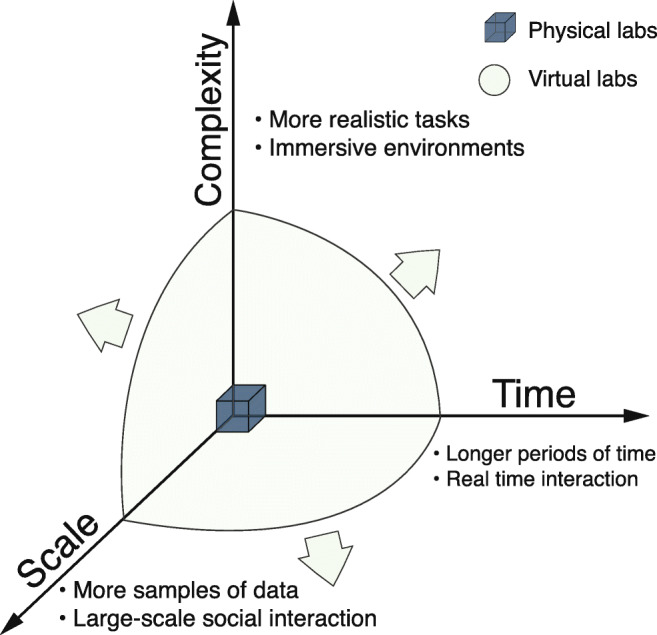
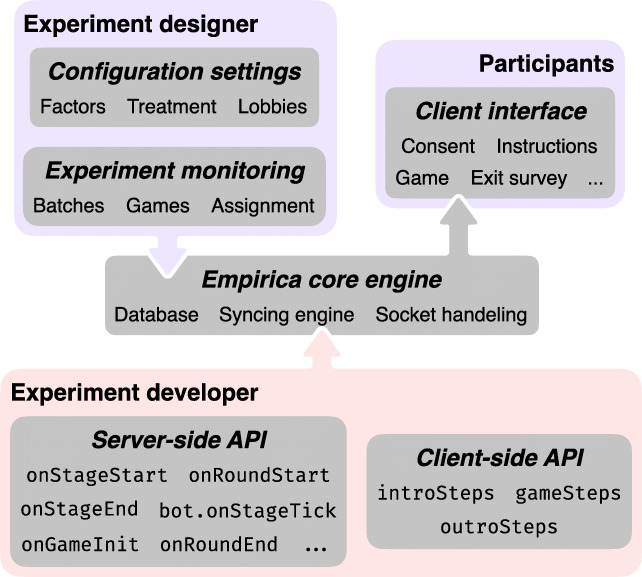
Virtual labs allow researchers to design high-throughput and macro-level experiments that are not feasible in traditional in-person physical lab settings. Despite the increasing popularity of online research, researchers still face many technical and logistical barriers when designing and deploying virtual lab experiments. While several platforms exist to facilitate the development of virtual lab experiments, they typically present researchers with a stark trade-off between usability and functionality. We introduce Empirica: a modular virtual lab that offers a solution to the usability-functionality trade-off by employing a "flexible defaults" design strategy. This strategy enables us to maintain complete "build anything" flexibility while offering a development platform that is accessible to novice programmers. Empirica's architecture is designed to allow for parameterizable experimental designs, reusable protocols, and rapid development. These features will increase the accessibility of virtual lab experiments, remove barriers to innovation in experiment design, and enable rapid progress in the understanding of human behavior.
虚拟实验室允许研究人员设计在传统的面对面物理实验室环境中不可行的高通量和宏观实验。尽管在线研究越来越受欢迎,但研究人员在设计和部署虚拟实验室实验时仍然面临许多技术和后勤障碍。虽然有几个平台可以帮助开发虚拟实验室实验,但它们通常在可用性和功能之间为研究人员提供了一个明显的权衡。我们引入了 Empirica:一个模块化的虚拟实验室,通过采用“灵活默认”设计策略来解决可用性-功能权衡问题。这种策略使我们能够在保持完全“构建任何东西”的灵活性的同时,为新手程序员提供一个易于使用的开发平台。Empirica 的架构旨在允许参数化实验设计、可重复使用的协议和快速开发。这些功能将增加虚拟实验室实验的可访问性,消除实验设计创新的障碍,并促进对人类行为的理解的快速发展。