Center for Humans and Machines, Max Planck Institute for Human Development, Lentzeallee 94, Berlin 14195, Germany.
Department of Humanities and Social Sciences, New Jersey Institute of Technology, Newark, NJ, USA.
Philos Trans A Math Phys Eng Sci. 2022 Jul 11;380(2227):20200426. doi: 10.1098/rsta.2020.0426. Epub 2022 May 23.
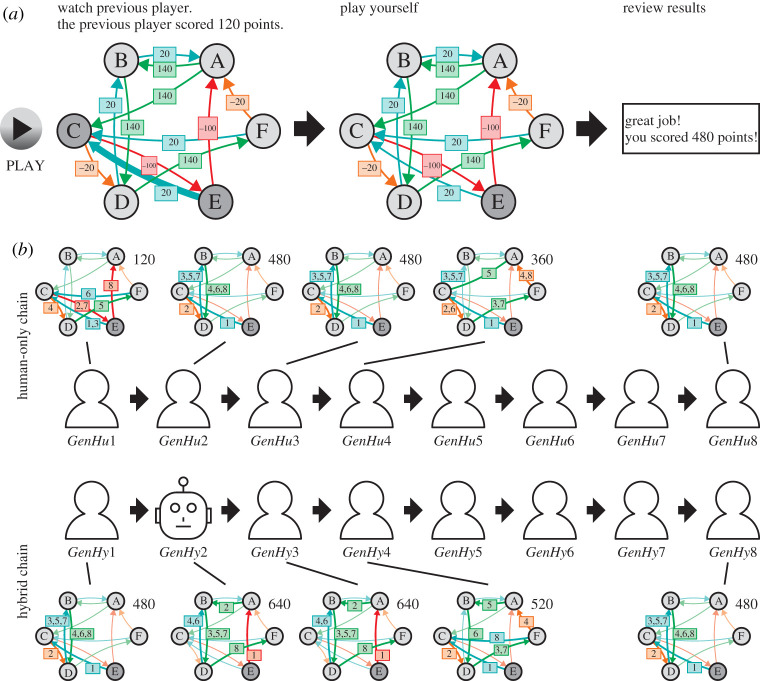
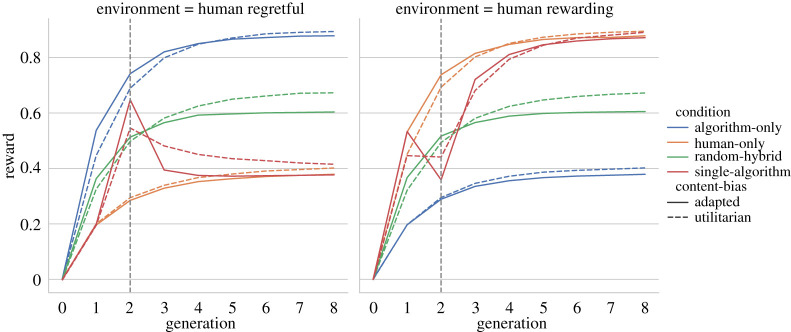
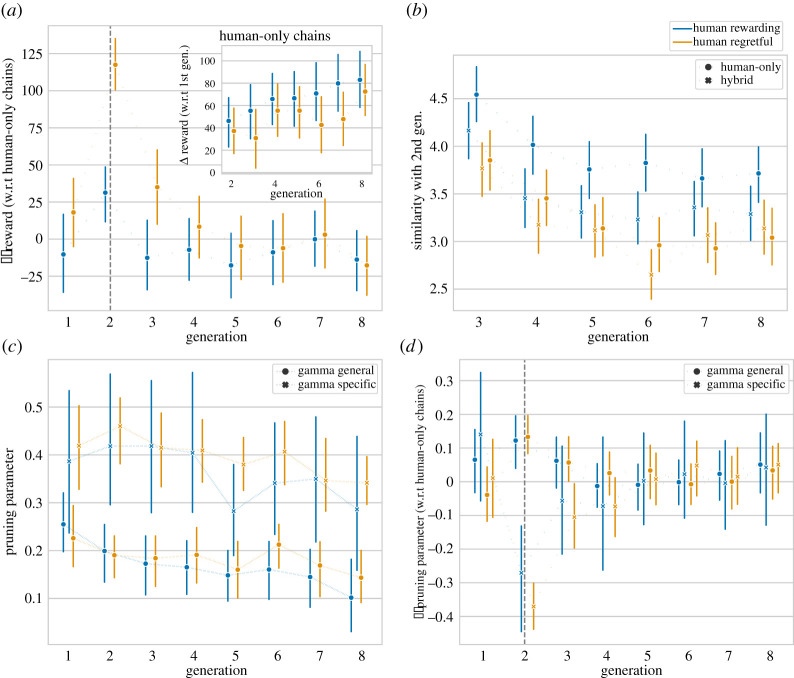
Humans are impressive social learners. Researchers of cultural evolution have studied the many biases shaping cultural transmission by selecting who we copy from and what we copy. One hypothesis is that with the advent of superhuman algorithms a hybrid type of cultural transmission, namely from algorithms to humans, may have long-lasting effects on human culture. We suggest that algorithms might show (either by learning or by design) different behaviours, biases and problem-solving abilities than their human counterparts. In turn, algorithmic-human hybrid problem solving could foster better decisions in environments where diversity in problem-solving strategies is beneficial. This study asks whether algorithms with complementary biases to humans can boost performance in a carefully controlled planning task, and whether humans further transmit algorithmic behaviours to other humans. We conducted a large behavioural study and an agent-based simulation to test the performance of transmission chains with human and algorithmic players. We show that the algorithm boosts the performance of immediately following participants but this gain is quickly lost for participants further down the chain. Our findings suggest that algorithms can improve performance, but human bias may hinder algorithmic solutions from being preserved. This article is part of the theme issue 'Emergent phenomena in complex physical and socio-technical systems: from cells to societies'.
人类是令人印象深刻的社会学习者。文化进化研究人员通过选择我们从谁那里复制以及我们复制什么来研究塑造文化传播的许多偏见。有一种假设是,随着超级算法的出现,一种混合类型的文化传播,即从算法到人类,可能会对人类文化产生持久的影响。我们认为,算法可能表现出(通过学习或设计)与人类不同的行为、偏见和解决问题的能力。反过来,算法-人类混合问题解决可以促进在解决策略多样性有益的环境中做出更好的决策。本研究探讨了具有与人类互补偏见的算法是否可以提高精心控制的规划任务的性能,以及人类是否会将算法行为进一步传播给其他人类。我们进行了一项大型行为研究和基于代理的模拟,以测试具有人类和算法参与者的传播链的性能。我们表明,算法可以提高立即跟随参与者的表现,但参与者在链条中的后续表现会迅速下降。我们的研究结果表明,算法可以提高性能,但人类的偏见可能会阻碍算法解决方案的保留。本文是“复杂物理和社会技术系统中的新兴现象:从细胞到社会”主题问题的一部分。