Non-Communicable Disease Theme, MRC/UVRI and LSHTM, Entebbe, Uganda.
Department of Non-Communicable Disease Epidemiology, London School of Hygiene and Tropical Medicine London, London, UK.
Hum Mol Genet. 2021 Jul 28;30(16):1559-1568. doi: 10.1093/hmg/ddab088.
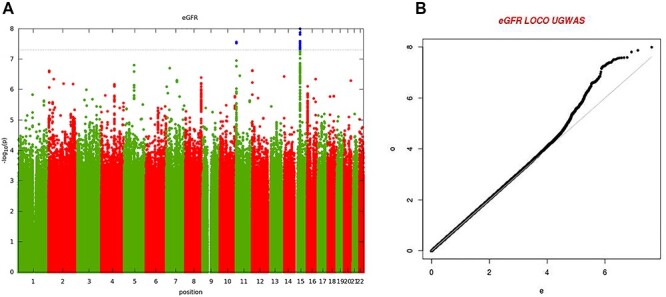
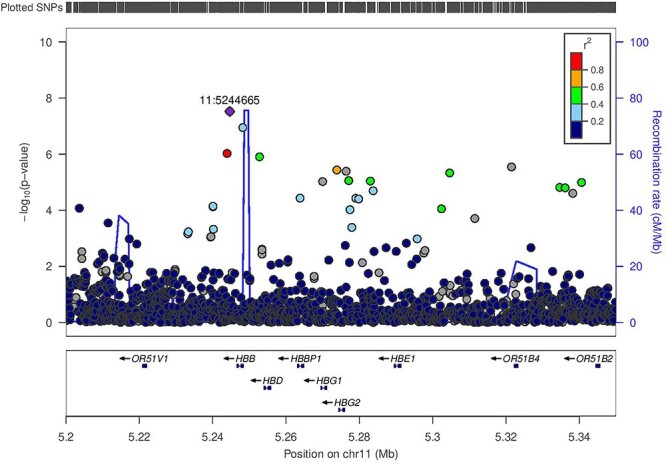
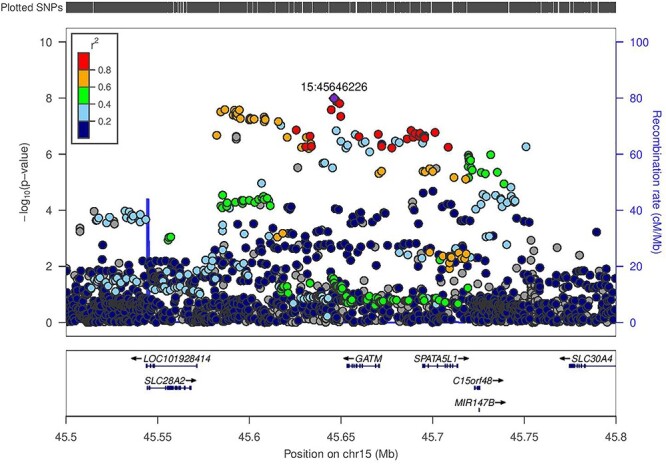
Genome-wide association studies (GWAS) of kidney function have uncovered hundreds of loci, primarily in populations of European ancestry. We have undertaken the first continental African GWAS of estimated glomerular filtration rate (eGFR), a measure of kidney function used to define chronic kidney disease (CKD). We conducted GWAS of eGFR in 3288 East Africans from the Uganda General Population Cohort (GPC) and replicated in 8224 African Americans from the Women's Health Initiative. Loci attaining genome-wide significant evidence for association (P < 5 × 10⁻⁸) were followed up with Bayesian fine-mapping to localize potential causal variants. The predictive power of a genetic risk score (GRS) constructed from previously reported trans-ancestry eGFR lead single nucleotide polymorphism (SNPs) was evaluated in the Uganda GPC. We identified and validated two eGFR loci. At the glycine amidinotransferase (GATM) locus, the association signal (lead SNP rs2433603, P = 1.0 × 10⁻⁸) in the Uganda GPC GWAS was distinct from previously reported signals at this locus. At the haemoglobin beta (HBB) locus, the association signal (lead SNP rs141845179, P = 3.0 × 10⁻⁸) has been previously reported. The lead SNP at the HBB locus accounted for 88% of the posterior probability of causality after fine-mapping, but did not colocalise with kidney expression quantitative trait loci. The trans-ancestry GRS of eGFR was not significantly predictive into the Ugandan population. In the first GWAS of eGFR in continental Africa, we validated two previously reported loci at GATM and HBB. At the GATM locus, the association signal was distinct from that previously reported. These results demonstrate the value of performing GWAS in continental Africans, providing a rich genomic resource to larger consortia for further discovery and fine-mapping. The study emphasizes that additional large-scale efforts in Africa are warranted to gain further insight into the genetic architecture of CKD.
全基因组关联研究(GWAS)已经发现了数百个与肾功能相关的基因座,这些基因座主要存在于欧洲血统的人群中。我们首次在非洲大陆开展了针对肾小球滤过率(eGFR)的 GWAS 研究,这是一种用于定义慢性肾脏病(CKD)的肾功能指标。我们对来自乌干达普通人群队列(GPC)的 3288 名东非人和来自妇女健康倡议(Women's Health Initiative)的 8224 名非裔美国人进行了 GWAS。对达到全基因组关联显著性证据(P < 5 × 10⁻⁸)的基因座进行贝叶斯精细定位,以确定潜在的因果变异。从先前报道的跨种族 eGFR 先导单核苷酸多态性(SNP)构建的遗传风险评分(GRS)的预测能力在乌干达 GPC 中进行了评估。我们鉴定并验证了两个 eGFR 基因座。在甘氨酸酰胺转移酶(GATM)基因座,乌干达 GPC GWAS 中的关联信号(先导 SNP rs2433603,P = 1.0 × 10⁻⁸)与该基因座先前报道的信号不同。在血红蛋白β(HBB)基因座,关联信号(先导 SNP rs141845179,P = 3.0 × 10⁻⁸)先前已有报道。精细定位后,HBB 基因座的先导 SNP 占因果关系后验概率的 88%,但与肾脏表达数量性状基因座没有共定位。跨种族 eGFR 的 GRS 对乌干达人群没有显著的预测作用。在非洲大陆进行的首次 eGFR GWAS 中,我们验证了 GATM 和 HBB 两个先前报道的基因座。在 GATM 基因座,关联信号与先前报道的信号不同。这些结果表明,在非洲大陆进行 GWAS 具有重要价值,为更大的联盟提供了丰富的基因组资源,以进一步发现和精细定位。该研究强调,有必要在非洲开展更多的大规模研究,以进一步深入了解 CKD 的遗传结构。