Department of Vascular Dysfunction, European Center for Angioscience (ECAS), Faculty of Medicine Mannheim, University of Heidelberg, Mannheim, Germany.
Cell Mol Life Sci. 2021 Apr;78(7):3247-3264. doi: 10.1007/s00018-020-03738-x. Epub 2021 Mar 30.
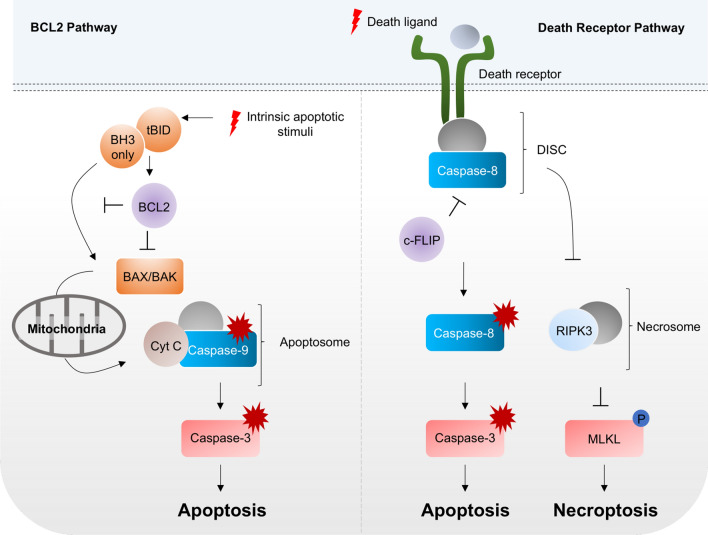
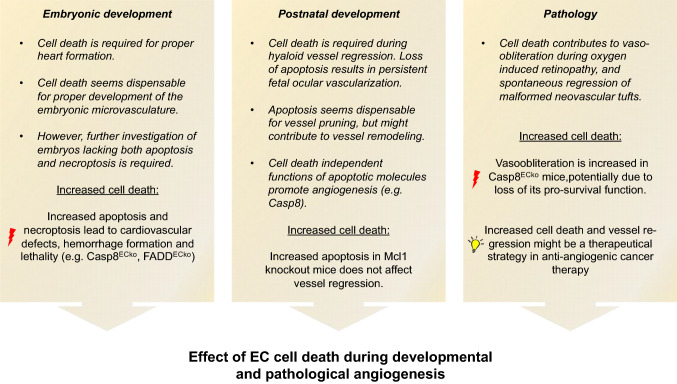
The formation of new blood vessels is driven by proliferation of endothelial cells (ECs), elongation of maturing vessel sprouts and ultimately vessel remodeling to create a hierarchically structured vascular system. Vessel regression is an essential process to remove redundant vessel branches in order to adapt the final vessel density to the demands of the surrounding tissue. How exactly vessel regression occurs and whether and to which extent cell death contributes to this process has been in the focus of several studies within the last decade. On top, recent findings challenge our simplistic view of the cell death signaling machinery as a sole executer of cellular demise, as emerging evidences suggest that some of the classic cell death regulators even promote blood vessel formation. This review summarizes our current knowledge on the role of the cell death signaling machinery with a focus on the apoptosis and necroptosis signaling pathways during blood vessel formation in development and pathology.
新血管的形成是由内皮细胞(EC)的增殖、成熟血管芽的伸长以及最终的血管重塑来驱动的,从而形成一个层次化的血管系统。血管退化是一个必要的过程,以去除多余的血管分支,从而使最终的血管密度适应周围组织的需求。血管退化是如何发生的,以及细胞死亡是否以及在多大程度上有助于这个过程,一直是过去十年中几项研究的焦点。此外,最近的发现挑战了我们对细胞死亡信号机制作为细胞死亡唯一执行者的简单看法,因为新出现的证据表明,一些经典的细胞死亡调节剂甚至可以促进血管形成。这篇综述总结了我们目前对细胞死亡信号机制的认识,重点介绍了在发育和病理过程中血管形成过程中凋亡和坏死信号通路的作用。