KU Leuven Department of Rehabilitation Sciences, Leuven, Belgium.
University Psychiatric Centre KU Leuven, Leuven, Kortenberg, Belgium.
Alzheimers Res Ther. 2021 Mar 30;13(1):70. doi: 10.1186/s13195-021-00806-7.
It is currently unknown whether exergaming is efficacious in people with major neurocognitive disorder (MNCD) residing in long-term care facilities. This pilot randomized controlled trial (RCT) explored the efficacy of a stepping exergame program on gait speed, balance, mobility, reaction time, cognitive and neuropsychiatric outcomes, quality of life, and daily life functioning in people with MNCD residing in long-term care facilities.
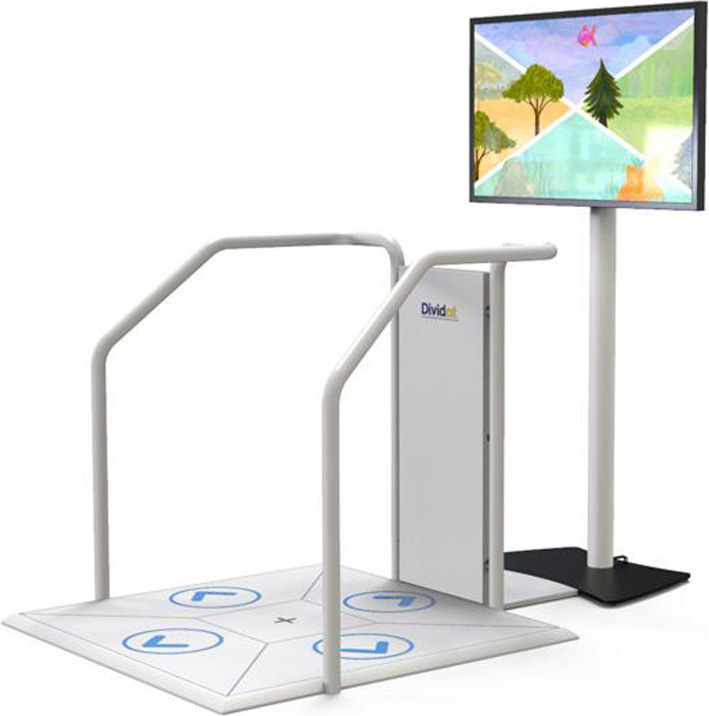
Participants were randomly assigned to 8 weeks, three times weekly, 15 min of exergaming versus watching preferred music videos. The exergame device consisted of a pressure-sensitive step training platform on which participants performed stepping movements to play the games. The device automatically adapted the training level to the participants' capabilities. The Short Physical Performance Battery (SPPB), step reaction time test (SRTT), Montréal Cognitive Assessment (MoCA), Neuropsychiatric Inventory (NPI), Cornell Scale for Depression in Dementia (CSDD), Dementia Quality of Life (DQoL), and Katz Activities of Daily Living (Katz ADL) were assessed at baseline and post-intervention. A Quade's non-parametric ANCOVA controlling for baseline values with post hoc Bonferroni correction (p < 0.00625) was used to analyze pre- and post-differences between the groups. Partial eta-squared (ηp) effect sizes were calculated.
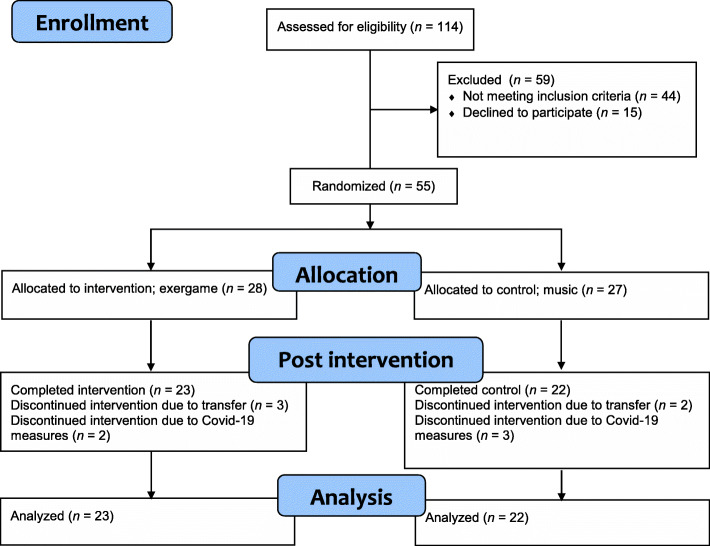
Forty-five of 55 randomized inpatients with mild to moderate MNCD (Mini-Mental State Examination score = 17.2 ± 4.5; aged 70-91; 35 women) completed the study. The exergame group (n = 23) demonstrated improvements in gait speed (p < 0.001, η = 0.41), total SPPB (p < 0.001, η = 0.64), SRTT (p<0.001, η = 0.51), MoCA (p<0.001, η = 0.38), and reductions in CSDD (p<0.001, η = 0.43) compared to the control group (n = 22). There were no differences in NPI (p = 0.165, η = 0.05), DQoL (p = 0.012, η = 0.16), and ADL (p = 0.008, η = 0.16) post-intervention scores between the experimental and control group, albeit DQol and ADL measures showed large effect sizes in the exergame group. The mean attendance rate was 82.9% in the exergame group and 73.7% in the music control group. There were no study-related adverse events reported by the participants, nor observed by the research team.
The findings of this pilot RCT suggest that an individually adapted exergame training improves lower extremity functioning, cognitive functioning and step reaction time and symptoms of depression in inpatients with MNCD residing in long-term care facilities.
ClinicalTrials.gov, NCT04436302.
目前尚不清楚在长期护理机构中居住的有重大神经认知障碍(MNCD)的人是否可以从健身游戏中受益。这项试点随机对照试验(RCT)探讨了踏步健身游戏计划对长期护理机构中 MNCD 患者的步态速度、平衡、移动能力、反应时间、认知和神经精神结果、生活质量以及日常生活功能的影响。
参与者被随机分配到 8 周,每周 3 次,每次 15 分钟的踏车游戏与观看喜爱的音乐视频。踏车游戏设备由一个压力感应踏步训练平台组成,参与者在平台上进行踏步运动以玩游戏。该设备会自动根据参与者的能力调整训练水平。在基线和干预后评估了简短身体表现电池(SPPB)、踏步反应时间测试(SRTT)、蒙特利尔认知评估(MoCA)、神经精神疾病问卷(NPI)、康奈尔痴呆抑郁量表(CSDD)、痴呆生活质量量表(DQoL)和 Katz 日常生活活动量表(Katz ADL)。使用具有事后 Bonferroni 校正(p<0.00625)的 Quade 非参数 ANCOVA 分析了组间前后差异。计算了部分 eta 平方(ηp)效应大小。
在 55 名随机入组的轻度至中度 MNCD 住院患者(简易精神状态检查评分=17.2±4.5;年龄 70-91 岁;35 名女性)中,有 45 名完成了研究。踏车游戏组(n=23)在步态速度(p<0.001,η=0.41)、总 SPPB(p<0.001,η=0.64)、SRTT(p<0.001,η=0.51)、MoCA(p<0.001,η=0.38)方面均有改善,而在 CSDD(p<0.001,η=0.43)方面则有所降低,与对照组(n=22)相比。实验组和对照组在 NPI(p=0.165,η=0.05)、DQoL(p=0.012,η=0.16)和 ADL(p=0.008,η=0.16)的干预后评分均无差异,尽管 DQol 和 ADL 测量在踏车游戏组中显示出较大的效应大小。踏车游戏组的平均出勤率为 82.9%,音乐对照组为 73.7%。参与者未报告任何与研究相关的不良事件,研究团队也未观察到任何不良事件。
这项初步 RCT 的结果表明,个体化适应的健身游戏训练可以改善长期护理机构中 MNCD 住院患者的下肢功能、认知功能和踏步反应时间以及抑郁症状。
ClinicalTrials.gov,NCT04436302。