Djordjevic Magdalena, Djordjevic Marko, Ilic Bojana, Stojku Stefan, Salom Igor
Institute of Physics Belgrade University of Belgrade Belgrade 11080 Serbia.
Quantitative Biology Group Faculty of Biology University of Belgrade Belgrade 11000 Serbia.
Glob Chall. 2021 Mar 1;5(5):2000101. doi: 10.1002/gch2.202000101. eCollection 2021 May.
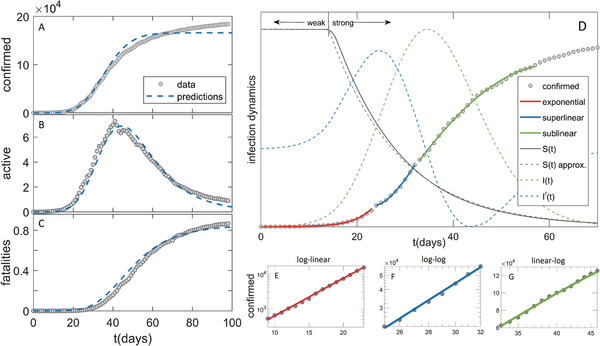
Widespread growth signatures in COVID-19 confirmed case counts are reported, with sharp transitions between three distinct dynamical regimes (exponential, superlinear, and sublinear). Through analytical and numerical analysis, a novel framework is developed that exploits information in these signatures. An approach well known to physics is applied, where one looks for common dynamical features, independently from differences in other factors. These features and associated scaling laws are used as a powerful tool to pinpoint regions where analytical derivations are effective, get an insight into qualitative changes of the disease progression, and infer the key infection parameters. The developed framework for joint analytical and numerical analysis of empirically observed COVID-19 growth patterns can lead to a fundamental understanding of infection progression under strong control measures, applicable to outbursts of both COVID-19 and other infectious diseases.
据报道,新冠确诊病例数呈现广泛的增长特征,在三种不同的动态模式(指数型、超线性和亚线性)之间存在急剧转变。通过分析和数值分析,开发了一个利用这些特征信息的新框架。应用了物理学中一种众所周知的方法,即寻找共同的动态特征,而不考虑其他因素的差异。这些特征和相关的标度律被用作一个强大的工具,以确定解析推导有效的区域,深入了解疾病进展的定性变化,并推断关键感染参数。所开发的对经验观察到的新冠增长模式进行联合分析和数值分析的框架,可促成对在严格控制措施下感染进展的基本理解,适用于新冠及其他传染病的爆发。