Chan Eugene Y
College of Health and Human Sciences, Purdue University, United States.
Addict Behav Rep. 2021 Mar 17;13:100342. doi: 10.1016/j.abrep.2021.100342. eCollection 2021 Jun.
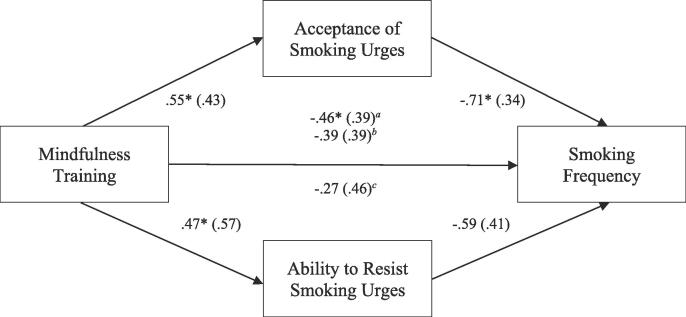
Mindfulness training has been shown to be effective in reducing smoking frequency. However, mindfulness training instructions that are free of mentions about smoking are rare, which makes it difficult to ascertain if it is the temporary state of being mindful or demand effects that reduce smoking frequency. It has also been posited that mindfulness training lowers smoking frequency by helping smokers surf the urge, but this remains untested. Thus, we conducted an experiment to test the likely process. We used a 6-minute audio clip to induce a brief mindfulness state or a mind-wandering state in 91 Australian students; the brief mindfulness exercise was free of any mentions about smoking. We found that exposure to the mindfulness-inducing audio clip helped smokers surf their urge when they were later exposed to cigarette cues and they smoked less over the subsequent 7 days. The current work offers empirical evidence for why mindfulness training can be effective in smoking cessation.
正念训练已被证明在降低吸烟频率方面有效。然而,不含吸烟相关内容的正念训练指导却很少见,这使得很难确定是正念的暂时状态还是需求效应降低了吸烟频率。也有人认为,正念训练通过帮助吸烟者应对冲动来降低吸烟频率,但这一点尚未得到验证。因此,我们进行了一项实验来测试可能的过程。我们使用一段6分钟的音频片段,在91名澳大利亚学生中诱导出短暂的正念状态或走神状态;简短的正念练习中没有任何关于吸烟的内容。我们发现,接触诱导正念的音频片段有助于吸烟者在后来接触香烟提示时应对冲动,并且在随后的7天里吸烟量减少。目前的研究为正念训练为何能有效戒烟提供了实证依据。