Department of Radiation Oncology, The First Affiliated Hospital of Nanjing Medical University, Nanjing, Jiangsu, P.R. China.
Suzhou Cancer Center Core Laboratory, The Affiliated Suzhou Hospital of Nanjing Medical University, Suzhou, Jiangsu, P.R. China.
Cancer Med. 2021 May;10(9):3101-3112. doi: 10.1002/cam4.3879. Epub 2021 Mar 30.
Radiotherapy is one of the main strategies for the treatment of esophageal squamous cell carcinoma (ESCC). However, treatment failure often occurs due to the emergence of radioresistance. In this study, we report a key regulator of radiation sensitivity, termed TAB182 that may become an ideal biomarker and therapeutic target to overcome radioresistance.
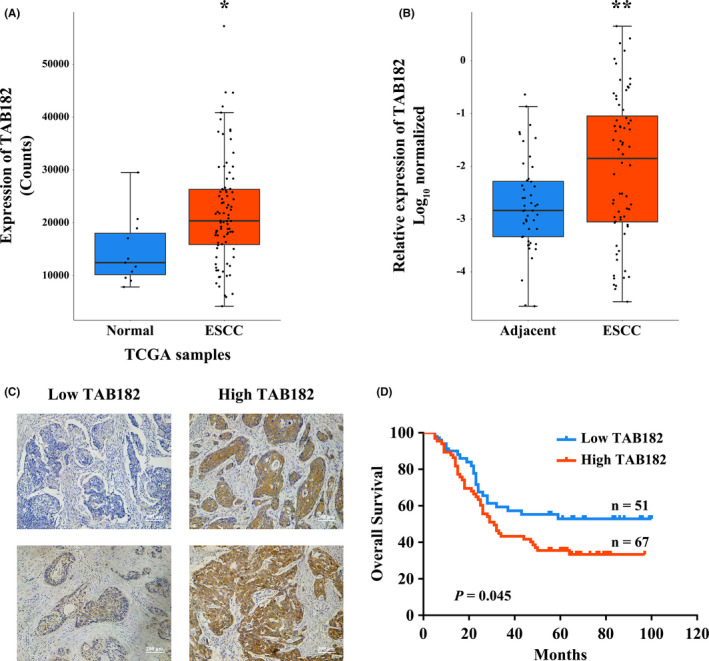
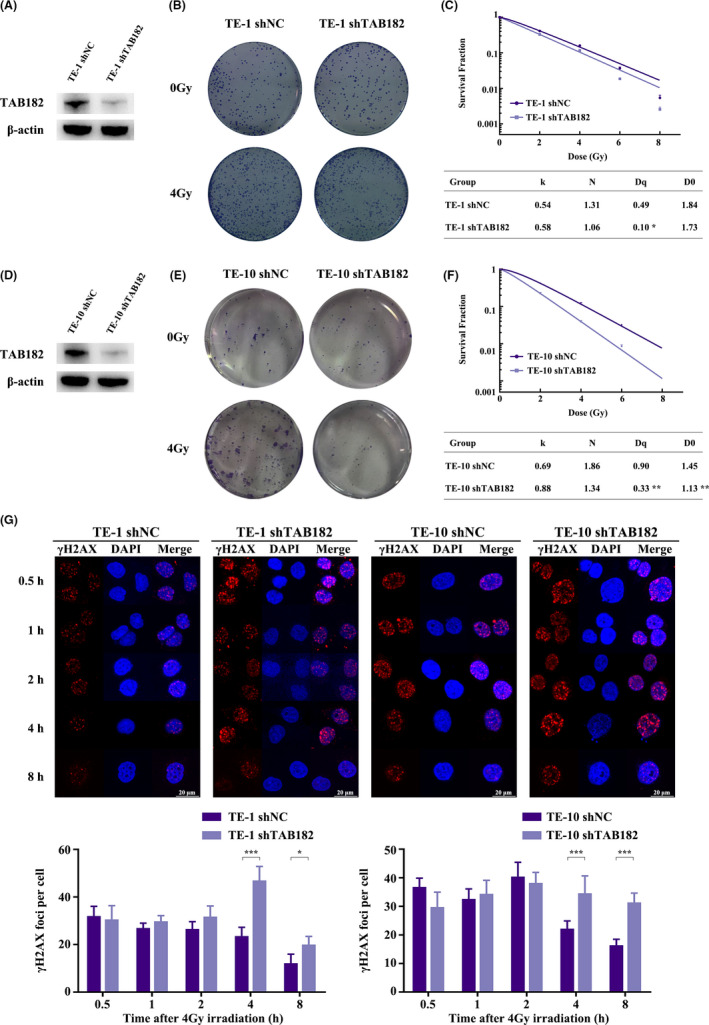
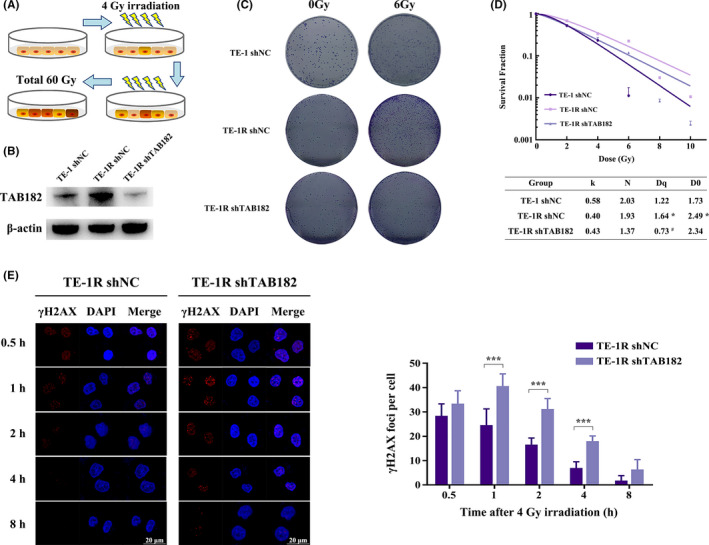
By applying qRT-PCR and immunohistochemical staining, the expression of TAB182 was detected in patient tissues. We next assessed the influence of TAB182 downregulation to radiosensitivity using clonogenic survival assay and γ-H2A.X foci analysis in TE-1, TE-10, and radioresistant TE-1R cell lines after ionizing radiation. To unveil the mechanism underlying, TAB182 interacting proteins were identified by mass spectrometry following co-immunoprecipitation. Furthermore, flow cytometry and western blot assay were applied to validate the identified proteins.
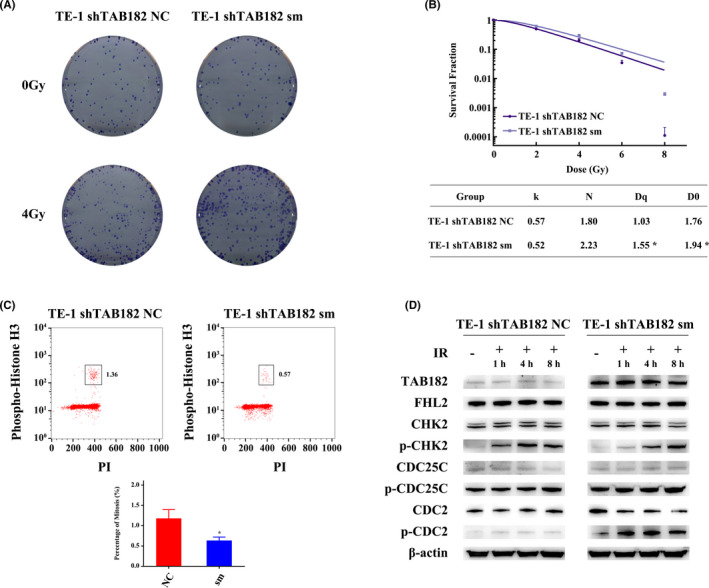
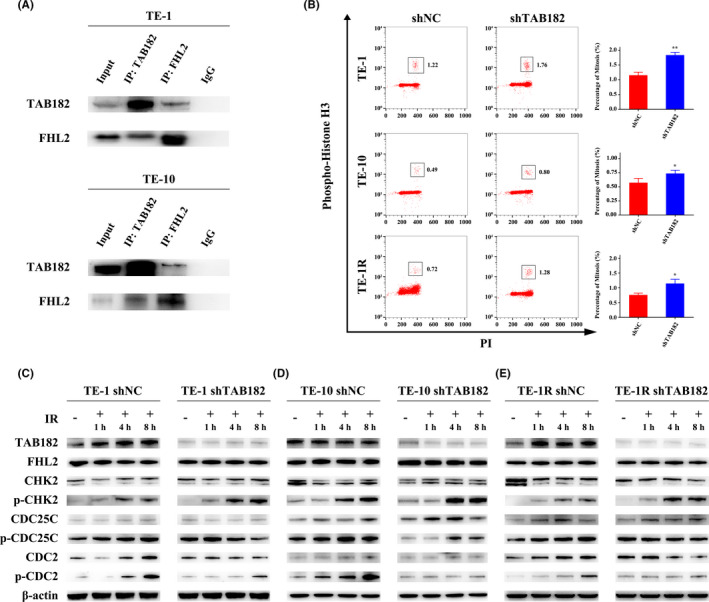
Our results demonstrated that the expression of TAB182 is higher in cancer tissues than normal tissues and elevated expression of TAB182 correlates with poor outcomes of postoperative radiotherapy. Downregulation of TAB182 sensitized cancer cells to ionizing radiation, particularly in radioresistant TE-1R cells that spontaneously overexpress TAB182. Mechanically, TAB182 interacts with FHL2 to induce G2-M arrest through wiring the CHK2/CDC25C/CDC2 signaling pathway. Finally, overexpression of shRNA-resistant TAB182 restored the checkpoint and radioresistance.
TAB182 potentiates the radioresistance of ESCC cells by modulating the G2-M checkpoint through its interaction with FHL2. Thus, TAB182 may become an ideal biomarker and therapeutic target of ESCC radiotherapy.
放射疗法是治疗食管鳞状细胞癌(ESCC)的主要策略之一。然而,由于出现放射抗性,治疗往往会失败。在这项研究中,我们报告了一种称为 TAB182 的辐射敏感性关键调节剂,它可能成为克服放射抗性的理想生物标志物和治疗靶标。
通过应用 qRT-PCR 和免疫组织化学染色,检测了患者组织中 TAB182 的表达。接下来,我们评估了 TAB182 下调对 TE-1、TE-10 和放射抗性 TE-1R 细胞系在电离辐射后克隆存活和γ-H2A.X 焦点分析中放射敏感性的影响。为了揭示潜在机制,通过共免疫沉淀后进行质谱分析鉴定了 TAB182 相互作用的蛋白质。此外,应用流式细胞术和 Western blot 分析验证了鉴定出的蛋白质。
我们的结果表明,TAB182 的表达在癌症组织中高于正常组织,并且 TAB182 的高表达与术后放射治疗的不良预后相关。TAB182 的下调使癌细胞对电离辐射敏感,特别是在自发过表达 TAB182 的放射抗性 TE-1R 细胞中。从机制上讲,TAB182 与 FHL2 相互作用,通过布线 CHK2/CDC25C/CDC2 信号通路诱导 G2-M 期阻滞。最后,shRNA 抗性 TAB182 的过表达恢复了检查点和放射抗性。
TAB182 通过与其相互作用蛋白 FHL2 调节 G2-M 检查点来增强 ESCC 细胞的放射抗性。因此,TAB182 可能成为 ESCC 放射治疗的理想生物标志物和治疗靶标。