Department of Clinical Sciences, Nazarbayev University School of Medicine, Kerey and Zhanibek Khans Street 5/1, Room 345, Nur-Sultan City, Kazakhstan.
Department of Biomedical Sciences, Nazarbayev University School of Medicine, Nur-Sultan, Kazakhstan.
BMC Nephrol. 2020 Sep 21;21(1):407. doi: 10.1186/s12882-020-02047-6.
The epidemiology of dialysis patients has been little studied in developing countries and economies in transition. We examined the prevalence, incidence and mortality rate of dialysis patients in Kazakhstan, via aggregation and utilization of large-scale administrative healthcare data.
The registry data of 8898 patients receiving dialysis therapy between 2014 and 2018 years were extracted from the Unified National Electronic Health System (UNEHS) and linked with the national population registry of Kazakhstan. We provide descriptive statistics of demographic, comorbidity and dialysis-related characteristics.
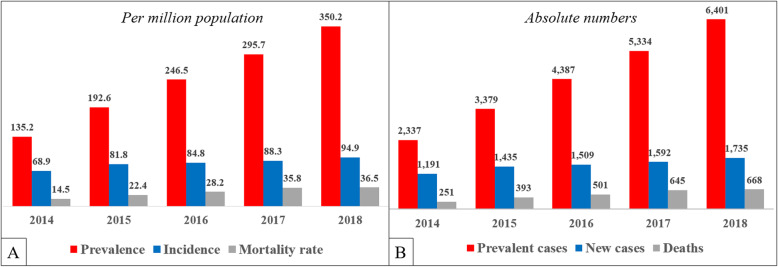
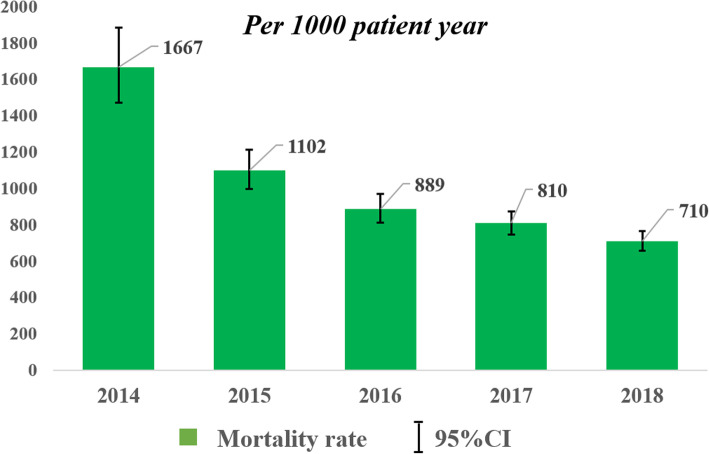
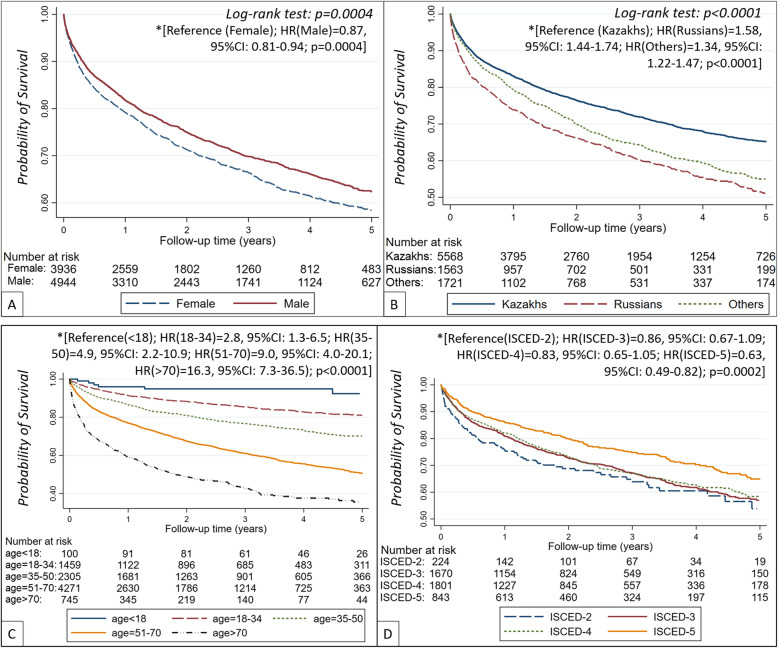
Among all patients undergoing maintenance dialysis for end-stage renal disease (ESRD), there were 3941 (44%) females and 4957 (56%) males. 98.7% of patients received hemodialysis and 1.3% peritoneal dialysis. The majority of the patients (63%) were ethnic Kazakhs, 18% were Russians and 19% were of other ethnicities. The prevalence and incidence rate in 2014 were 135.2 and 68.9 per million population (PMP), respectively, which were different in 2018 [350.2 and 94.9 PMP, respectively]. Overall mortality rate among dialysis patients reduced from 1667/1000 patient-years [95%Confidence Interval (CI): 1473-1886] (PY) in 2014 to 710/1000PY [95%CI: 658-767] in 2018. We observed 13% lower crude survival probability in females compared to males and in older patients compared to younger ones. Russian ethnicity had 58% higher risk of death, while other ethnicities had 34% higher risk of death compared to in those of Kazakh ethnicity.
We describe for the first time in Kazakhstan an increase in the prevalence and incidence of ESRD on dialysis, while mortality rate decreased over time, during 2014-2018. We observed statistically significant lower survival probability in female dialysis patients compared to males, in older patients compared to younger ones, and in patients of Russian ethnicity compared to Kazakh.
在发展中国家和经济转型国家,透析患者的流行病学研究甚少。我们通过汇总和利用大规模的医疗保健管理数据,研究了哈萨克斯坦透析患者的患病率、发病率和死亡率。
从统一国家电子健康系统(UNEHS)中提取了 2014 年至 2018 年期间接受透析治疗的 8898 名患者的登记数据,并与哈萨克斯坦国家人口登记处进行了关联。我们提供了人口统计学、合并症和透析相关特征的描述性统计数据。
在所有接受终末期肾病(ESRD)维持性透析的患者中,女性 3941 例(44%),男性 4957 例(56%)。98.7%的患者接受血液透析,1.3%接受腹膜透析。大多数患者(63%)是哈萨克族,18%是俄罗斯族,19%是其他民族。2014 年的患病率和发病率分别为每百万人 135.2 和 68.9,而 2018 年分别为 350.2 和 94.9。透析患者的总体死亡率从 2014 年的 1667/1000 患者年(95%置信区间[CI]:1473-1886)降至 2018 年的 710/1000PY(95%CI:658-767)。我们观察到女性的粗生存率比男性低 13%,年龄较大的患者比年龄较小的患者低 13%。俄罗斯族裔的死亡风险高 58%,而其他族裔的死亡风险比哈萨克族裔高 34%。
我们首次在哈萨克斯坦描述了 2014-2018 年间透析治疗的 ESRD 患病率和发病率增加,而死亡率随时间降低。我们观察到女性透析患者的生存率明显低于男性,年龄较大的患者的生存率明显低于年龄较小的患者,俄罗斯族裔的生存率明显低于哈萨克族裔。