Soufflet-Freslon Vanessa, Araou Emilie, Jeauffre Julien, Thouroude Tatiana, Chastellier Annie, Michel Gilles, Mikanagi Yuki, Kawamura Koji, Banfield Mark, Oghina-Pavie Cristiana, Clotault Jérémy, Pernet Alix, Foucher Fabrice
Univ Angers, Institut Agro, INRAE, IRHS, SFR QUASAV, F-49000 Angers, France, 49071, Beaucouzé, France.
Natural History Museum and Institute, Chiba, Japan.
Hortic Res. 2021 Apr 1;8(1):76. doi: 10.1038/s41438-021-00512-3.
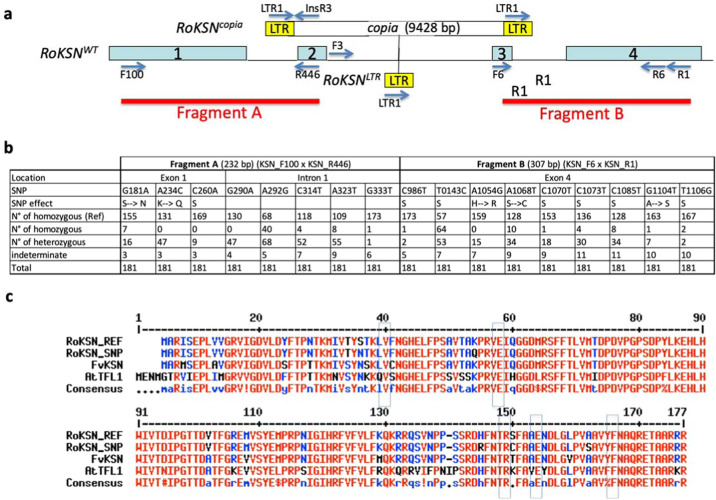
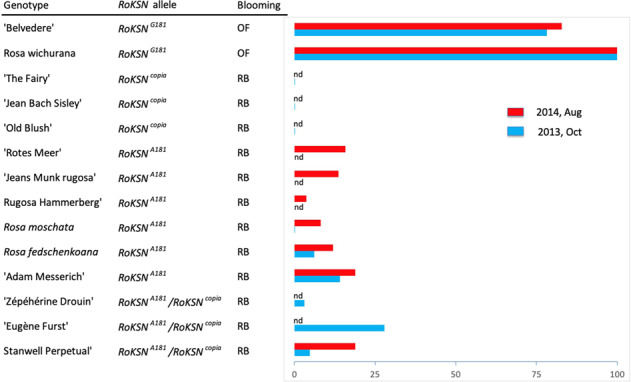
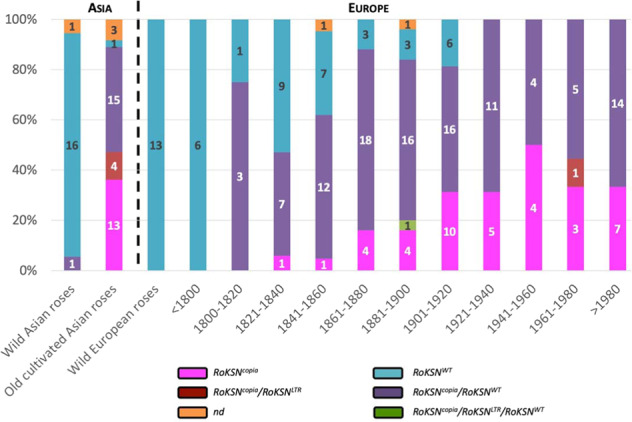
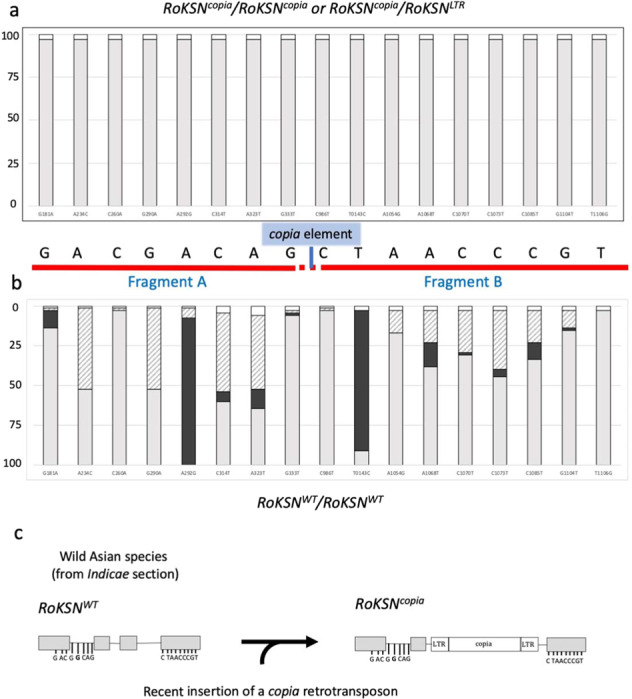
Blooming seasonality is an important trait in ornamental plants and was selected by humans. Wild roses flower only in spring whereas most cultivated modern roses can flower continuously. This trait is explained by a mutation of a floral repressor gene, RoKSN, a TFL1 homologue. In this work, we studied the origin, the diversity and the selection of the RoKSN gene. We analyzed 270 accessions, including wild and old cultivated Asian and European roses as well as modern roses. By sequencing the RoKSN gene, we proposed that the allele responsible for continuous-flowering, RoKSN, originated from Chinese wild roses (Indicae section), with a recent insertion of the copia element. Old cultivated Asian roses with the RoKSN allele were introduced in Europe, and the RoKSN allele was progressively selected during the 19th and 20th centuries, leading to continuous-flowering modern roses. Furthermore, we detected a new allele, RoKSN, leading to a weak reblooming. This allele encodes a functional floral repressor and is responsible for a moderate accumulation of RoKSN transcripts. A transient selection of this RoKSN allele was observed during the 19th century. Our work highlights the selection of different alleles at the RoKSN locus for recurrent blooming in rose.
花期的延长是观赏植物的一个重要特性,是人类选择的结果。野生玫瑰只在春天开花,而大多数现代栽培玫瑰能够连续开花。这种特性是由一种 floral repressor 基因 RoKSN(一种 TFL1 同源基因)的突变所导致的。在这项研究中,我们对 RoKSN 基因的起源、多样性和选择进行了研究。我们分析了 270 份样本,包括野生和古老栽培的亚洲及欧洲玫瑰以及现代玫瑰。通过对 RoKSN 基因进行测序,我们发现导致连续开花的等位基因 RoKSN 起源于中国野生玫瑰(月季组),近期有 copia 元件的插入。携带 RoKSN 等位基因的古老亚洲栽培玫瑰被引入欧洲,并且在 19 世纪和 20 世纪期间 RoKSN 等位基因逐渐被选择,从而产生了连续开花的现代玫瑰。此外,我们检测到一个新的等位基因 RoKSN,它导致较弱的再次开花现象。这个等位基因编码一种功能性的 floral repressor,并导致 RoKSN 转录本适度积累。在 19 世纪观察到了对这个 RoKSN 等位基因的短暂选择。我们的研究突出了在玫瑰中为实现反复开花而在 RoKSN 位点对不同等位基因的选择。