Weller James L, Ortega Raúl
School of Biological Sciences, University of Tasmania, Hobart, TAS Australia.
Front Plant Sci. 2015 Apr 9;6:207. doi: 10.3389/fpls.2015.00207. eCollection 2015.
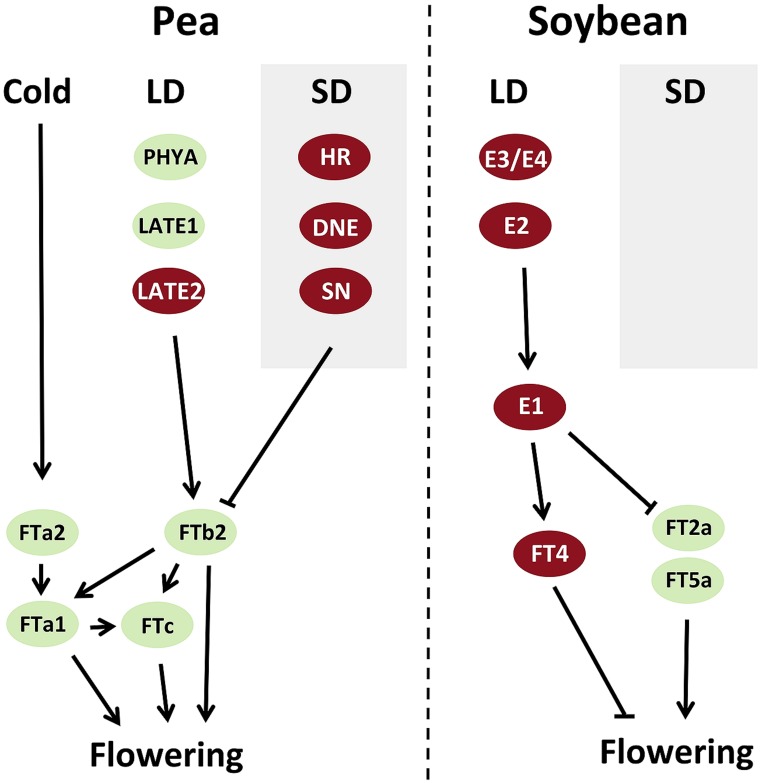
The timing of flowering, and in particular the degree to which it is responsive to the environment, is a key factor in the adaptation of a given species to various eco-geographic locations and agricultural practices. Flowering time variation has been documented in many crop legumes, and selection for specific variants has permitted significant expansion and improvement in cultivation, from prehistoric times to the present day. Recent advances in legume genomics have accelerated the process of gene identification and functional analysis, and opened up new prospects for a molecular understanding of flowering time adaptation in this important crop group. Within the legumes, two species have been prominent in flowering time studies; the vernalization-responsive long-day species pea (Pisum sativum) and the warm-season short-day plant soybean (Glycine max). Analysis of flowering in these species is now being complemented by reverse genetics capabilities in the model legumes Medicago truncatula and Lotus japonicus, and the emergence of genome-scale resources in a range of other legumes. This review will outline the insights gained from detailed forward genetic analysis of flowering time in pea and soybean, highlighting the importance of light perception, the circadian clock and the FT family of flowering integrators. It discusses the current state of knowledge on genetic mechanisms for photoperiod and vernalization response, and concludes with a broader discussion of flowering time adaptation across legumes generally.
开花时间,尤其是其对环境的响应程度,是特定物种适应不同生态地理位置和农业实践的关键因素。许多豆科作物都有开花时间变异的记录,从史前时期到现在,对特定变异体的选择使得种植范围得以显著扩大和改良。豆科植物基因组学的最新进展加速了基因鉴定和功能分析的进程,并为从分子层面理解这一重要作物群体的开花时间适应性开辟了新前景。在豆科植物中,有两个物种在开花时间研究中备受瞩目;对春化有响应的长日照物种豌豆(Pisum sativum)和暖季短日照植物大豆(Glycine max)。目前,对这些物种开花情况的分析正通过模式豆科植物蒺藜苜蓿(Medicago truncatula)和百脉根(Lotus japonicus)的反向遗传学能力以及一系列其他豆科植物中基因组规模资源的出现得到补充。本综述将概述从对豌豆和大豆开花时间的详细正向遗传学分析中获得的见解,强调光感知、生物钟以及开花整合因子FT家族的重要性。它讨论了光周期和春化反应遗传机制的当前知识状态,并以对豆科植物总体开花时间适应性的更广泛讨论作为结尾。