Liorzou Mathilde, Pernet Alix, Li Shubin, Chastellier Annie, Thouroude Tatiana, Michel Gilles, Malécot Valéry, Gaillard Sylvain, Briée Céline, Foucher Fabrice, Oghina-Pavie Cristiana, Clotault Jérémy, Grapin Agnès
IRHS, Agrocampus Ouest, INRA, Université d'Angers, SFR 4207 QuaSaV, 49071, Beaucouzé, France.
IRHS, Agrocampus Ouest, INRA, Université d'Angers, SFR 4207 QuaSaV, 49071, Beaucouzé, France Flower Research Institute, Yunnan Academy of Agricultural Sciences, Kunming 650205, China.
J Exp Bot. 2016 Aug;67(15):4711-25. doi: 10.1093/jxb/erw269. Epub 2016 Jul 12.
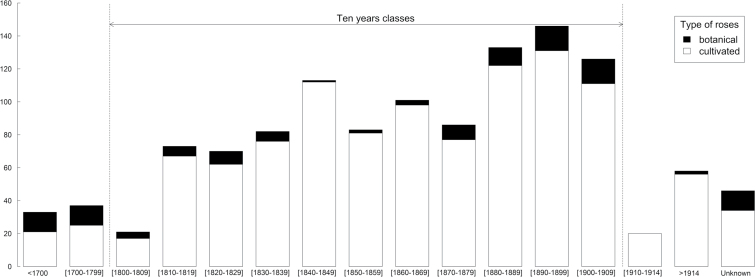
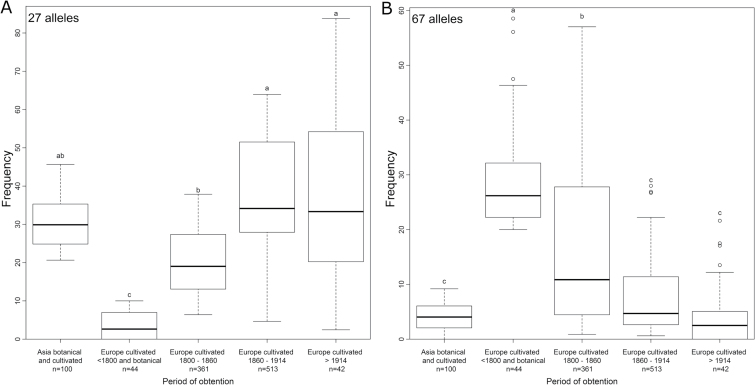
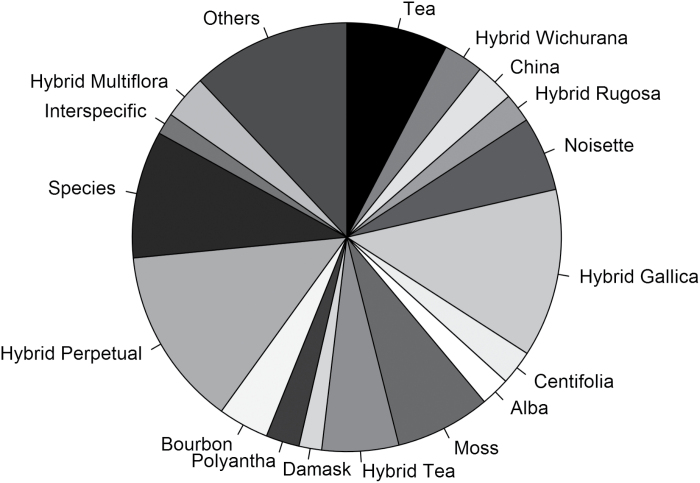
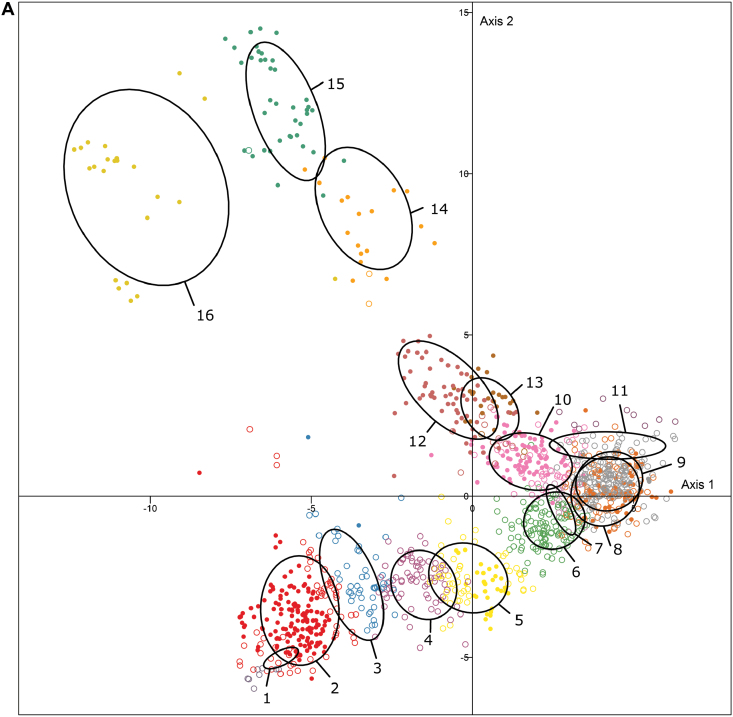
Hybridization with introduced genetic resources is commonly practiced in ornamental plant breeding to introgress desired traits. The 19th century was a golden age for rose breeding in France. The objective here was to study the evolution of rose genetic diversity over this period, which included the introduction of Asian genotypes into Europe. A large sample of 1228 garden roses encompassing the conserved diversity cultivated during the 18th and 19th centuries was genotyped with 32 microsatellite primer pairs. Its genetic diversity and structure were clarified. Wide diversity structured in 16 genetic groups was observed. Genetic differentiation was detected between ancient European and Asian accessions, and a temporal shift from a European to an Asian genetic background was observed in cultivated European hybrids during the 19th century. Frequent crosses with Asian roses throughout the 19th century and/or selection for Asiatic traits may have induced this shift. In addition, the consistency of the results with respect to a horticultural classification is discussed. Some horticultural groups, defined according to phenotype and/or knowledge of their pedigree, seem to be genetically more consistent than others, highlighting the difficulty of classifying cultivated plants. Therefore, the horticultural classification is probably more appropriate for commercial purposes rather than genetic relatedness, especially to define preservation and breeding strategies.
在观赏植物育种中,与引入的遗传资源进行杂交是一种常用的方法,目的是导入所需性状。19世纪是法国玫瑰育种的黄金时代。本文旨在研究这一时期玫瑰遗传多样性的演变,其中包括亚洲基因型引入欧洲的情况。对1228份涵盖18世纪和19世纪栽培的保守多样性的园林玫瑰大样本,使用32对微卫星引物进行基因分型。明确了其遗传多样性和结构。观察到广泛的多样性被划分为16个遗传组。检测到古代欧洲和亚洲种质之间的遗传分化,并且在19世纪栽培的欧洲杂交种中观察到从欧洲遗传背景到亚洲遗传背景的时间变化。19世纪与亚洲玫瑰的频繁杂交和/或对亚洲性状的选择可能导致了这种变化。此外,还讨论了结果与园艺分类的一致性。一些根据表型和/或系谱知识定义的园艺组,在遗传上似乎比其他组更一致,这凸显了栽培植物分类的困难。因此,园艺分类可能更适合商业目的,而非遗传相关性,特别是在定义保存和育种策略时。