Campagno Keith E, Mitchell Claire H
Department of Basic and Translational Science, University of Pennsylvania, Philadelphia, PA, United States.
Department of Ophthalmology, University of Pennsylvania, Philadelphia, PA, United States.
Front Cell Neurosci. 2021 Mar 15;15:645244. doi: 10.3389/fncel.2021.645244. eCollection 2021.
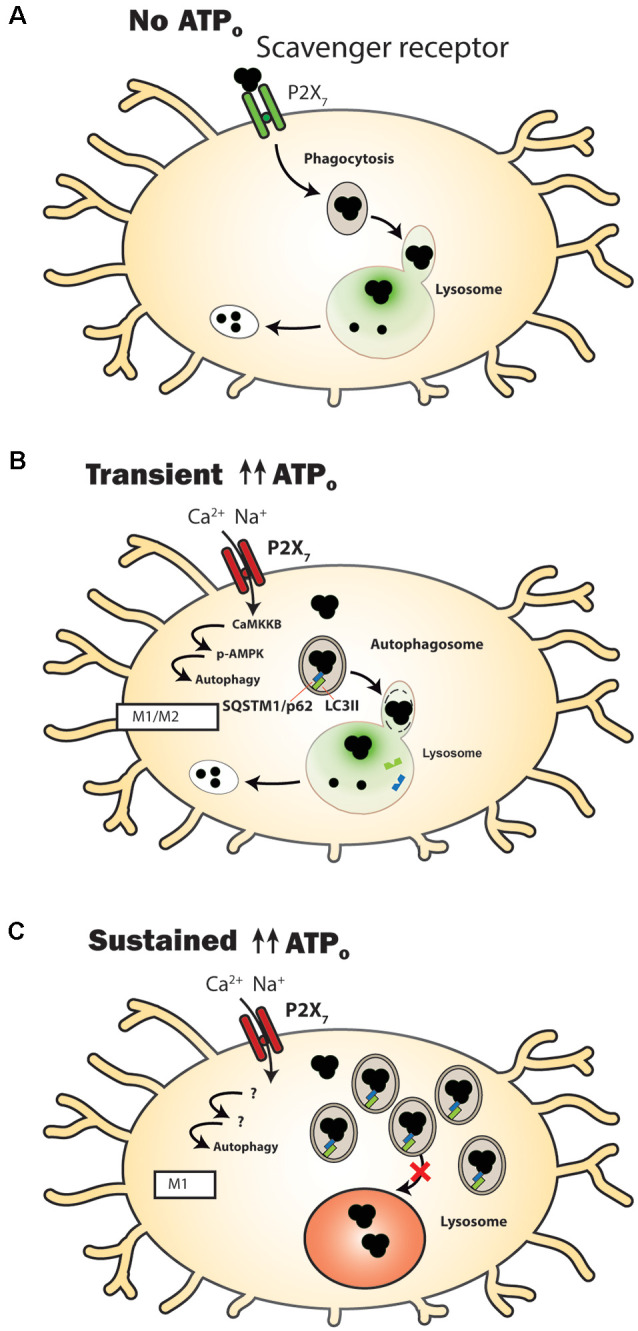
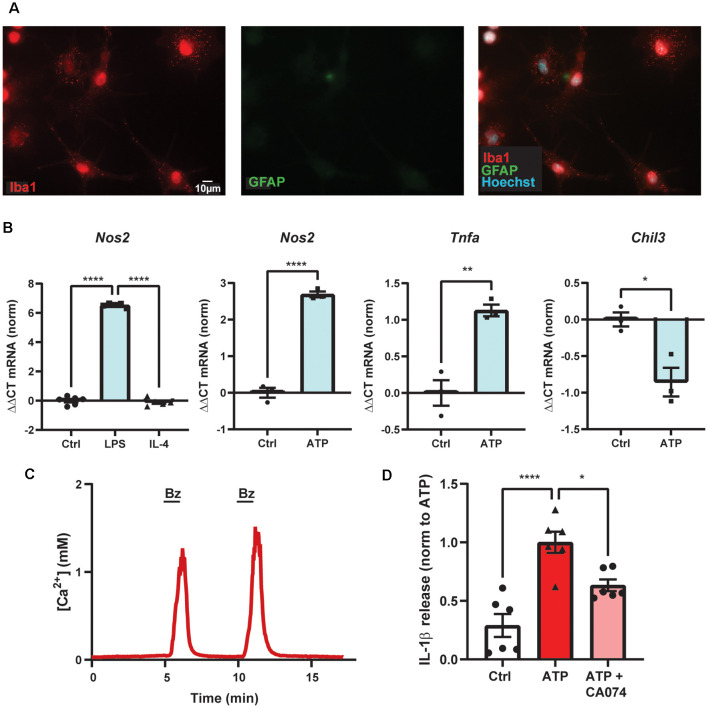
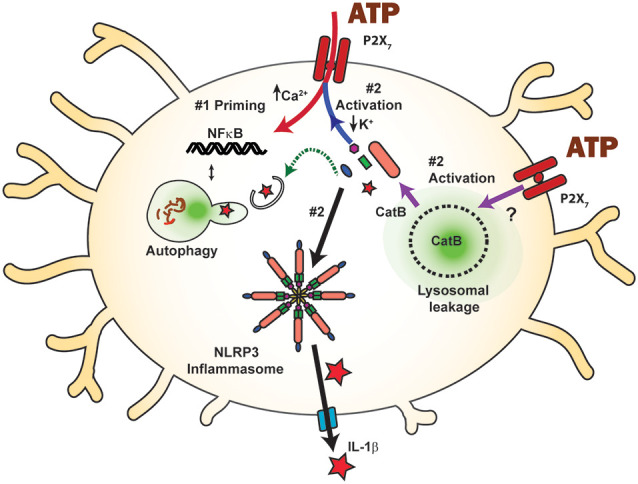
Microglial cells regulate neural homeostasis by coordinating both immune responses and clearance of debris, and the P2X receptor for extracellular ATP plays a central role in both functions. The P2X receptor is primarily known in microglial cells for its immune signaling and NLRP3 inflammasome activation. However, the receptor also affects the clearance of extracellular and intracellular debris through modifications of lysosomal function, phagocytosis, and autophagy. In the absence of an agonist, the P2X receptor acts as a scavenger receptor to phagocytose material. Transient receptor stimulation induces autophagy and increases LC3-II levels, likely through calcium-dependent phosphorylation of AMPK, and activates microglia to an M1 or mixed M1/M2 state. We show an increased expression of and and a decreased expression of () from primary cultures of brain microglia exposed to high levels of ATP. Sustained stimulation can reduce lysosomal function in microglia by increasing lysosomal pH and slowing autophagosome-lysosome fusion. P2X receptor stimulation can also cause lysosomal leakage, and the subsequent rise in cytoplasmic cathepsin B activates the NLRP3 inflammasome leading to caspase-1 cleavage and IL-1β maturation and release. Support for P2X receptor activation of the inflammasome following lysosomal leakage comes from data on primary microglia showing IL-1β release following receptor stimulation is inhibited by cathepsin B blocker CA-074. This pathway bridges endolysosomal and inflammatory roles and may provide a key mechanism for the increased inflammation found in age-dependent neurodegenerations characterized by excessive lysosomal accumulations. Regardless of whether the inflammasome is activated this lysosomal leakage or the better-known K-efflux pathway, the inflammatory impact of P2X receptor stimulation is balanced between the autophagic reduction of inflammasome components and their increase following P2X-mediated priming. In summary, the P2X receptor modulates clearance of extracellular debris by microglial cells and mediates lysosomal damage that can activate the NLRP3 inflammasome. A better understanding of how the P2X receptor alters phagocytosis, lysosomal health, inflammation, and autophagy can lead to therapies that balance the inflammatory and clearance roles of microglial cells.
小胶质细胞通过协调免疫反应和清除碎片来调节神经内环境稳态,细胞外ATP的P2X受体在这两种功能中都起着核心作用。P2X受体在小胶质细胞中主要因其免疫信号传导和NLRP3炎性小体激活而为人所知。然而,该受体还通过改变溶酶体功能、吞噬作用和自噬来影响细胞外和细胞内碎片的清除。在没有激动剂的情况下,P2X受体作为一种清道夫受体来吞噬物质。短暂的受体刺激可诱导自噬并增加LC3-II水平,可能是通过AMPK的钙依赖性磷酸化,并将小胶质细胞激活为M1或混合的M1/M2状态。我们发现,暴露于高水平ATP的脑小胶质细胞原代培养物中,[具体基因名称1]和[具体基因名称2]的表达增加,而[具体基因名称3]的表达降低。持续刺激可通过提高溶酶体pH值和减缓自噬体-溶酶体融合来降低小胶质细胞的溶酶体功能。P2X受体刺激还可导致溶酶体渗漏,随后细胞质组织蛋白酶B的升高激活NLRP3炎性小体,导致半胱天冬酶-1裂解以及IL-1β成熟和释放。溶酶体渗漏后P2X受体激活炎性小体的证据来自原代小胶质细胞的数据,显示受体刺激后的IL-1β释放受到组织蛋白酶B阻滞剂CA-074的抑制。这条途径连接了内溶酶体和炎症作用,可能为以溶酶体过度积累为特征的年龄依赖性神经退行性疾病中发现的炎症增加提供关键机制。无论炎性小体是通过这种溶酶体渗漏还是更知名的钾外流途径被激活,P2X受体刺激的炎症影响在炎性小体成分的自噬性减少与其在P2X介导的启动后的增加之间保持平衡。总之,P2X受体调节小胶质细胞对细胞外碎片的清除,并介导可激活NLRP3炎性小体的溶酶体损伤。更好地理解P2X受体如何改变吞噬作用、溶酶体健康、炎症和自噬,可能会带来平衡小胶质细胞炎症和清除作用的疗法。