National Cancer Institute, NIH, Bethesda, MD, USA.
College of Pharmacy, University of Florida, Gainesville, FL, USA.
J Natl Cancer Inst. 2021 Oct 1;113(10):1285-1298. doi: 10.1093/jnci/djab064.
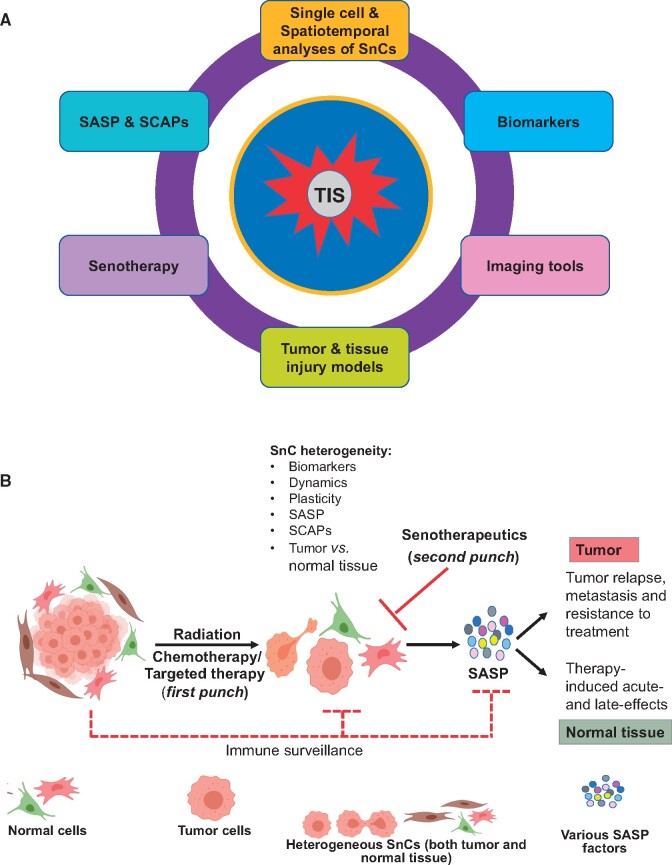
Cellular senescence is an essential tumor suppressive mechanism that prevents the propagation of oncogenically activated, genetically unstable, and/or damaged cells. Induction of tumor cell senescence is also one of the underlying mechanisms by which cancer therapies exert antitumor activity. However, an increasing body of evidence from preclinical studies demonstrates that radiation and chemotherapy cause accumulation of senescent cells (SnCs) both in tumor and normal tissue. SnCs in tumors can, paradoxically, promote tumor relapse, metastasis, and resistance to therapy, in part, through expression of the senescence-associated secretory phenotype. In addition, SnCs in normal tissue can contribute to certain radiation- and chemotherapy-induced side effects. Because of its multiple roles, cellular senescence could serve as an important target in the fight against cancer. This commentary provides a summary of the discussion at the National Cancer Institute Workshop on Radiation, Senescence, and Cancer (August 10-11, 2020, National Cancer Institute, Bethesda, MD) regarding the current status of senescence research, heterogeneity of therapy-induced senescence, current status of senotherapeutics and molecular biomarkers, a concept of "one-two punch" cancer therapy (consisting of therapeutics to induce tumor cell senescence followed by selective clearance of SnCs), and its integration with personalized adaptive tumor therapy. It also identifies key knowledge gaps and outlines future directions in this emerging field to improve treatment outcomes for cancer patients.
细胞衰老(cellular senescence)是一种重要的肿瘤抑制机制,可防止致癌基因激活、遗传不稳定和/或受损细胞的增殖。诱导肿瘤细胞衰老也是癌症治疗发挥抗肿瘤活性的潜在机制之一。然而,越来越多的临床前研究证据表明,放疗和化疗会在肿瘤和正常组织中积累衰老细胞(senescent cells,SnCs)。肿瘤中的衰老细胞(SnCs)反而会通过衰老相关分泌表型(senescence-associated secretory phenotype)促进肿瘤复发、转移和对治疗的耐药,部分原因在于此。此外,正常组织中的衰老细胞(SnCs)可能会导致某些放疗和化疗引起的副作用。由于其多种作用,细胞衰老(cellular senescence)可能成为抗癌斗争的重要靶点。本文概述了 2020 年 8 月 10 日至 11 日在美国国立癌症研究所(National Cancer Institute)举行的“放疗、衰老与癌症(Radiation, Senescence, and Cancer)”专题研讨会上的讨论内容,该会议讨论了衰老研究的现状、治疗诱导衰老的异质性、衰老治疗学和分子生物标志物的现状、“双重打击”癌症疗法(包括诱导肿瘤细胞衰老的疗法和随后选择性清除衰老细胞的疗法)的概念,以及它与个性化适应性肿瘤治疗的整合。本文还确定了该新兴领域中的关键知识空白,并概述了未来的发展方向,以改善癌症患者的治疗效果。