Horstmann M, Heier L, Kruppert S, Weiss L C, Tollrian R, Adamec L, Westermeier A, Speck T, Poppinga S
Department of Animal Ecology, Evolution and Biodiversity, Ruhr-University Bochum, Universitätsstraße 150, D-44780, Bochum, Germany.
Friday Harbor Laboratories, University of Washington, 620 University Road, WA 98250, USA.
Integr Org Biol. 2019 Mar 25;1(1):oby012. doi: 10.1093/iob/oby012. eCollection 2019.
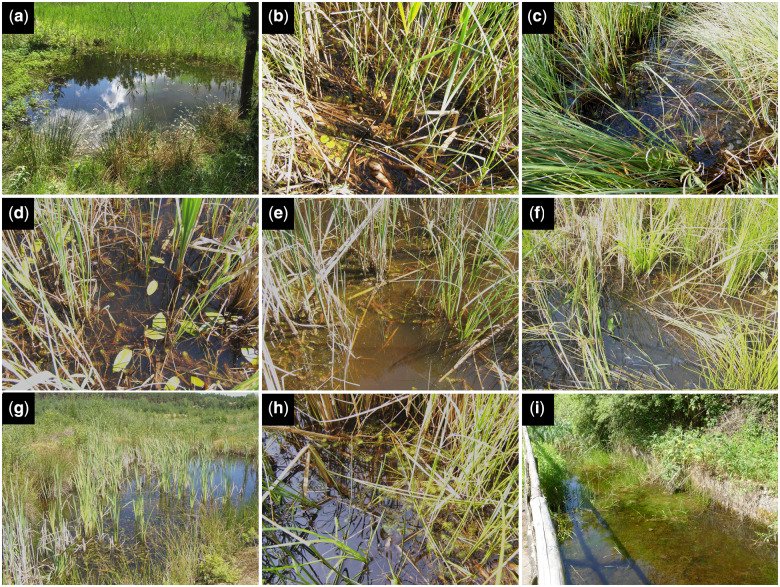
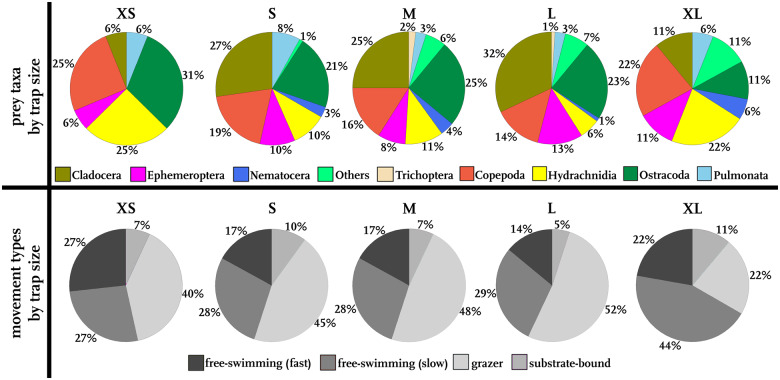
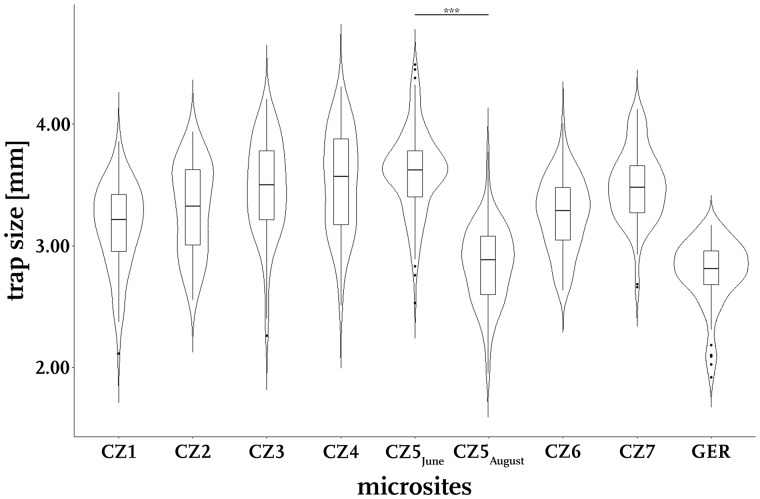
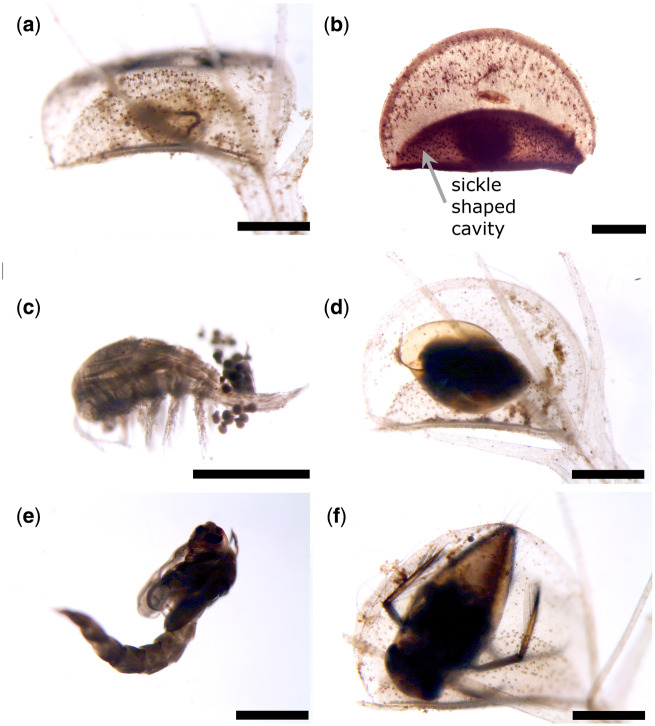
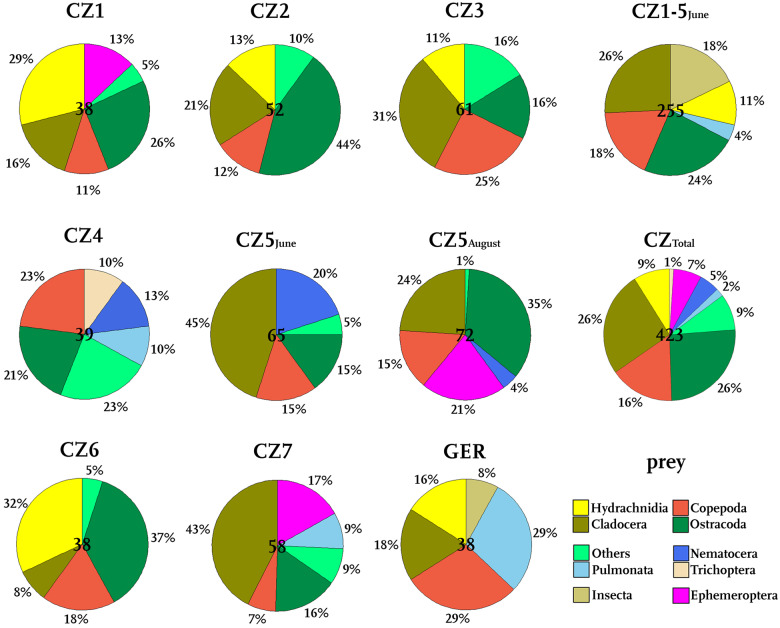
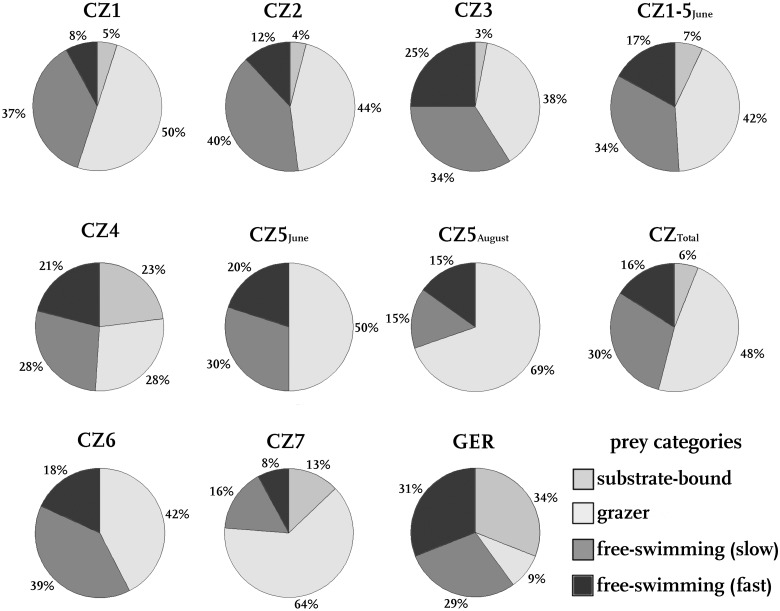
The critically endangered carnivorous waterwheel plant (, Droseraceae) possesses underwater snap traps for capturing small aquatic animals, but knowledge on the exact prey species is limited. Such information would be essential for continuing ecological research, drawing conclusions regarding trapping efficiency and trap evolution, and eventually, for conservation. Therefore, we performed comparative trap size measurements and snapshot prey analyses at seven Czech and one German naturalized microsites on plants originating from at least two different populations. One Czech site was sampled twice during 2017. We recorded seven main prey taxonomic groups, that is, Cladocera, Copepoda, Ostracoda, Ephemeroptera, Nematocera, Hydrachnidia, and Pulmonata. In total, we recorded 43 different prey taxa in 445 prey-filled traps, containing in sum 461 prey items. With one exception, prey spectra did not correlate with site conditions (e.g. water depth) or trap size. Our data indicate that shows no prey specificity but catches opportunistically, independent of prey species, prey mobility mode (swimming or substrate-bound), and speed of movement. Even in cases where the prey size exceeded trap size, successful capture was accomplished by clamping the animal between the traps' lobes. As we found a wide prey range that was attracted, it appears unlikely that the capture is enhanced by specialized chemical- or mimicry-based attraction mechanisms. However, for animals seeking shelter, a place to rest, or a substrate to graze on, may indirectly attract prey organisms in the vicinity, whereas other prey capture events (like that of comparably large notonectids) may also be purely coincidental.
极度濒危的食肉植物貉藻(茅膏菜科)拥有水下捕捉陷阱来捕获小型水生动物,但关于确切猎物种类的了解有限。此类信息对于持续开展生态学研究、得出关于捕捉效率和陷阱进化的结论以及最终的保护工作至关重要。因此,我们在七个捷克和一个德国归化微生境对源自至少两个不同种群的植物进行了陷阱大小比较测量和猎物快照分析。2017年期间对一个捷克地点进行了两次采样。我们记录了七个主要猎物分类群,即枝角类、桡足类、介形类、蜉蝣目、长角亚目、水螨目和肺螺亚纲。我们总共在445个装有猎物的陷阱中记录了43种不同的猎物分类单元,共计461个猎物个体。除了一个例外,猎物谱与地点条件(如水深)或陷阱大小无关。我们的数据表明,貉藻没有猎物特异性,而是机会性地捕捉猎物,与猎物种类、猎物移动方式(游泳或附着于基质)以及移动速度无关。即使在猎物大小超过陷阱大小的情况下,通过将动物夹在陷阱的叶之间也能成功捕获。由于我们发现了广泛的被吸引猎物范围,似乎不太可能通过基于特殊化学或拟态的吸引机制来提高捕获量。然而,对于寻求庇护所、休息场所或觅食基质的动物来说,貉藻可能会间接吸引附近的猎物生物,而其他猎物捕获事件(如相对较大的仰蝽科昆虫的捕获)也可能纯粹是巧合。