Institute of Crop Science and Resource Conservation (INRES), University of Bonn, D-53113 Bonn, Germany.
Institute of Plant Biology and Biotechnology, University of Münster, D-48143 Münster, Germany.
Plant Physiol. 2021 May 27;186(1):125-141. doi: 10.1093/plphys/kiaa095.
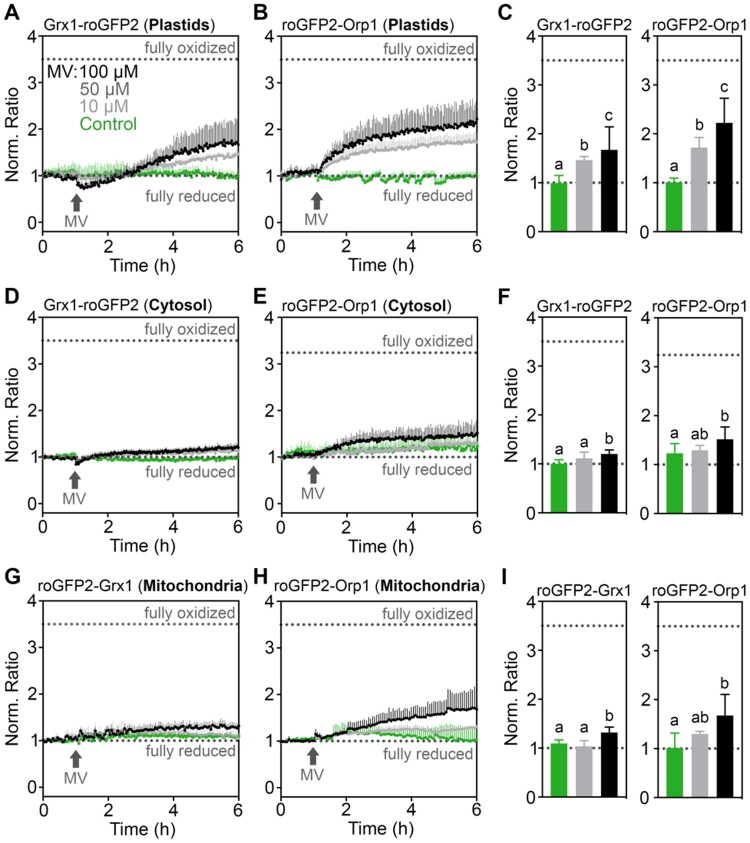
Metabolic fluctuations in chloroplasts and mitochondria can trigger retrograde signals to modify nuclear gene expression. Mobile signals likely to be involved are reactive oxygen species (ROS), which can operate protein redox switches by oxidation of specific cysteine residues. Redox buffers, such as the highly reduced glutathione pool, serve as reservoirs of reducing power for several ROS-scavenging and ROS-induced damage repair pathways. Formation of glutathione disulfide and a shift of the glutathione redox potential (EGSH) toward less negative values is considered as hallmark of several stress conditions. Here we used the herbicide methyl viologen (MV) to generate ROS locally in chloroplasts of intact Arabidopsis (Arabidopsis thaliana) seedlings and recorded dynamic changes in EGSH and H2O2 levels with the genetically encoded biosensors Grx1-roGFP2 (for EGSH) and roGFP2-Orp1 (for H2O2) targeted to chloroplasts, the cytosol, or mitochondria. Treatment of seedlings with MV caused rapid oxidation in chloroplasts and, subsequently, in the cytosol and mitochondria. MV-induced oxidation was significantly boosted by illumination with actinic light, and largely abolished by inhibitors of photosynthetic electron transport. MV also induced autonomous oxidation in the mitochondrial matrix in an electron transport chain activity-dependent manner that was milder than the oxidation triggered in chloroplasts by the combination of MV and light. In vivo redox biosensing resolves the spatiotemporal dynamics of compartmental responses to local ROS generation and provides a basis for understanding how compartment-specific redox dynamics might operate in retrograde signaling and stress acclimation in plants.
叶绿体和线粒体中的代谢波动可以引发逆行信号,从而改变核基因表达。可能涉及的移动信号是活性氧(ROS),它可以通过氧化特定半胱氨酸残基来操作蛋白质氧化还原开关。氧化还原缓冲液,如高度还原的谷胱甘肽池,充当几种 ROS 清除和 ROS 诱导的损伤修复途径的还原能力储备。谷胱甘肽二硫化物的形成和谷胱甘肽氧化还原电势(EGSH)向更负的值的转移被认为是几种应激条件的标志。在这里,我们使用除草剂甲基紫精(MV)在完整拟南芥(Arabidopsis thaliana)幼苗的叶绿体中局部产生 ROS,并使用遗传编码的生物传感器 Grx1-roGFP2(用于 EGSH)和 roGFP2-Orp1(用于 H2O2)记录 EGSH 和 H2O2 水平的动态变化,这些传感器靶向叶绿体、细胞质或线粒体。用 MV 处理幼苗会导致叶绿体中迅速氧化,随后在细胞质和线粒体中氧化。用强光照射会显著增强 MV 诱导的氧化,而光合电子传递抑制剂则会大大抑制这种氧化。MV 还以电子传递链活性依赖的方式在线粒体基质中诱导自主氧化,其强度低于 MV 和光组合在叶绿体中引发的氧化。体内氧化还原生物传感可解析区室对局部 ROS 产生的区室反应的时空动力学,并为理解特定区室的氧化还原动力学如何在植物中的逆行信号和应激适应中发挥作用提供基础。