Department of Environmental Health Engineering, Neyshabur University of Medical Sciences, Neyshabur, Iran.
Department of Epidemiology, Johns Hopkins Bloomberg School of Public Health, Baltimore, MD, USA.
BMC Neurol. 2021 Apr 1;21(1):145. doi: 10.1186/s12883-021-02170-3.
Socioeconomic factors may be involved in risk of multiple sclerosis (MS), either indirectly or as confounding factors. In this study two comprehensive indicators reflecting socioeconomic differences, including the Human Development Index (HDI) and Prosperity Index (PI), were used to assess the impact of these factors on the worldwide distribution of MS.
The data for this global ecological study were obtained from three comprehensive databases including the Global Burden of Disease (as the source of MS indices), United Nations Development Programme (source for HDI) and the Legatum Institute Database for PI. MS indices (including prevalence, incidence, mortality, and disability-adjusted life years) were all analyzed in the form of age- and sex-standardized. Correlation and regression analyses were used to investigate the relationship between HDI and PI and their subsets with MS indices.
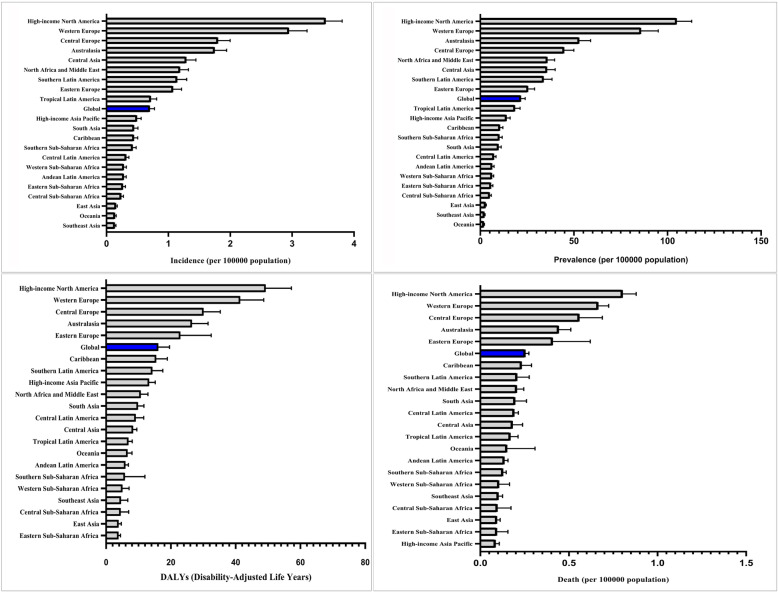
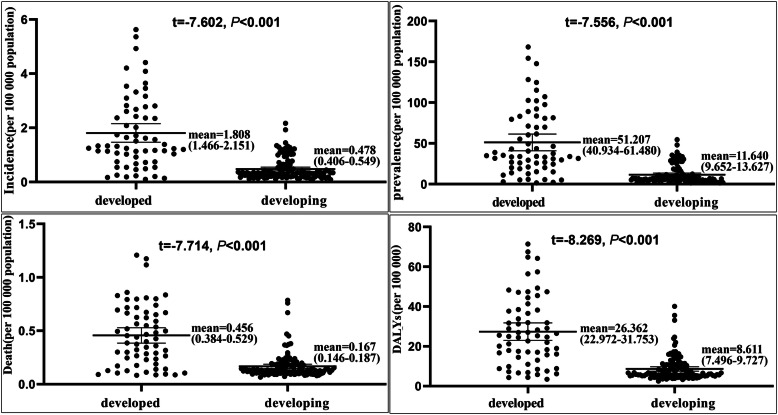
All MS indices were correlated with HDI and PI. It was also found that developed countries had significantly higher prevalence and incidence rates of MS than developing countries. Education and governance from the PI, and gross national income and expected years of schooling from the HDI were more associated with MS. Education was significantly related to MS indices (p < 0.01) in both developed and developing countries.
In general, the difference in income and the socioeconomic development globally have created a landscape for MS that should be studied in more detail in future studies.
社会经济因素可能间接地或作为混杂因素影响多发性硬化症(MS)的风险。在这项研究中,使用了两个反映社会经济差异的综合指标,包括人类发展指数(HDI)和繁荣指数(PI),以评估这些因素对全球 MS 分布的影响。
这项全球生态研究的数据来自三个综合数据库,包括全球疾病负担(作为 MS 指标的来源)、联合国开发计划署(HDI 的来源)和列格坦研究所 PI 数据库。MS 指标(包括患病率、发病率、死亡率和伤残调整生命年)均以年龄和性别标准化的形式进行分析。使用相关和回归分析来研究 HDI 和 PI 及其与 MS 指标的子集之间的关系。
所有 MS 指标均与 HDI 和 PI 相关。还发现发达国家的 MS 患病率和发病率明显高于发展中国家。PI 中的教育和治理以及 HDI 中的国民总收入和预期受教育年限与 MS 更为相关。教育与发达国家和发展中国家的 MS 指标显著相关(p<0.01)。
总体而言,全球收入差异和社会经济发展状况为 MS 创造了一个需要在未来研究中更详细研究的局面。