Aging Research Center, Korea Research Institute of Bioscience and Biotechnology (KRIBB), Daejeon 34141, Korea.
Department of Biomolecular Science, KRIBB School of Bioscience, Korea University of Science and Technology, Daejeon 34113, Korea.
Mol Cells. 2021 Mar 31;44(3):136-145. doi: 10.14348/molcells.2021.2239.
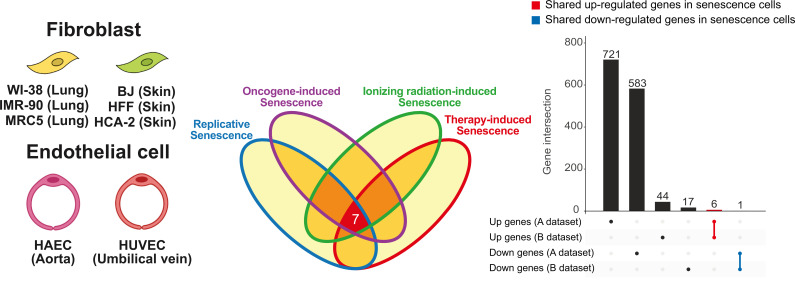
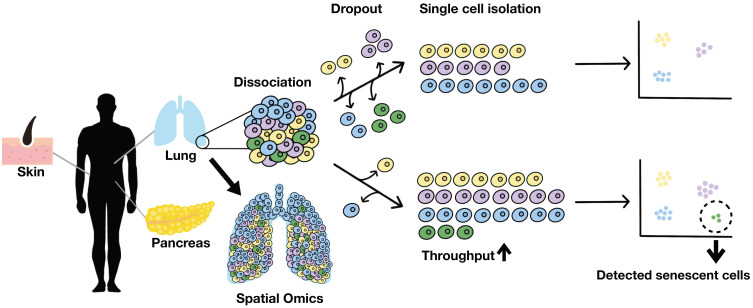
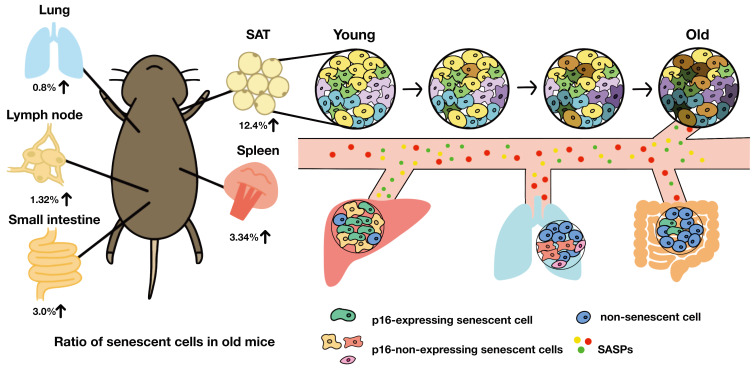
Senescent cells that gradually accumulate during aging are one of the leading causes of aging. While senolytics can improve aging in humans as well as mice by specifically eliminating senescent cells, the effect of the senolytics varies in different cell types, suggesting variations in senescence. Various factors can induce cellular senescence, and the rate of accumulation of senescent cells differ depending on the organ. In addition, since the heterogeneity is due to the spatiotemporal context of senescent cells, studies are needed to increase the understanding of senescent cells. Since current methods are often unable to distinguish senescent cells from other cells, efforts are being made to find markers commonly expressed in senescent cells using bulk RNA-sequencing. Moreover, single-cell RNA (scRNA) sequencing, which analyzes the transcripts of each cell, has been utilized to understand the characteristics of the rare senescent cells. Recently, transcriptomic cell atlases for each organ using this technology have been published in various species. Novel senescent cells that do not express previously established marker genes have been discovered in some organs. However, there is still insufficient information on senescent cells due to the limited throughput of the scRNA sequencing technology. Therefore, it is necessary to improve the throughput of the scRNA sequencing technology or develop a way to enrich the rare senescent cells. The senescent cell atlas that is established using rapidly developing single-cell technologies will contribute to the precise rejuvenation by specifically removing senescent cells in each tissue and individual.
衰老过程中逐渐积累的衰老细胞是衰老的主要原因之一。虽然衰老细胞清除剂可以通过特异性清除衰老细胞来改善人类和小鼠的衰老,但衰老细胞清除剂在不同细胞类型中的效果不同,这表明衰老存在差异。各种因素都可以诱导细胞衰老,并且衰老细胞的积累速度因器官而异。此外,由于衰老细胞的异质性是由于其时空背景,因此需要研究来增加对衰老细胞的理解。由于目前的方法通常无法将衰老细胞与其他细胞区分开来,因此正在努力使用批量 RNA 测序找到衰老细胞中常见表达的标记物。此外,单细胞 RNA(scRNA)测序分析每个细胞的转录本,已被用于了解罕见衰老细胞的特征。最近,使用该技术在各种物种中发布了每个器官的转录组细胞图谱。在一些器官中发现了不表达先前建立的标记基因的新型衰老细胞。然而,由于 scRNA 测序技术的通量有限,关于衰老细胞的信息仍然不足。因此,有必要提高 scRNA 测序技术的通量或开发一种富集稀有衰老细胞的方法。使用快速发展的单细胞技术建立的衰老细胞图谱将有助于通过特异性清除每个组织和个体中的衰老细胞来实现精确的年轻化。