Social Determinants of Health Research Center, Lorestan University of Medical Sciences, Khorramabad, Iran.
Health Management and Economics Research Center, Iran University of Medical Sciences, Tehran, Iran.
Yale J Biol Med. 2021 Mar 31;94(1):13-21. eCollection 2021 Mar.
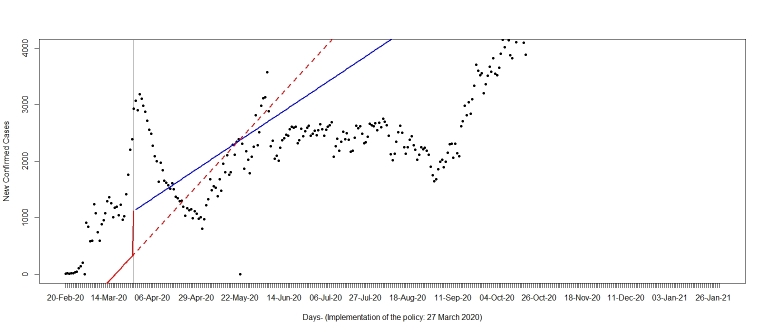
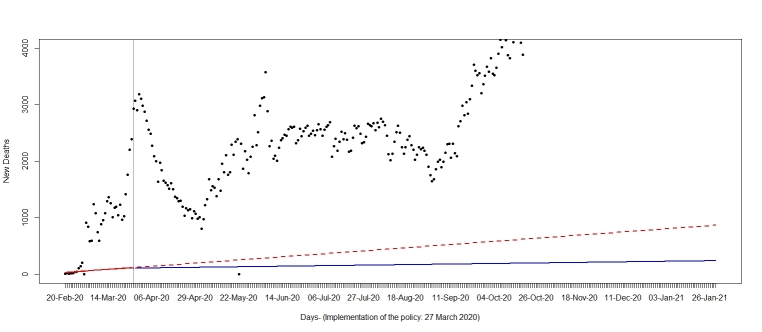
: In December 2019, a viral outbreak occurred in China, and rapidly spread out worldwide. Due to the lack of immediately available vaccines and effective drugs, many policy- and decision-makers have focused on non-pharmacological methods, including social distancing. This study was aimed at assessing the effects of the implementation of this policy in Iran, one of the countries most affected by COVID-19. We conducted a quasi-experimental study, utilizing the interrupted time series analysis (ITSA) approach. : We collected daily data between February 20, 2020 and January 29, 2021, through governmental websites from 954 public hospitals and healthcare settings. The Iranian government launched the social distancing policy on March 27, 2020. Statistical analyses, including ITSA, were carried out with R software Version 3.6.1 (London, UK). : During the study period, 1,398,835 confirmed incidence cases and 57,734 deaths occurred. We found a decrease of -179.93 (95% CI: -380.11 to -20.25, P-value=0.078) confirmed incidence cases following the implementation of the social distancing policy, corresponding to a daily decrease in the trend of -31.17 (95% CI: -46.95 to -15.40, P-value=0.08). Moreover, we found a decrease of -28.28 (95% CI: -43.55 to -13.01, P-value=0.05) deaths, corresponding to a daily decrease in the trend of -4.52 (95% CI: -5.25 to -3.78, P-value=0.003). : The growth rate of confirmed incidence cases and deaths from COVID-19 in Iran has decreased from March 27, 2020 to January 29, 2021, after the implementation of social distancing. By implementing this policy in all countries, the burden of COVID-19 may be mitigated.
2019 年 12 月,中国发生了病毒性爆发,并迅速在全球范围内蔓延。由于缺乏现成的疫苗和有效的药物,许多政策制定者和决策者都关注非药物方法,包括社会隔离。本研究旨在评估这一政策在伊朗实施的效果,伊朗是受 COVID-19 影响最严重的国家之一。我们进行了一项准实验研究,采用了中断时间序列分析(ITSA)方法。我们收集了 2020 年 2 月 20 日至 2021 年 1 月 29 日期间通过政府网站从 954 家公立医院和医疗机构获得的每日数据。伊朗政府于 2020 年 3 月 27 日推出了社会隔离政策。统计分析,包括 ITSA,使用 R 软件版本 3.6.1(英国伦敦)进行。在研究期间,共发生了 1398835 例确诊病例和 57734 例死亡。我们发现,实施社会隔离政策后,确诊病例减少了-179.93(95%置信区间:-380.11 至-20.25,P 值=0.078),对应于趋势每日减少-31.17(95%置信区间:-46.95 至-15.40,P 值=0.08)。此外,我们发现死亡人数减少了-28.28(95%置信区间:-43.55 至-13.01,P 值=0.05),对应于趋势每日减少-4.52(95%置信区间:-5.25 至-3.78,P 值=0.003)。伊朗 COVID-19 确诊病例和死亡人数的增长率自 2020 年 3 月 27 日实施社会隔离以来,从 2020 年 3 月 27 日至 2021 年 1 月 29 日有所下降。在所有国家实施这一政策,可以减轻 COVID-19 的负担。