Govaerts Jeroen, Boeyckens Julie, Lammens Astrid, Gilis Annelies, Bouckaert Filip, De Hert Marc, De Lepeleire Jan, Stubbs Brendon, Desplenter Franciska
University Psychiatric Center Katholieke Universiteit (KU) Leuven, Leuvensesteenweg 517, Kortenberg, 3070, Belgium.
Department of Pharmaceutical and Pharmacological Sciences, Clinical Pharmacology and Pharmacotherapy, KU Leuven, Leuven, Belgium.
Ther Adv Psychopharmacol. 2021 Mar 19;11:20451253211000610. doi: 10.1177/20451253211000610. eCollection 2021.
This cross-sectional pharmacoepidemiologic study examined the prevalence of polypharmacy and psychotropic polypharmacy among inpatients in a tertiary psychiatric hospital in Belgium.
Current prescriptions of all inpatients suffering from mental disorders were extracted from the hospital Computerized Physician Order Entry. Two methods were used to examine definitive polypharmacy (defined as the concomitant use of at least five medicines): number of medicines per active component and per prescription. Psychotropic polypharmacy was defined as the concomitant use of at least two psychotropic medicines, based on the first counting, i.e., per active component.
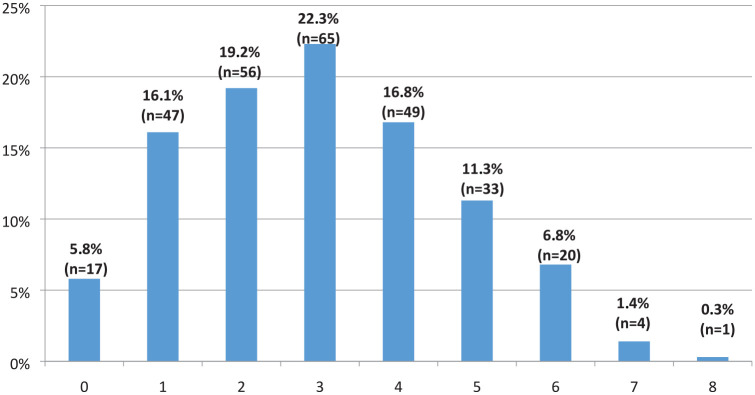
In 292 included patients, the prevalence of definitive polypharmacy was 65.8%, with a mean number of 6.8 ± 4.2 medicines per patient. The most prevalent medicines were related to the central nervous system (55.7%), followed by medicines related to the gastro-intestinal (17.6%) and cardiovascular (9.4%) systems. A prevalence of psychotropic polypharmacy of 78.1% was observed, with a mean of 3.0 ± 1.7 psychotropic medicines per patient. Psychotropic polypharmacy was classified in same-class (71.5%), multi-class (82.5%), augmentation (20.6%), and adjuvant (35.5%) polypharmacy.
These findings are consistent with previous reports of highly prevalent polypharmacy in patients with mental disorders. Although, in some cases, polypharmacy can be an important part of good clinical practice, the high prevalence of both polypharmacy and psychotropic polypharmacy emphasizes that attention must be paid to the potentially associated risks. Consensus on the definition and method of determination of polypharmacy is needed to support further research.
这项横断面药物流行病学研究调查了比利时一家三级精神病医院住院患者中多重用药和精神药物多重用药的患病率。
从医院的计算机化医师医嘱录入系统中提取所有精神障碍住院患者的当前处方。采用两种方法来检查明确的多重用药情况(定义为同时使用至少五种药物):按活性成分和按处方计算的药物数量。精神药物多重用药定义为基于首次计数(即按活性成分)同时使用至少两种精神药物。
在纳入的292名患者中,明确的多重用药患病率为65.8%,每位患者平均用药数量为6.8±4.2种。最常见的药物与中枢神经系统有关(55.7%),其次是与胃肠道(17.6%)和心血管系统(9.4%)有关的药物。观察到精神药物多重用药的患病率为78.1%,每位患者平均使用3.0±1.7种精神药物。精神药物多重用药分为同类(71.5%)、多类(82.5%)、增效(20.6%)和辅助(35.5%)多重用药。
这些发现与先前关于精神障碍患者中多重用药高度流行的报告一致。尽管在某些情况下,多重用药可能是良好临床实践的重要组成部分,但多重用药和精神药物多重用药的高患病率强调必须关注潜在的相关风险。需要就多重用药的定义和确定方法达成共识,以支持进一步的研究。