Zhang Haiyan, Xie Yongfei, Hu Zhi, Yu Hong, Xie Xiang, Ye Yingchun, Xu Wenfeng, Nian Siji, Yuan Qing
Public Experimental Technology Center, The School of Basic Medical Science, Southwest Medical University, Luzhou, China.
Life Sciences School, Anhui Agricultural University, Hefei, China.
Front Oncol. 2021 Mar 16;11:608113. doi: 10.3389/fonc.2021.608113. eCollection 2021.
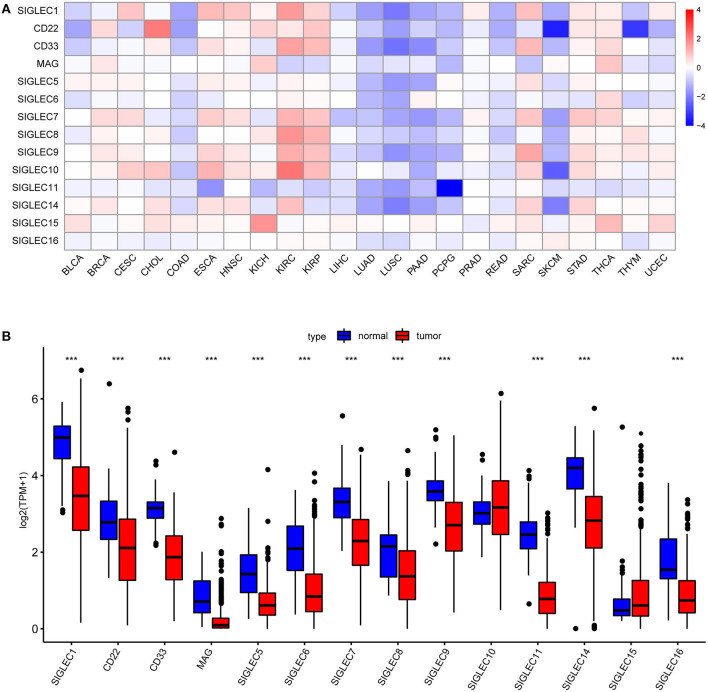
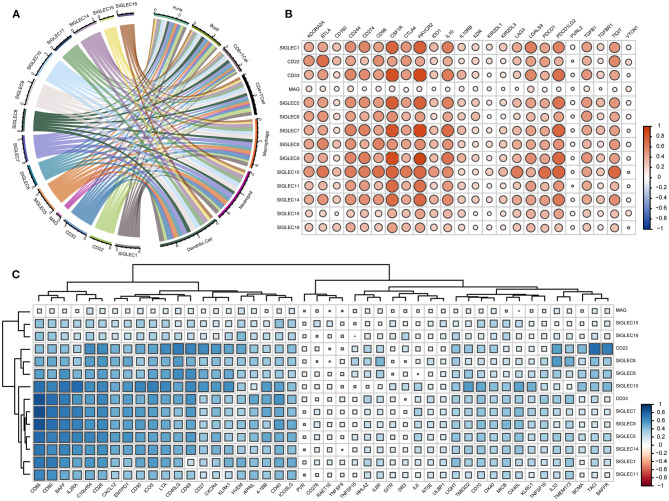
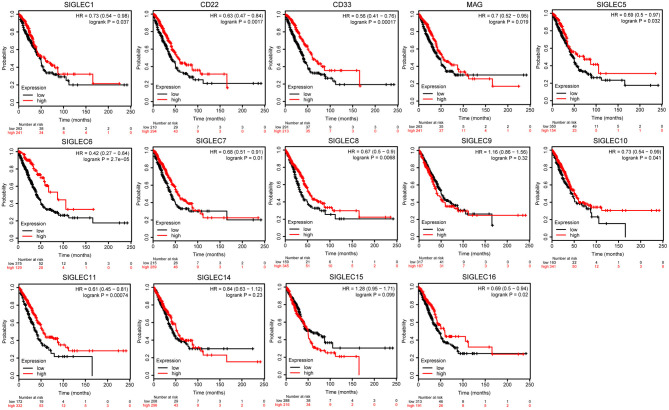
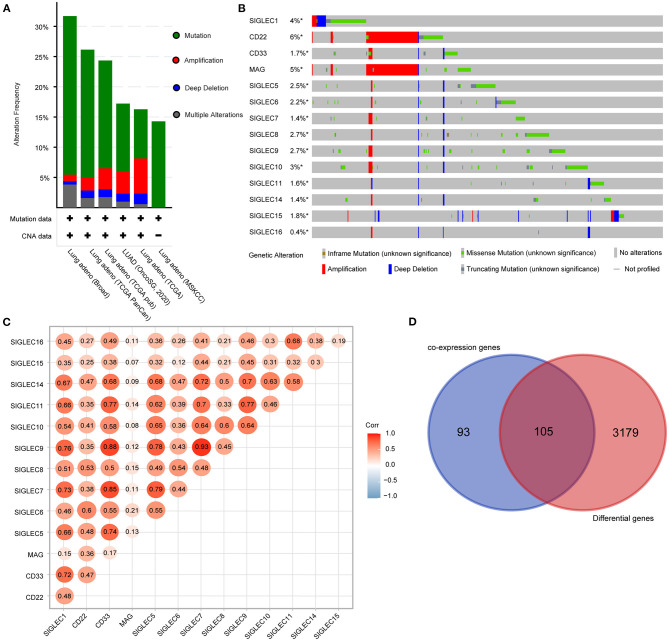
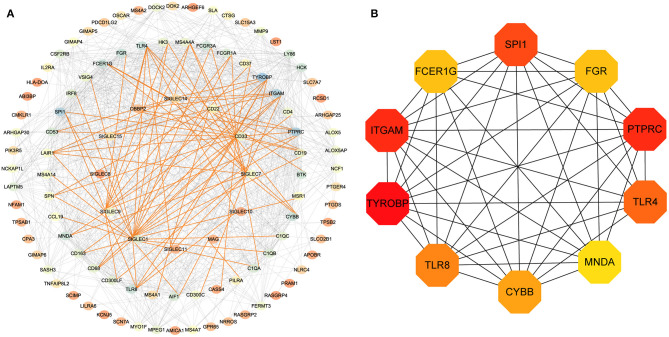
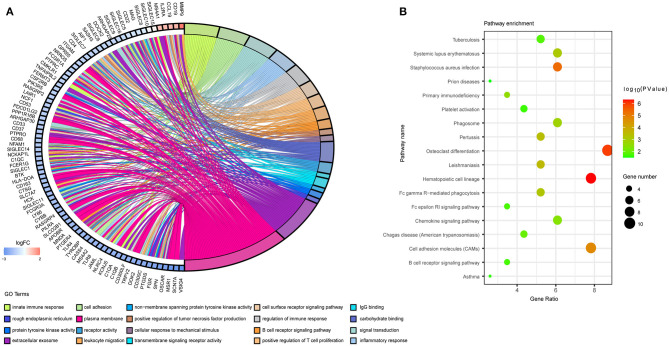
Sialic acid-binding immunoglobulin-type lectin (SIGLEC) family members are involved in regulating immune-cell activation, proliferation, and apoptosis, and they play an important role in tumor development. However, their expression and correlation with immune molecules in lung adenocarcinoma (LUAD) remain unclear. We utilized Gene Expression Profiling Interactive Analysis, Kaplan-Meier analysis, the limma package in R/Bioconductor, the University of California Santa Cruz Cancer Genome Browser, cBioPortal, STRING, Cytoscape, DAVID, and the Tumor Immune Estimation Resource for gene and protein profiling and analyses. The results showed that SIGLEC10 and SIGLEC15 levels were upregulated in LUAD, whereas SIGLEC1, CD22 (SIGLEC2), CD33, myelin-associated glycoprotein (SIGLEC4), SIGLEC5, SIGLEC6, SIGLEC7, SIGLEC8, SIGLEC11, and SIGLEC14 levels were significantly downregulated, with their low expression associated with poor overall survival. Moreover, we observed high SIGLEC-mutation rates (22%) in LUAD patients, with SIGLEC functions determined as primarily involved in regulating the immune response, signal transduction, inflammatory response, and cell adhesion. Furthermore, we found that SIGLEC expression was significantly correlated with immune-cell infiltration, especially macrophages, neutrophils, and dendritic cells, and highly associated with immune molecules such as CD80, CD86, CD28, B-cell-activating factor, programmed cell death 1 ligand 2, and colony stimulating factor 1 receptor. These results provide insight into the potential molecular mechanism associated with SIGLEC-related development of LUAD, as well as clues for screening biomarkers and therapeutic targets.
唾液酸结合免疫球蛋白样凝集素(SIGLEC)家族成员参与调节免疫细胞的激活、增殖和凋亡,在肿瘤发展中发挥重要作用。然而,它们在肺腺癌(LUAD)中的表达及其与免疫分子的相关性仍不清楚。我们利用基因表达谱交互分析、Kaplan-Meier分析、R/Bioconductor中的limma软件包、加利福尼亚大学圣克鲁兹分校癌症基因组浏览器、cBioPortal、STRING、Cytoscape、DAVID以及肿瘤免疫估计资源进行基因和蛋白质谱分析。结果显示,LUAD中SIGLEC10和SIGLEC15水平上调,而SIGLEC1、CD22(SIGLEC2)、CD33、髓鞘相关糖蛋白(SIGLEC4)、SIGLEC5、SIGLEC6、SIGLEC7、SIGLEC8、SIGLEC11和SIGLEC14水平显著下调,其低表达与总体生存率差相关。此外,我们观察到LUAD患者中SIGLEC的突变率较高(22%),SIGLEC的功能主要涉及调节免疫反应、信号转导、炎症反应和细胞黏附。此外,我们发现SIGLEC表达与免疫细胞浸润显著相关,尤其是巨噬细胞、中性粒细胞和树突状细胞,并且与CD80、CD86、CD28、B细胞激活因子、程序性细胞死亡1配体2和集落刺激因子1受体等免疫分子高度相关。这些结果为LUAD中与SIGLEC相关的发展潜在分子机制提供了见解,也为筛选生物标志物和治疗靶点提供了线索。