RWTH Aachen University, Institute for Biology I, Unit of Plant Molecular Cell Biology, Aachen, Germany.
Ludwig-Maximilians-University (LMU), LMU University Hospital, Chair of Vascular Biology, Institute for Stroke and Dementia Research (ISD), Munich, Germany.
J Biol Chem. 2021 Jan-Jun;296:100611. doi: 10.1016/j.jbc.2021.100611. Epub 2021 Mar 30.
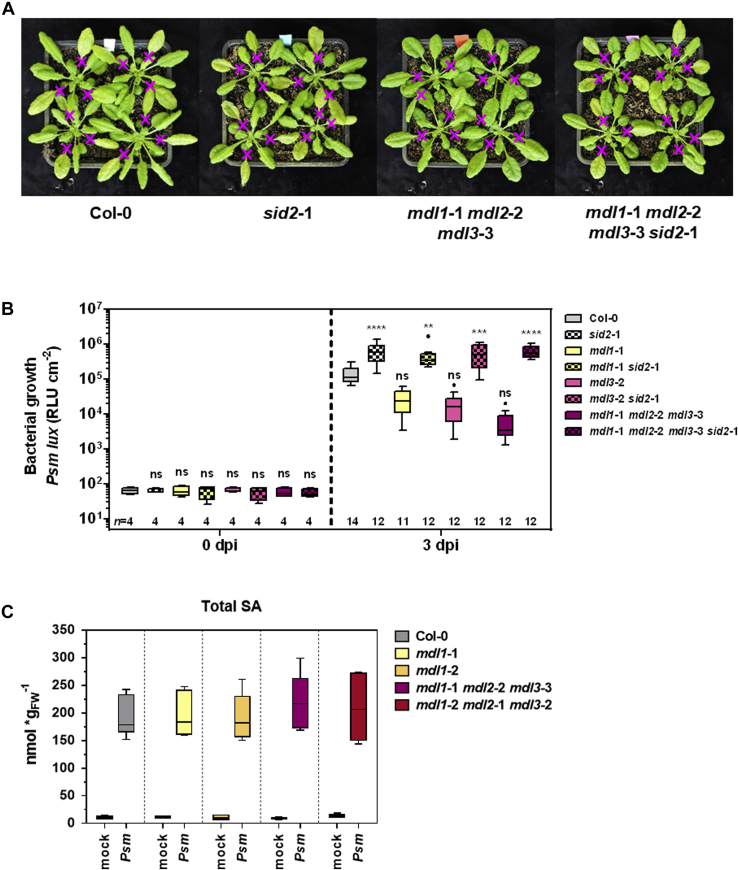
Human macrophage migration inhibitory factor (MIF) is an atypical chemokine implicated in intercellular signaling and innate immunity. MIF orthologs (MIF/D-DT-like proteins, MDLs) are present throughout the plant kingdom, but remain experimentally unexplored in these organisms. Here, we provide an in planta characterization and functional analysis of the three-member gene/protein MDL family in Arabidopsis thaliana. Subcellular localization experiments indicated a nucleo-cytoplasmic distribution of MDL1 and MDL2, while MDL3 is localized to peroxisomes. Protein-protein interaction assays revealed the in vivo formation of MDL1, MDL2, and MDL3 homo-oligomers, as well as the formation of MDL1-MDL2 hetero-oligomers. Functionally, Arabidopsismdl mutants exhibited a delayed transition from vegetative to reproductive growth (flowering) under long-day conditions, but not in a short-day environment. In addition, mdl mutants were more resistant to colonization by the bacterial pathogen Pseudomonas syringae pv. maculicola. The latter phenotype was compromised by the additional mutation of SALICYLIC ACID INDUCTION DEFICIENT 2 (SID2), a gene implicated in the defense-induced biosynthesis of the key signaling molecule salicylic acid. However, the enhanced antibacterial immunity was not associated with any constitutive or pathogen-induced alterations in the levels of characteristic phytohormones or defense-associated metabolites. Interestingly, bacterial infection triggered relocalization and accumulation of MDL1 and MDL2 at the peripheral lobes of leaf epidermal cells. Collectively, our data indicate redundant functionality and a complex interplay between the three chemokine-like Arabidopsis MDL proteins in the regulation of both developmental and immune-related processes. These insights expand the comparative cross-kingdom analysis of MIF/MDL signaling in human and plant systems.
人巨噬细胞移动抑制因子(MIF)是一种参与细胞间信号转导和固有免疫的非典型趋化因子。MIF 同源物(MIF/D-DT 样蛋白,MDLs)存在于整个植物界,但在这些生物中仍未得到实验探索。在这里,我们对拟南芥中三成员基因/蛋白 MDL 家族进行了体内特征描述和功能分析。亚细胞定位实验表明 MDL1 和 MDL2 具有核质分布,而 MDL3 定位于过氧化物酶体。蛋白-蛋白相互作用试验表明,MDL1、MDL2 和 MDL3 同源寡聚体以及 MDL1-MDL2 异源寡聚体在体内形成。功能上,拟南芥 mdl 突变体在长日照条件下从营养生长向生殖生长(开花)的转变延迟,但在短日照环境中则没有。此外,mdl 突变体对细菌病原体丁香假单胞菌 pv. maculicola 的定殖更具抗性。后一种表型因水杨酸诱导缺陷 2(SID2)基因的额外突变而受损,该基因参与防御诱导的关键信号分子水杨酸的生物合成。然而,增强的抗菌免疫与特征性植物激素或防御相关代谢物的任何组成型或病原体诱导的变化无关。有趣的是,细菌感染触发了 MDL1 和 MDL2 在叶片表皮细胞外周叶的重新定位和积累。总的来说,我们的数据表明,三个拟南芥 MDL 类趋化因子蛋白在调节发育和免疫相关过程中具有冗余功能和复杂的相互作用。这些发现扩展了人类和植物系统中 MIF/MDL 信号的比较跨物种分析。