Gualandi Isacco, Tessarolo Marta, Mariani Federica, Possanzini Luca, Scavetta Erika, Fraboni Beatrice
Dipartimento di Chimica Industriale 'Toso Montanari', Università di Bologna, Viale Risorgimento 4, 40136 Bologna, Italy.
Dipartimento di Fisica e Astronomia, Università di Bologna, Viale Berti Pichat 6/2, 40127 Bologna, Italy.
Polymers (Basel). 2021 Mar 14;13(6):894. doi: 10.3390/polym13060894.
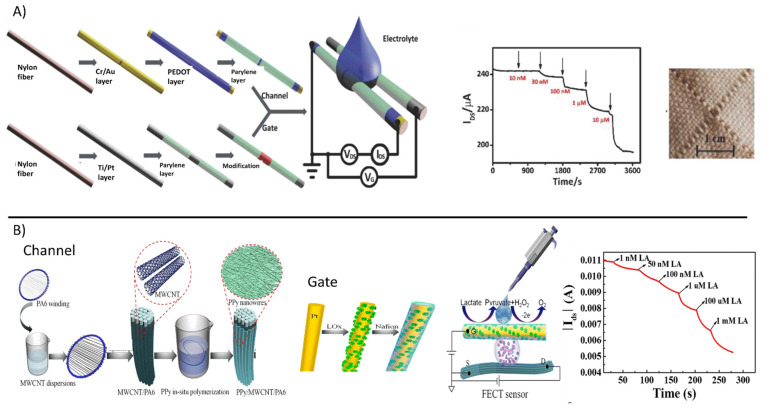
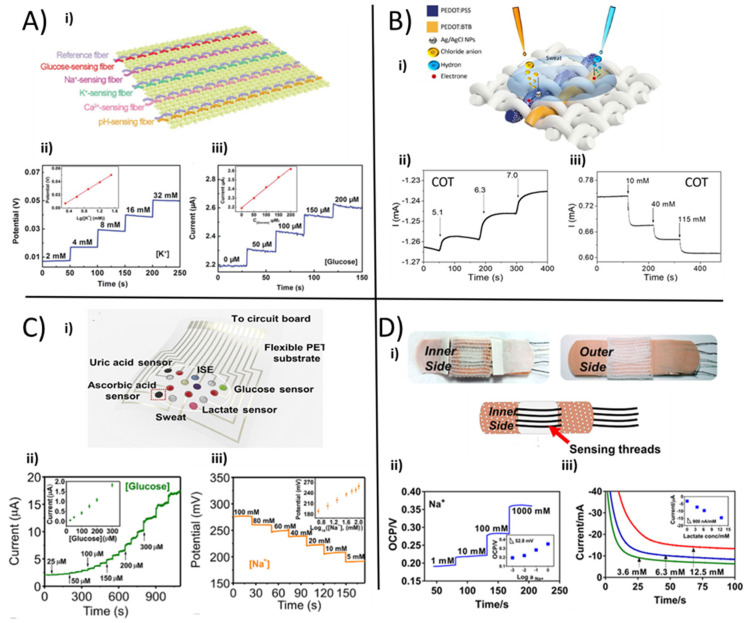
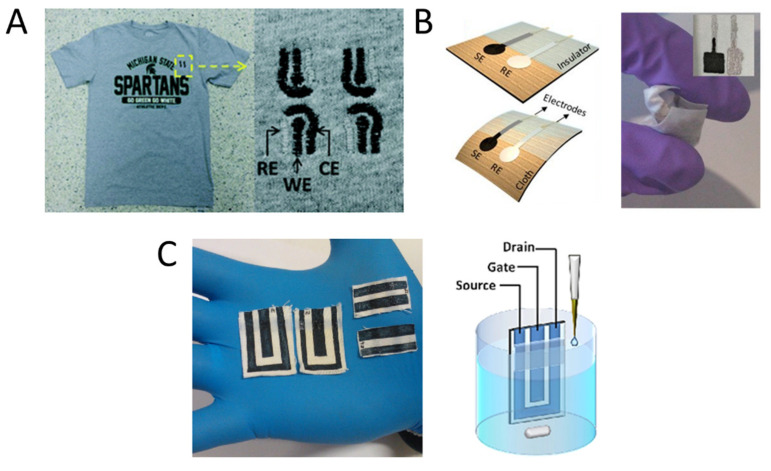
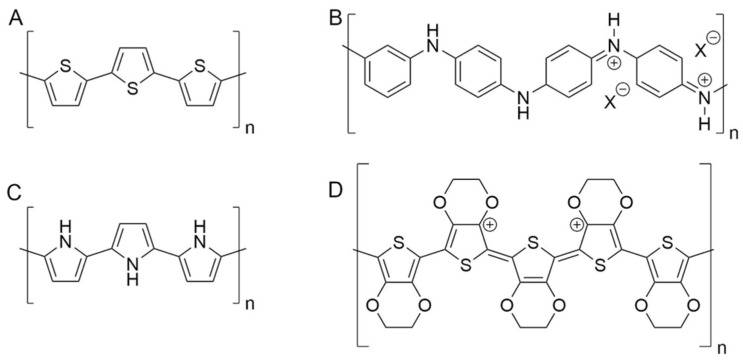
Wearable textile chemical sensors are promising devices due to the potential applications in medicine, sports activities and occupational safety and health. Reaching the maturity required for commercialization is a technology challenge that mainly involves material science because these sensors should be adapted to flexible and light-weight substrates to preserve the comfort of the wearer. Conductive polymers (CPs) are a fascinating solution to meet this demand, as they exhibit the mechanical properties of polymers, with an electrical conductivity typical of semiconductors. Moreover, their biocompatibility makes them promising candidates for effectively interfacing the human body. In particular, sweat analysis is very attractive to wearable technologies as perspiration is a naturally occurring process and sweat can be sampled non-invasively and continuously over time. This review discusses the role of CPs in the development of textile electrochemical sensors specifically designed for real-time sweat monitoring and the main challenges related to this topic.
可穿戴纺织化学传感器因其在医学、体育活动以及职业安全与健康方面的潜在应用而成为很有前景的设备。实现商业化所需的成熟度是一项技术挑战,这主要涉及材料科学,因为这些传感器应适配于柔性且轻质的基材,以保持佩戴者的舒适度。导电聚合物(CPs)是满足这一需求的极具吸引力的解决方案,因为它们兼具聚合物的机械性能以及典型半导体的导电性。此外,它们的生物相容性使其成为有效连接人体的有前景的候选材料。特别是,汗液分析对可穿戴技术非常有吸引力,因为排汗是一个自然发生的过程,并且可以随着时间的推移以非侵入性且连续的方式采集汗液样本。本综述讨论了导电聚合物在专门用于实时汗液监测的纺织电化学传感器开发中的作用以及与该主题相关的主要挑战。