Department of Sports Science and Physical Education, The Chinese University of Hong Kong (CUHK), Hong Kong, China.
CUHK Jockey Club Institute of Ageing, The Chinese University of Hong Kong, Hong Kong, China.
Int J Environ Res Public Health. 2021 Mar 8;18(5):2710. doi: 10.3390/ijerph18052710.
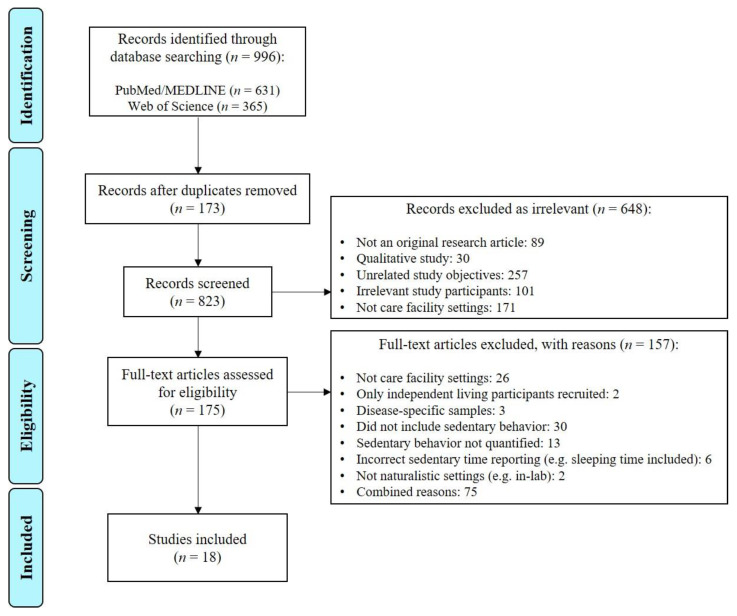
Understanding the sedentary patterns can guide the design of strategies to engage older adults in physical activity. This scoping review aimed to synthesize available evidence on sedentary behaviors in care facilities. We searched PubMed/MEDLINE and Web of Science for studies published from inception through October 2020. Eighteen studies were included and reviewed according to the Preferred Reporting Items for Systematic reviews and Meta-Analyses (PRISMA) guidelines. Data obtained were analyzed based on levels of care provided. Overall, daily sedentary time was higher among residents in high level care facilities (e.g., nursing homes) (11.6 h/day) than intermediate/mixed level care facilities (e.g., assisted living) (9.5 h/day). In intermediate/mixed level care facilities, television (TV) viewing was the most common sedentary activity (2.5-2.9 h/day; 26% of daily sedentary time), while napping was the most favorite sedentary activity (4.7 h/day; 36% of waking hours) in high level care facilities. Sex differences in daily patterns of sedentary behavior (sedentary time, uninterrupted bouts, and bout durations) were commonly observed in intermediate/mixed level care facilities, as exemplified by men being more sedentary by 0.7-1.1 h/day. In summary, this study highlights distinctive sedentary patterns among older adults residing in different levels of care facilities, addressing a pressing need for customized interventions to engage care facility residents in physical activity.
了解久坐行为模式可以指导设计策略,使老年人积极参与体育活动。本范围综述旨在综合现有关于护理设施中久坐行为的证据。我们在 PubMed/MEDLINE 和 Web of Science 上搜索了从开始到 2020 年 10 月发表的研究。根据系统评价和荟萃分析的首选报告项目(PRISMA)指南,对 18 项研究进行了纳入和审查。根据提供的护理水平对获得的数据进行了分析。总体而言,高水平护理设施(如养老院)的居民久坐时间(每天 11.6 小时)高于中/混合水平护理设施(如辅助生活)(每天 9.5 小时)。在中/混合水平护理设施中,看电视(TV)是最常见的久坐活动(每天 2.5-2.9 小时;占每天久坐时间的 26%),而在高水平护理设施中,午睡是最受欢迎的久坐活动(每天 4.7 小时;占清醒时间的 36%)。在中/混合水平护理设施中,常见到老年人日常久坐行为(久坐时间、不中断的时间段和时间段持续时间)存在性别差异,例如男性每天久坐时间比女性多 0.7-1.1 小时。总之,这项研究强调了不同护理水平的老年人中独特的久坐模式,这迫切需要针对特定人群的干预措施,鼓励护理设施居民积极参与体育活动。