Graduate Institute of Bioelectronics and Bioinformatics, National Taiwan University, Taipei 106, Taiwan.
Department of Medical Biotechnology and Laboratory Sciences, College of Medicine, Chang Gung University, Taoyuan 333, Taiwan.
Biosensors (Basel). 2021 Mar 6;11(3):75. doi: 10.3390/bios11030075.
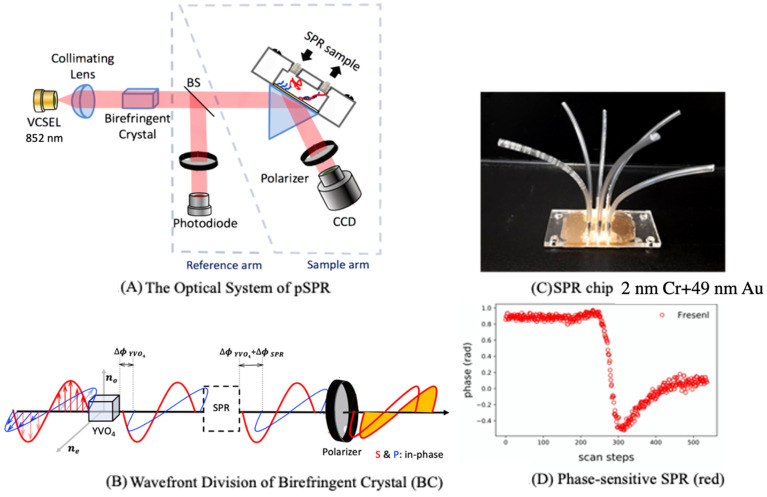
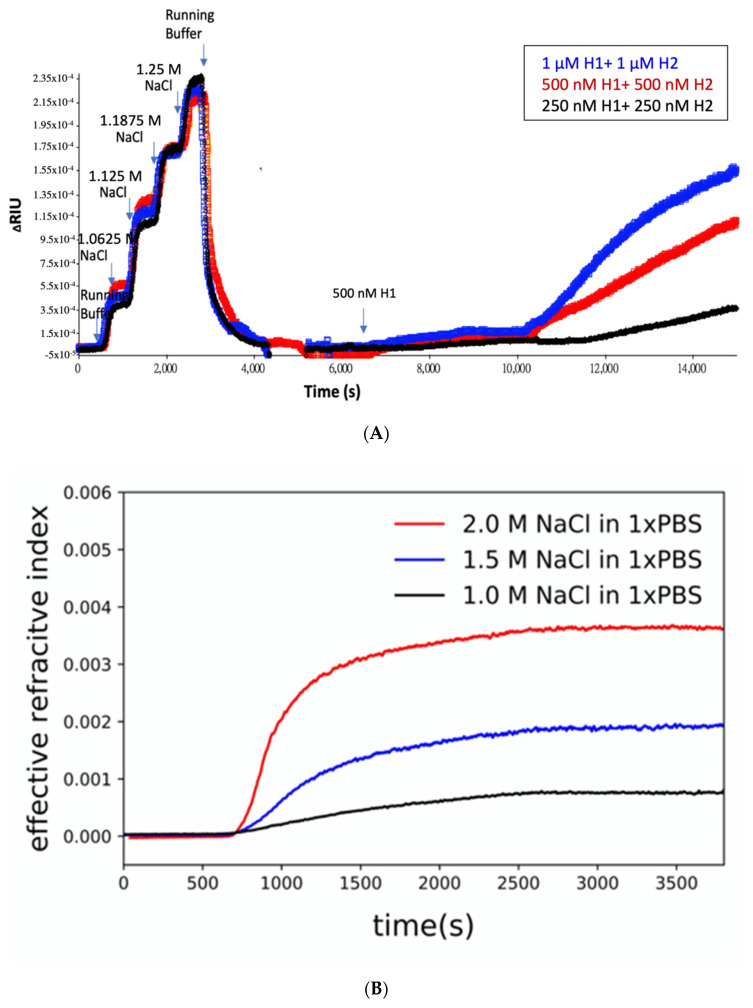
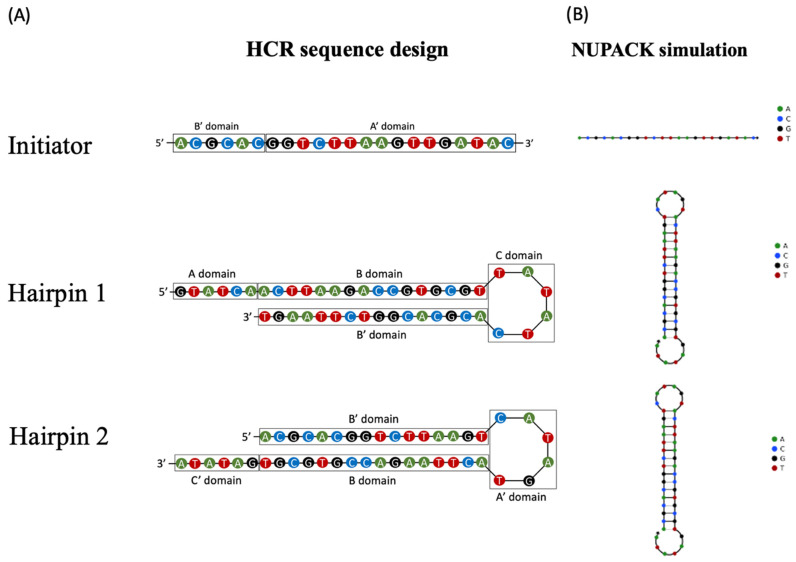
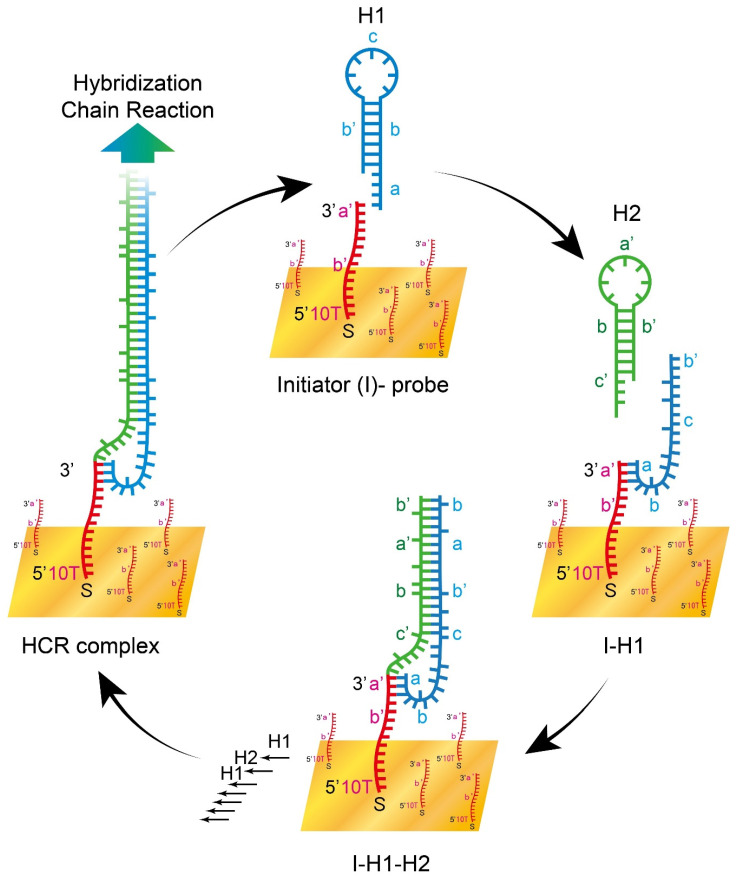
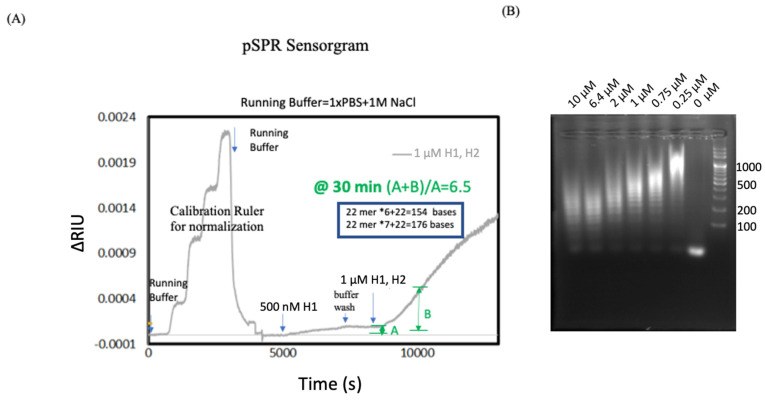
Surface Plasmon Resonance (SPR) is widely used in biological and chemical sensing with fascinating properties. However, the application of SPR to detect trace targets is hampered by non-specific binding and poor signal. A variety of approaches for amplification have been explored to overcome this deficiency including DNA aptamers as versatile target detection tools. Hybridization chain reaction (HCR) is a high-efficiency enzyme-free DNA amplification method operated at room temperature, in which two stable species of DNA hairpins coexist in solution until the introduction of the initiator strand triggers a cascade of hybridization events. At an optimal salt condition, as the concentrations of H1 and H2 increased, the HCR signals were enhanced, leading to signal amplification reaching up to 6.5-fold of the detection measure at 30 min. This feature enables DNA to act as an amplifying transducer for biosensing applications to provide an enzyme-free alternative that can easily detect complex DNA sequences. Improvement of more diverse recognition events can be achieved by integrating HCR with a phase-sensitive SPR (pSPR)-tested aptamer stimulus. This work seeks to establish pSPR aptamer system for highly informative sensing by means of an amplification HCR. Thus, combining pSPR and HCR technologies provide an expandable platform for sensitive biosensing.
表面等离子体共振(SPR)具有迷人的特性,被广泛应用于生物和化学传感。然而,SPR 应用于痕量目标检测受到非特异性结合和信号差的限制。为了克服这一缺陷,已经探索了各种放大方法,包括 DNA 适体作为多功能的目标检测工具。杂交链式反应(HCR)是一种在室温下进行的高效无酶 DNA 扩增方法,其中两种稳定的 DNA 发夹在溶液中共存,直到引入引发链触发级联杂交事件。在最佳盐条件下,随着 H1 和 H2 浓度的增加,HCR 信号增强,导致信号放大达到 30 分钟时检测测量值的 6.5 倍。这一特性使 DNA 能够作为生物传感应用的放大换能器,提供一种无酶的替代方案,能够轻松检测复杂的 DNA 序列。通过将 HCR 与相位敏感 SPR(pSPR)-测试适体刺激相结合,可以实现更多样化识别事件的改进。本工作旨在通过放大 HCR 建立 pSPR 适体系统,实现高信息量传感。因此,结合 pSPR 和 HCR 技术为敏感的生物传感提供了一个可扩展的平台。