Department of Animal Behaviour, Bielefeld University, Konsequenz 45, 33615 Bielefeld, Germany.
Department of Evolutionary, Ecology, National Museum of Natural Sciences, CSIC. José Gutiérrez Abascal 2, 28006 Madrid, Spain.
Int J Environ Res Public Health. 2021 Mar 2;18(5):2431. doi: 10.3390/ijerph18052431.
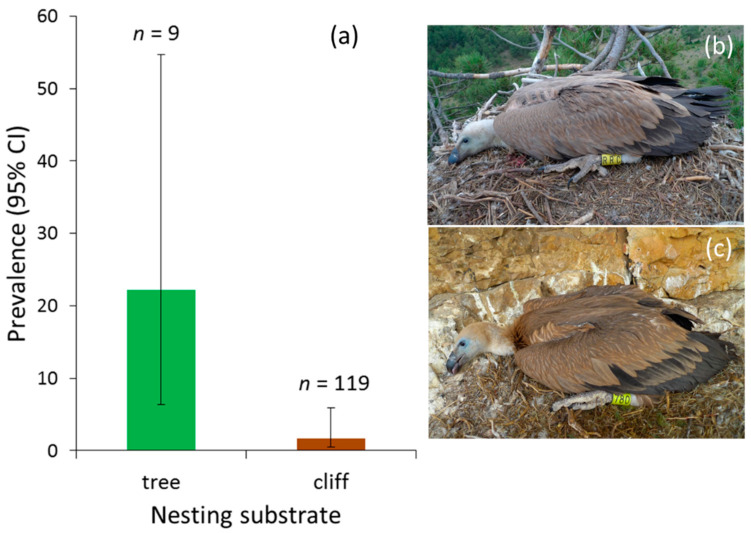
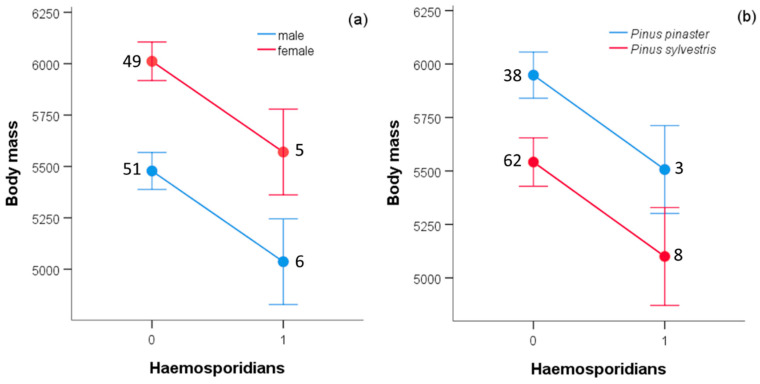
Avian haemosporidians are a common and widespread group of vector-borne parasites capable of infecting most bird species around the world. They can negatively affect host condition and fitness. Vultures are assumed to have a very low prevalence of these blood parasites, likely due to their strong immunity; however, factors contributing to variation in host exposure and susceptibility to haemosporidians are complex, and supporting evidence is still very limited. We analyzed blood samples collected from nestlings of three vulture species in Spain over 18 years, and used updated nested-PCR protocols capable of detecting all haesmosporidian cytochrome b lineages typical for diurnal birds of prey (Accipitriformes). Similarly to previous studies, we found low haemosporidian prevalence in cliff-breeding species, with as the only represented blood parasite genus: 3.1% in griffon vultures () ( = 128) and 5.3% in Egyptian vultures () ( = 114). In contrast, the tree-breeding cinereous vulture () had a substantially higher prevalence: 10.3% ( = 146). By far the most common lineage in Spanish scavenging raptors was the lineage CIAE02. No effects of nestling age and sex, or temporal trends in prevalence were found, but an effect of nest habitat (tree-nest vs. cliff-nest) was found in the griffon vulture. These patterns may be explained by a preference of vectors to forage in and around trees rather than on cliffs and wide open spaces. We found an apparent detrimental effect of haemosporidians on body mass of nestling cinereous vultures. Further research is needed to evaluate the pathogenicity of each haemosporidian lineage and their interaction with the immune system of nestlings, especially if compromised due to pollution with pharmaceuticals and infection by bacterial and mycotic pathogens.
禽血孢子虫是一类常见且广泛分布的寄生虫,能够感染世界上大多数鸟类。它们会对宿主的健康和生存能力产生负面影响。秃鹫被认为携带这些血液寄生虫的比例非常低,这可能是由于它们具有很强的免疫力;然而,导致宿主暴露和易感性变化的因素很复杂,而且支持性证据仍然非常有限。我们分析了在西班牙的三种秃鹫物种的雏鸟身上采集的血液样本,使用了更新的巢式 PCR 方案,该方案能够检测到所有适合白天猛禽(鹰形目)的血孢子虫细胞色素 b 谱系。与之前的研究类似,我们发现在岩栖物种中血液寄生虫的流行率很低,只有作为唯一代表的血液寄生虫属:高山兀鹫中的比例为 3.1%( = 128),埃及秃鹫中的比例为 5.3%( = 114)。相比之下,树栖的白头秃鹫的流行率要高得多:10.3%( = 146)。在西班牙的食腐猛禽中,最常见的谱系是 CIAE02 谱系。我们没有发现雏鸟年龄和性别、流行率的时间趋势有影响,但发现巢栖息地(树巢与岩巢)对高山兀鹫有影响。这些模式可能是由于寄生虫更倾向于在树木内部和周围觅食,而不是在悬崖和开阔地带觅食。我们发现白头秃鹫雏鸟的体重明显受到血孢子虫的负面影响。需要进一步研究来评估每个血孢子虫谱系的致病性及其与雏鸟免疫系统的相互作用,特别是如果由于药物污染和细菌和真菌病原体感染而使免疫系统受损的话。