Laboratory of Vaccinology and Biobanking, International Reference Centre CIRCB), BP 3077 Yaoundé, Cameroon.
Department of Pharmaceutical Microbiology & Biotechnology, Nnamdi Azikiwe University, 420110 Awka, Nigeria.
Viruses. 2021 Mar 27;13(4):568. doi: 10.3390/v13040568.
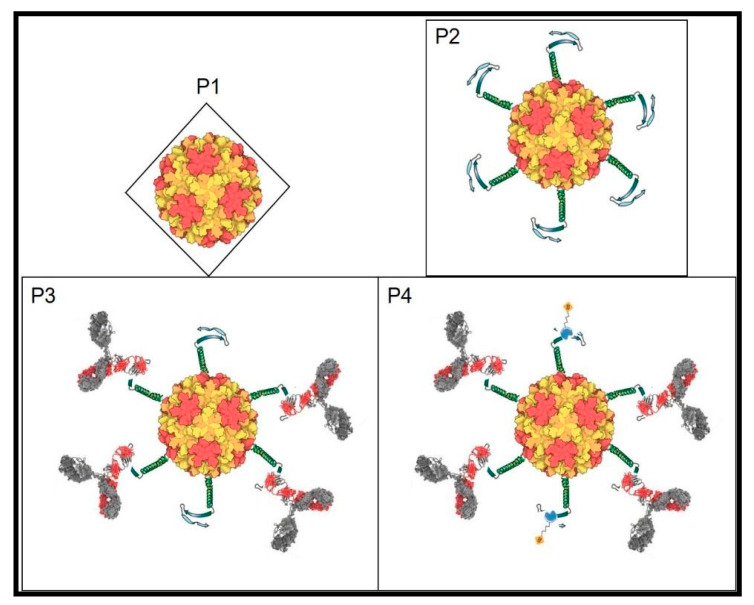
Phage display technology involves the surface genetic engineering of phages to expose desirable proteins or peptides whose gene sequences are packaged within phage genomes, thereby rendering direct linkage between genotype with phenotype feasible. This has resulted in phage display systems becoming invaluable components of directed evolutionary biotechnology. The M13 is a DNA phage display system which dominates this technology and usually involves selected proteins or peptides being displayed through surface engineering of its minor coat proteins. The displayed protein or peptide's functionality is often highly reduced due to harsh treatment of M13 variants. Recently, we developed a novel phage display system using the coliphage Qβ as a nano-biotechnology platform. The coliphage Qβ is an RNA phage belonging to the family of a long investigated virus. Qβ phages exist as a quasispecies and possess features making them comparatively more suitable and unique for directed evolutionary biotechnology. As a quasispecies, Qβ benefits from the promiscuity of its RNA dependent RNA polymerase replicase, which lacks proofreading activity, and thereby permits rapid variant generation, mutation, and adaptation. The minor coat protein of Qβ is the readthrough protein, A. It shares the same initiation codon with the major coat protein and is produced each time the ribosome translates the UGA stop codon of the major coat protein with the of misincorporation of tryptophan. This misincorporation occurs at a low level (1/15). Per convention and definition, A is the target for display technology, as this minor coat protein does not play a role in initiating the life cycle of Qβ phage like the pIII of M13. The maturation protein A of Qβ initiates the life cycle by binding to the pilus of the F host bacteria. The extension of the A protein with a foreign peptide probe recognizes and binds to the target freely, while the A initiates the infection. This avoids any disturbance of the complex and the necessity for acidic elution and neutralization prior to infection. The combined use of both the A and A proteins of Qβ in this display system allows for novel bio-panning, in vitro maturation, and evolution. Additionally, methods for large library size construction have been improved with our directed evolutionary phage display system. This novel phage display technology allows 12 copies of a specific desired peptide to be displayed on the exterior surface of Qβ in uniform distribution at the corners of the phage icosahedron. Through the recently optimized subtractive bio-panning strategy, fusion probes containing up to 80 amino acids altogether with linkers, can be displayed for target selection. Thus, combined uniqueness of its genome, structure, and proteins make the Qβ phage a desirable suitable innovation applicable in affinity maturation and directed evolutionary biotechnology. The evolutionary adaptability of the Qβ phage display strategy is still in its infancy. However, it has the potential to evolve functional domains of the desirable proteins, glycoproteins, and lipoproteins, rendering them superior to their natural counterparts.

噬菌体展示技术涉及噬菌体表面的遗传工程,以暴露理想的蛋白质或肽,其基因序列被包装在噬菌体基因组中,从而使基因型与表型之间的直接联系成为可能。这导致噬菌体展示系统成为定向进化生物技术中不可或缺的组成部分。M13 是一种 DNA 噬菌体展示系统,它主导着这项技术,通常涉及通过其次要衣壳蛋白的表面工程来展示选定的蛋白质或肽。由于对 M13 变体的苛刻处理,展示的蛋白质或肽的功能通常大大降低。最近,我们开发了一种使用大肠杆菌噬菌体 Qβ作为纳米生物技术平台的新型噬菌体展示系统。大肠杆菌噬菌体 Qβ是一种属于长期研究的病毒家族的 RNA 噬菌体。Qβ 噬菌体作为准种存在,具有使其更适合和独特于定向进化生物技术的特征。作为一种准种,Qβ 受益于其 RNA 依赖性 RNA 聚合酶复制酶的混杂性,该酶缺乏校对活性,从而允许快速产生变体、突变和适应。Qβ 的次要衣壳蛋白是通读蛋白 A。它与主要衣壳蛋白具有相同的起始密码子,并且每次核糖体翻译主要衣壳蛋白的 UGA 终止密码子时,都会产生错误掺入色氨酸的 A。这种错误掺入发生在低水平(1/15)。根据惯例和定义,A 是显示技术的目标,因为这种次要衣壳蛋白不像 M13 的 pIII 那样在 Qβ 噬菌体的生命周期中发挥作用。Qβ 的成熟蛋白 A 通过与 F 宿主细菌的菌毛结合来启动生命周期。带有外源肽探针的 A 蛋白的延伸识别并自由结合靶标,而 A 则启动感染。这避免了任何对复杂结构的干扰,并且不需要在感染前进行酸性洗脱和中和。在这种展示系统中,同时使用 Qβ 的 A 和 A 蛋白允许进行新型生物淘选、体外成熟和进化。此外,我们的定向进化噬菌体展示系统还改进了构建大型文库的方法。这种新型噬菌体展示技术允许在 Qβ 的外表面以均匀的方式在噬菌体二十面体的角上显示 12 个特定理想肽的拷贝。通过最近优化的减法生物淘选策略,可以显示总共包含多达 80 个氨基酸的融合探针,以及接头,用于靶标选择。因此,其基因组、结构和蛋白质的独特组合使 Qβ 噬菌体成为一种理想的适用于亲和成熟和定向进化生物技术的创新。Qβ 噬菌体展示策略的进化适应性仍处于起步阶段。然而,它有可能进化出理想蛋白质、糖蛋白和脂蛋白的功能域,使它们优于天然对应物。