Lambert Jo L W, De Schepper Sofie, Speeckaert Reinhart
Department of Dermatology, Ghent University Hospital, B-9000 Gent, Belgium.
J Clin Med. 2021 Mar 3;10(5):1040. doi: 10.3390/jcm10051040.
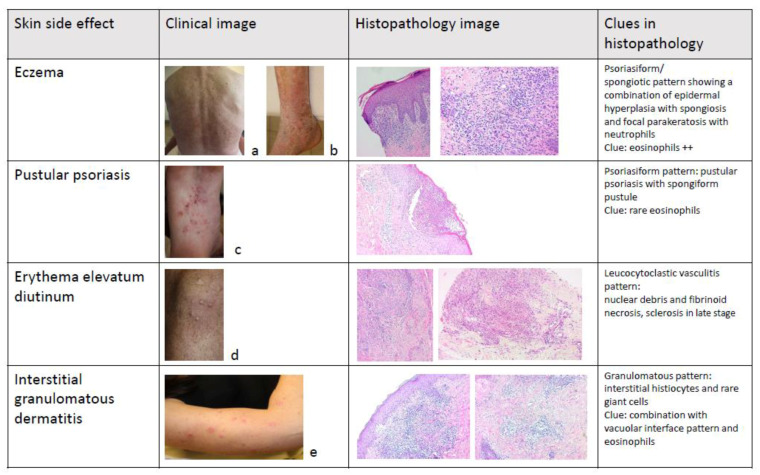
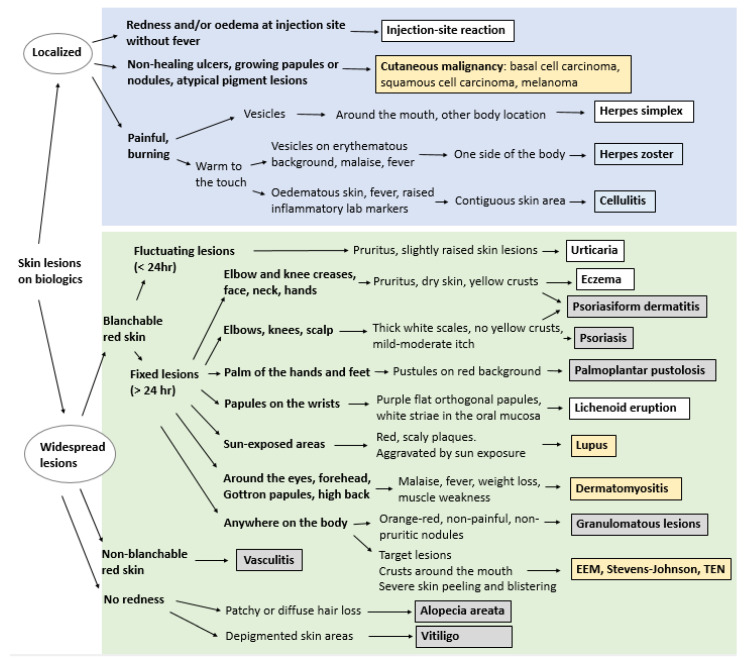
The biologic era has greatly improved the treatment of Crohn's disease and ulcerative colitis. Biologics can however induce a wide variety of skin eruptions, especially those targeting the TNF-α and Th17 pathway. These include infusion reactions, eczema, psoriasis, lupus, alopecia areata, vitiligo, lichenoid reactions, granulomatous disorders, vasculitis, skin cancer, and cutaneous infections. It is important to recognize these conditions as treatment-induced adverse reactions and adapt the treatment strategy accordingly. Some conditions can be treated topically while others require cessation or switch of the biological therapy. TNF-α antagonists have the highest rate adverse skin eruptions followed by ustekinumab and anti-integrin receptor blockers. In this review, we provide an overview of the most common skin eruptions which can be encountered in clinical practice when treating IBD (Inflammatory bowel disease) patients and propose a therapeutic approach for each condition.
生物制剂时代极大地改善了克罗恩病和溃疡性结肠炎的治疗。然而,生物制剂可引发多种皮肤疹,尤其是那些针对肿瘤坏死因子-α(TNF-α)和17型辅助性T细胞(Th17)通路的皮疹。这些皮疹包括输液反应、湿疹、银屑病、狼疮、斑秃、白癜风、苔藓样反应、肉芽肿性疾病、血管炎、皮肤癌和皮肤感染。将这些情况识别为治疗引起的不良反应并相应调整治疗策略很重要。有些情况可局部治疗,而其他情况则需要停止或更换生物疗法。TNF-α拮抗剂引发皮肤不良反应的发生率最高,其次是优特克单抗和抗整合素受体阻滞剂。在本综述中,我们概述了在治疗炎症性肠病(IBD)患者的临床实践中可能遇到的最常见皮肤疹,并针对每种情况提出了一种治疗方法。