Department of Dermatology, Medical University of Vienna, Vienna, Austria.
CeMM Research Center for Molecular Medicine, Vienna, Austria.
Immunol Rev. 2023 Jul;316(1):104-119. doi: 10.1111/imr.13213. Epub 2023 May 5.
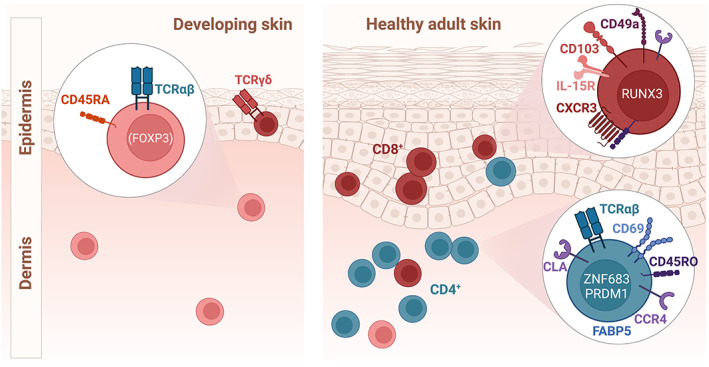
The human skin is populated by a diverse pool of memory T cells, which can act rapidly in response to pathogens and cancer antigens. Tissue-resident memory T cells (T ) have been implicated in range of allergic, autoimmune and inflammatory skin diseases. Clonal expansion of cells with T properties is also known to contribute to cutaneous T-cell lymphoma. Here, we review the heterogeneous phenotypes, transcriptional programs, and effector functions of skin T . We summarize recent studies on T formation, longevity, plasticity, and retrograde migration and contextualize the findings to skin T and their role in maintaining skin homeostasis and altered functions in skin disease.
人类皮肤中存在着多种多样的记忆 T 细胞,它们可以对病原体和癌症抗原迅速作出反应。组织驻留记忆 T 细胞(T 细胞)被认为与多种过敏性、自身免疫性和炎症性皮肤病有关。具有 T 细胞特性的细胞克隆扩增也被认为有助于皮肤 T 细胞淋巴瘤的发生。在这里,我们综述了皮肤 T 细胞的异质性表型、转录程序和效应功能。我们总结了最近关于 T 细胞形成、寿命、可塑性、逆行迁移的研究,并将这些发现与皮肤 T 细胞及其在维持皮肤稳态和皮肤疾病中功能改变的作用联系起来。