First Department of Pathology, Medical School, National and Kapodistrian University of Athens, 75, M. Asias Str., Bld 10, Goudi, GR11527 Athens, Greece.
Int J Mol Sci. 2021 Mar 9;22(5):2744. doi: 10.3390/ijms22052744.
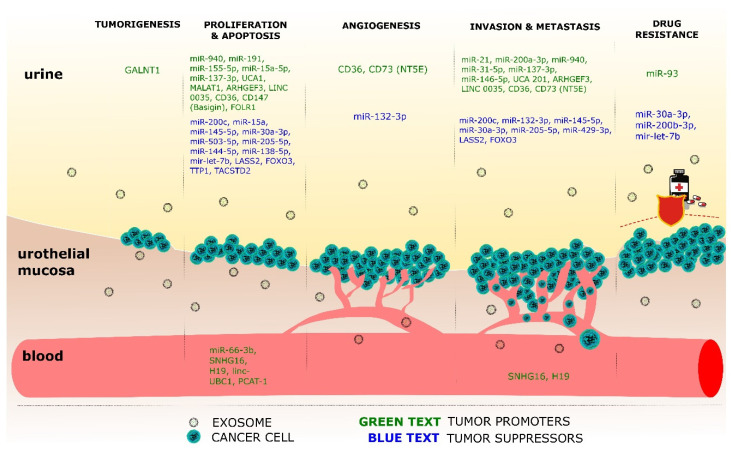
Exosomes are extracellular vesicles, enriched in biomolecular cargo consisting of nucleic acids, proteins, and lipids, which take part in intercellular communication and play a crucial role in both physiologic functions and oncogenesis. Bladder cancer is the most common urinary malignancy and its incidence is steadily rising in developed countries. Despite the high five-year survival in patients diagnosed at early disease stage, survival substantially drops in patients with muscle-invasive or metastatic disease. Therefore, early detection of primary disease as well as recurrence is of paramount importance. The role that exosomal biomarkers could play in bladder cancer patient diagnosis and surveillance, as well as their potential therapeutic applications, has not been extensively studied in this malignancy. In the present review, we summarize all relevant data obtained so far from cell lines, animal models, and patient biofluids and tissues. Current literature suggests that urine is a rich source of extracellular vesicle-derived biomarkers, compared with blood and bladder tissue samples, with potential applications in bladder cancer management. Further studies improving sample collection procedures and optimizing purification and analytical methods should augment bladder cancer diagnostic, prognostic, and therapeutic input of extracellular vesicles biomarkers in the future.
外泌体是细胞外囊泡,富含生物分子货物,包括核酸、蛋白质和脂质,参与细胞间通讯,在生理功能和肿瘤发生中发挥关键作用。膀胱癌是最常见的泌尿系统恶性肿瘤,在发达国家其发病率稳步上升。尽管早期诊断的患者五年生存率较高,但肌层浸润性或转移性疾病患者的生存率显著下降。因此,早期发现原发性疾病和复发至关重要。外泌体生物标志物在膀胱癌患者诊断和监测中的作用以及它们的潜在治疗应用在这种恶性肿瘤中尚未得到广泛研究。在本综述中,我们总结了迄今为止从细胞系、动物模型和患者生物体液和组织中获得的所有相关数据。目前的文献表明,与血液和膀胱组织样本相比,尿液是富含外泌体衍生生物标志物的来源,在外泌体衍生生物标志物在膀胱癌管理中的应用具有潜在的应用价值。进一步的研究改进样本采集程序和优化纯化和分析方法,将增加外泌体标志物在未来膀胱癌诊断、预后和治疗中的作用。