
理解为何在高级麻醉学培训阶段所有类型的动机都是必要的,以及它们如何影响工作满意度:将自我决定理论应用于医疗保健领域的翻译
Understanding Why All Types of Motivation Are Necessary in Advanced Anaesthesiology Training Levels and How They Influence Job Satisfaction: Translation of the Self-Determination Theory to Healthcare.
作者信息
Moll-Khosrawi Parisa, Zimmermann Stefan, Zoellner Christian, Schulte-Uentrop Leonie
机构信息
Department of Anaesthesiology, University Medical Center Hamburg-Eppendorf, Martinistr. 52, 20246 Hamburg, Germany.
Institute of Biochemistry and Molecular Cell Biology, University Medical Center Hamburg-Eppendorf, Martinistr. 52, 20246 Hamburg, Germany.
出版信息
Healthcare (Basel). 2021 Mar 1;9(3):262. doi: 10.3390/healthcare9030262.
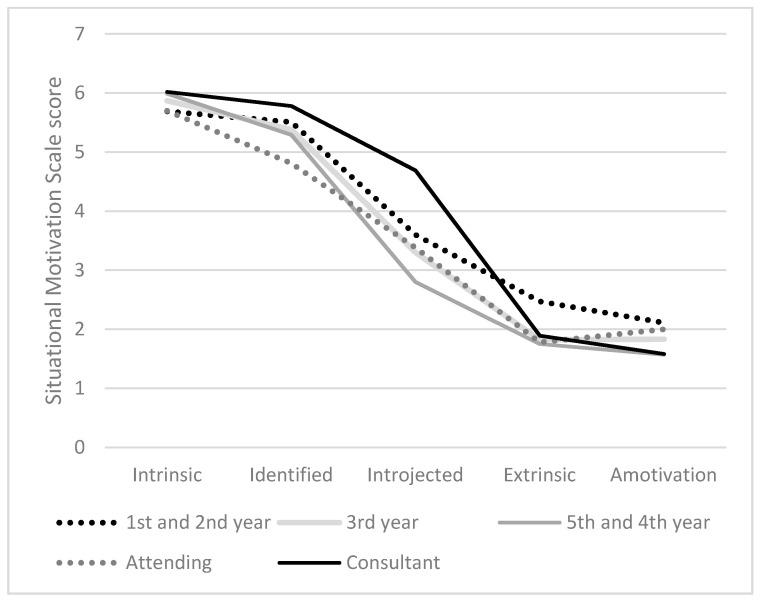
Studies applying the self-determination theory have shown that intrinsic motivation and autonomous regulation lead to job satisfaction and to better job performance. What has not been worked out clearly yet are the effects of extrinsic motivation and controlled regulation on affect, job performance and job satisfaction. However, it has been described that controlled regulation is often necessary for mundane tasks. In anaesthesiology, routine daily tasks can be perceived as mundane by those who have achieved a certain level of training (e.g., consultants). Therefore, it was hypothesised that consultants have high expressions of all motivational qualities. Furthermore, it was hypothesised that job satisfaction of anaesthesiologists is correlated with autonomous motivation. The hypotheses were tested in a cross-sectional study design within a group of anaesthesiologists. The study participants reported the same pattern throughout the motivational continuum. Consultants reported the highest levels of all motivational qualities, including controlled regulation, as well as the highest levels of job satisfaction. Junior residents reported high levels of amotivation and extrinsic regulation. The lowest levels of identified regulation and job satisfaction were reported by the group of attendings. Job satisfaction was positively correlated with intrinsic motivation and negatively correlated with amotivation. Therefore, our findings from the field of anaesthesiology show that the expressions of high levels of controlled regulation might be necessary for specialists to engage in mundane daily tasks. Intrinsic motivation and autonomous regulation are necessary for job satisfaction and the presence of controlled regulation and extrinsic behavioural regulation have no declining effects. Furthermore, the decrease of amotivation will lead to enhanced job satisfaction and the resulting consequences will be extensive. Junior residents need to be supported with the aim to enhance their feeling of autonomy and competence in order to decrease amotivation and to foster autonomous regulation and hence to increase job satisfaction and well-being. Further special focus should be on attendings to counteract their lacking identification with the job. Hereby, the provision of feedback and professional perspectives might foster the process of re-identification.
运用自我决定理论的研究表明,内在动机和自主调节会带来工作满意度和更好的工作绩效。然而,外在动机和受控调节对情感、工作绩效和工作满意度的影响尚未明确。不过,有人指出,对于日常任务而言,受控调节通常是必要的。在麻醉学领域,对于那些达到一定培训水平的人(如会诊医生)来说,日常的常规任务可能会被视为平凡琐碎。因此,研究假设会诊医生具有所有动机特质的高表达。此外,研究还假设麻醉医生的工作满意度与自主动机相关。这些假设在一组麻醉医生中采用横断面研究设计进行了检验。研究参与者在整个动机连续体上呈现出相同的模式。会诊医生报告了所有动机特质的最高水平,包括受控调节,以及最高水平的工作满意度。初级住院医生报告了较高水平的无动机和外在调节。主治医生组报告的自主调节和工作满意度水平最低。工作满意度与内在动机呈正相关,与无动机呈负相关。因此,我们在麻醉学领域的研究结果表明,高水平的受控调节表达可能是专家从事日常平凡任务所必需的。内在动机和自主调节对于工作满意度是必要的,而受控调节和外在行为调节的存在并没有负面影响。此外,无动机的减少将导致工作满意度提高,其结果将是广泛的。需要支持初级住院医生,以增强他们的自主感和能力感,从而减少无动机,促进自主调节,进而提高工作满意度和幸福感。应特别关注主治医生,以克服他们对工作缺乏认同感的问题。在此过程中,提供反馈和专业视角可能会促进重新认同的过程。
 Zotero 插件