Ward Michael P, Brookes Victoria J
Sydney School of Veterinary Science, The University of Sydney, Camden, NSW 2570, Australia.
School of Animal and Veterinary Sciences, Faculty of Science, Charles Sturt University, Wagga Wagga, NSW 2678, Australia.
Pathogens. 2021 Mar 20;10(3):375. doi: 10.3390/pathogens10030375.
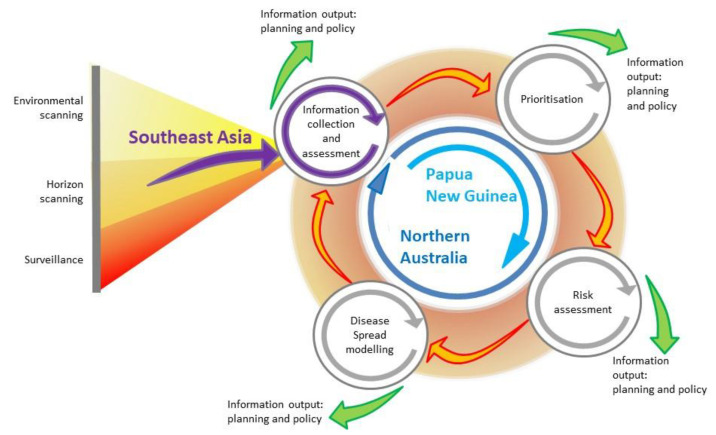
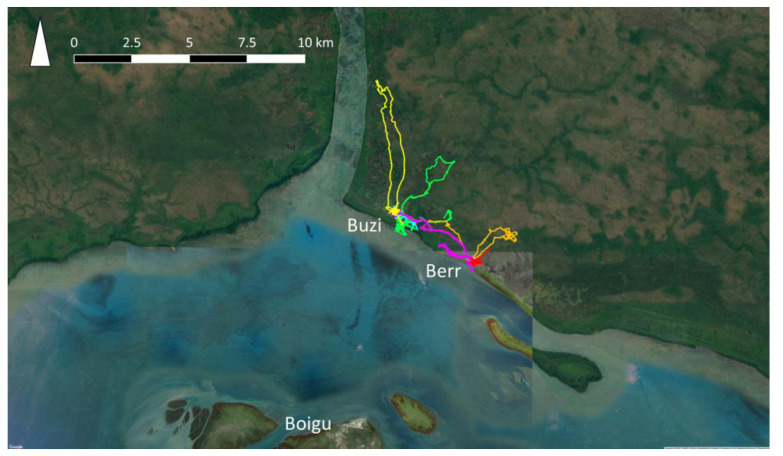
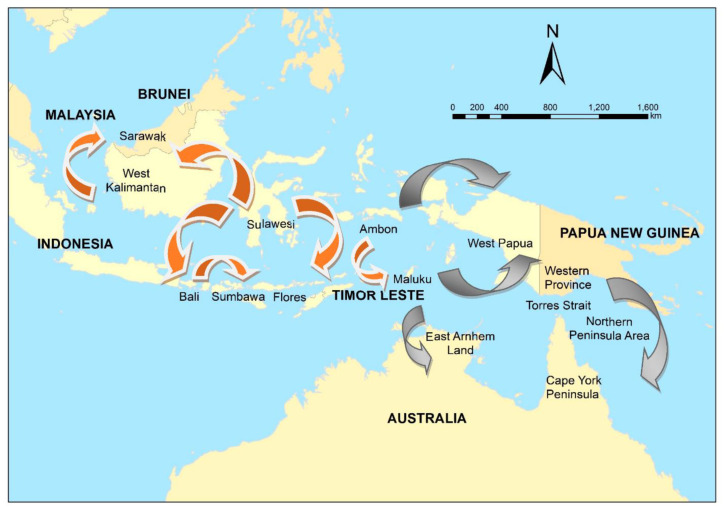
Emerging infectious disease (EID) events have the potential to cause devastating impacts on human, animal and environmental health. A range of tools exist which can be applied to address EID event detection, preparedness and response. Here we use a case study of rabies in Southeast Asia and Oceania to illustrate, via nearly a decade of research activities, how such tools can be systematically integrated into a framework for EID preparedness. During the past three decades, canine rabies has spread to previously free areas of Southeast Asia, threatening the rabies-free status of countries such as Timor Leste, Papua New Guinea and Australia. The program of research to address rabies preparedness in the Oceanic region has included scanning and surveillance to define the emerging nature of canine rabies within the Southeast Asia region; field studies to collect information on potential reservoir species, their distribution and behaviour; participatory and sociological studies to identify priorities for disease response; and targeted risk assessment and disease modelling studies. Lessons learnt include the need to develop methods to collect data in remote regions, and the need to continuously evaluate and update requirements for preparedness in response to evolving drivers of emerging infectious disease.
新发传染病(EID)事件有可能对人类、动物和环境卫生造成毁灭性影响。现有一系列工具可用于新发传染病事件的检测、防范和应对。在此,我们以东南亚和大洋洲的狂犬病为例,通过近十年的研究活动,说明如何将这些工具系统地整合到新发传染病防范框架中。在过去三十年里,犬狂犬病已蔓延至东南亚此前无狂犬病的地区,威胁到东帝汶、巴布亚新几内亚和澳大利亚等国家的无狂犬病状态。大洋洲地区应对狂犬病防范的研究项目包括扫描和监测,以确定东南亚地区犬狂犬病的新发性质;实地研究,以收集有关潜在宿主物种、其分布和行为的信息;参与性和社会学研究,以确定疾病应对的优先事项;以及针对性风险评估和疾病建模研究。汲取的经验教训包括需要开发在偏远地区收集数据的方法,以及需要不断评估和更新应对新发传染病不断变化的驱动因素的防范要求。