Department of Biostatistics, Epidemiology & Informatics, Perelman School of Medicine at University of Pennsylvania, Philadelphia, Pennsylvania, United States of America.
Zoonotic Disease Research Lab, One Health Unit, School of Public Health and Administration, Universidad Peruana Cayetano Heredia, Lima, Perú.
PLoS Negl Trop Dis. 2021 May 21;15(5):e0009414. doi: 10.1371/journal.pntd.0009414. eCollection 2021 May.
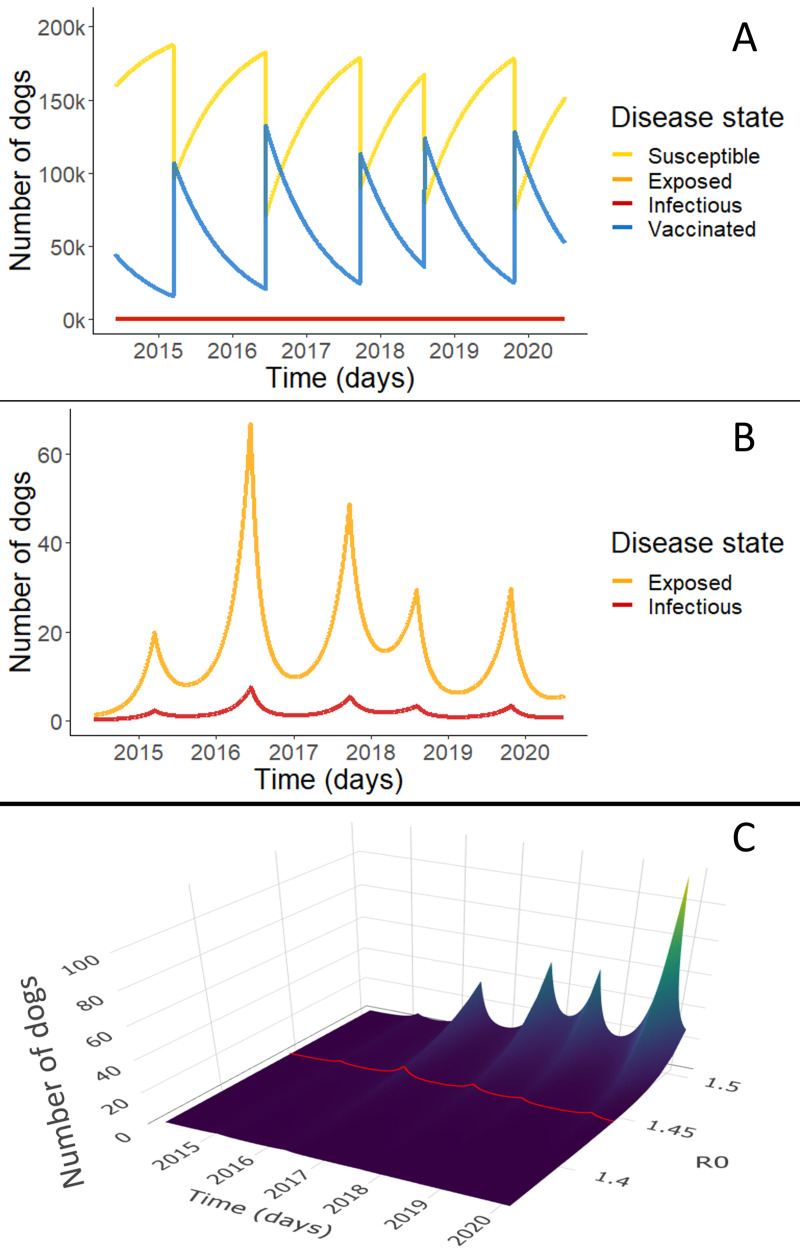
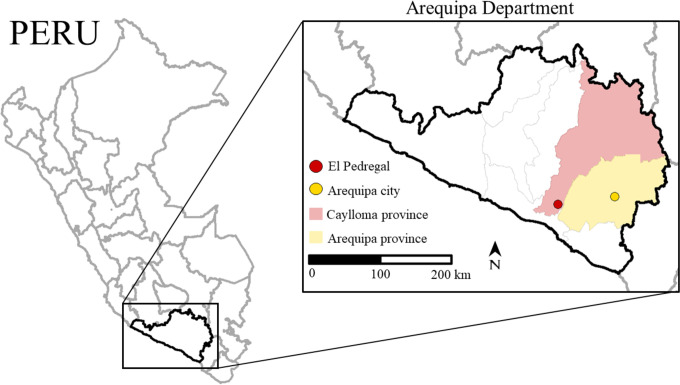
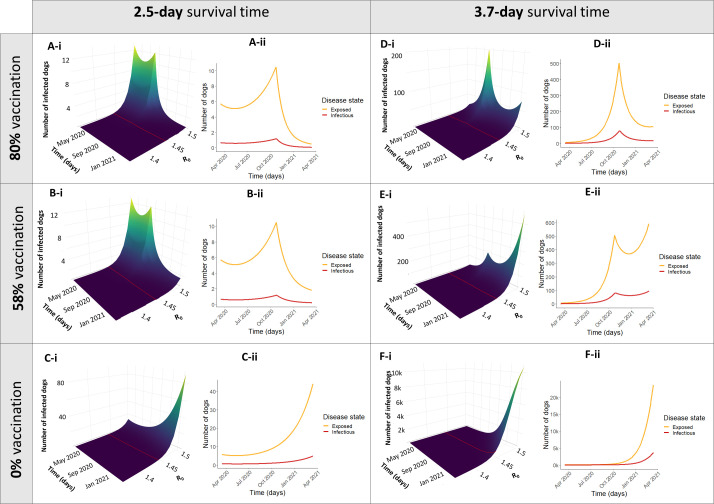
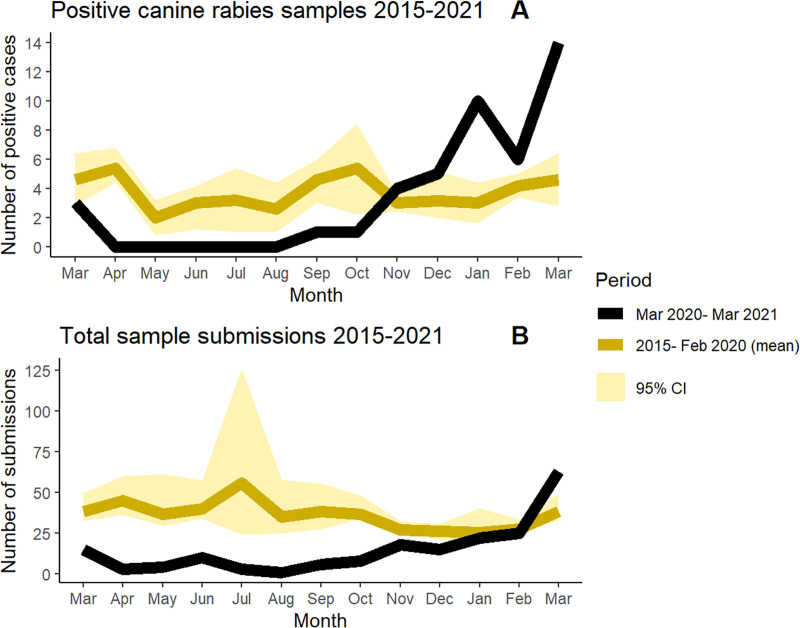
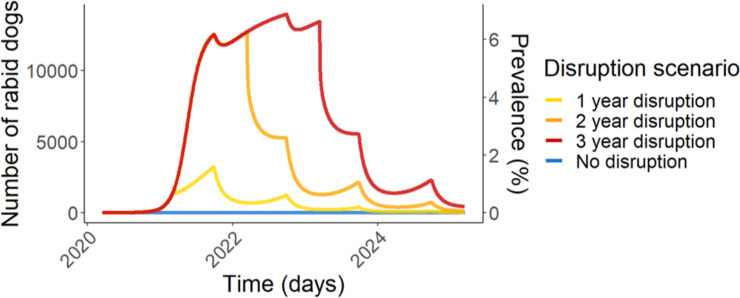
In Latin America, there has been tremendous progress towards eliminating canine rabies. Major components of rabies elimination programs leading to these successes have been constant and regular surveillance for rabid dogs and uninterrupted yearly mass dog vaccination campaigns. Unfortunately, vital measures to control COVID-19 have had the negative trade-off of jeopardizing these rabies elimination and prevention activities. We aimed to assess the effect of interrupting canine rabies surveillance and mass dog vaccination campaigns on rabies trends. We built a deterministic compartment model of dog rabies dynamics to create a conceptual framework for how different disruptions may affect rabies virus transmission. We parameterized the model for conditions found in Arequipa, Peru, a city with active rabies virus transmission. We examined our results over a range of plausible values for R0 (1.36-2.0). Also, we prospectively evaluated surveillance data during the pandemic to detect temporal changes. Our model suggests that a decrease in canine vaccination coverage as well as decreased surveillance could lead to a sharp rise in canine rabies within months. These results were consistent over all plausible values of R0. Surveillance data from late 2020 and early 2021 confirms that in Arequipa, Peru, rabies cases are on an increasing trajectory. The rising rabies trends in Arequipa, if indicative to the region as whole, suggest that the achievements made in Latin America towards the elimination of dog-mediated human rabies may be in jeopardy.
在拉丁美洲,消除犬狂犬病方面取得了巨大进展。导致这些成功的狂犬病消除计划的主要组成部分是对狂犬病犬的持续和定期监测以及不间断的年度大规模犬疫苗接种运动。不幸的是,控制 COVID-19 的重要措施对这些狂犬病消除和预防活动产生了负面影响。我们旨在评估中断犬狂犬病监测和大规模犬疫苗接种运动对狂犬病趋势的影响。我们建立了一个犬狂犬病动力学的确定性隔间模型,为不同的干扰如何影响狂犬病病毒的传播创建了一个概念框架。我们针对秘鲁阿雷基帕市的条件对模型进行了参数化,该市存在活跃的狂犬病病毒传播。我们在 R0(1.36-2.0)的一系列合理值范围内检查了我们的结果。此外,我们还前瞻性地评估了大流行期间的监测数据,以检测时间变化。我们的模型表明,犬疫苗接种覆盖率的降低以及监测的减少可能会导致犬狂犬病在几个月内急剧上升。这些结果在 R0 的所有合理值上都是一致的。2020 年末和 2021 年初的监测数据证实,在秘鲁阿雷基帕,狂犬病病例呈上升趋势。如果阿雷基帕的上升趋势表明整个地区的情况,则表明拉丁美洲在消除犬介导的人类狂犬病方面取得的成就可能受到威胁。