Vecera Courtney M, Fries Gabriel R, Shahani Lokesh R, Soares Jair C, Machado-Vieira Rodrigo
Experimental Therapeutics and Molecular Pathophysiology Program, Louis A. Faillace, MD, Department of Psychiatry and Behavioral Sciences, McGovern Medical School, The University of Texas Health Science Center at Houston, Houston, TX 77054, USA.
Center of Excellence on Mood Disorders, Louis A. Faillace, MD, Department of Psychiatry and Behavioral Sciences, McGovern Medical School, The University of Texas Health Science Center at Houston, Houston, TX 77054, USA.
Pharmaceuticals (Basel). 2021 Mar 24;14(4):287. doi: 10.3390/ph14040287.
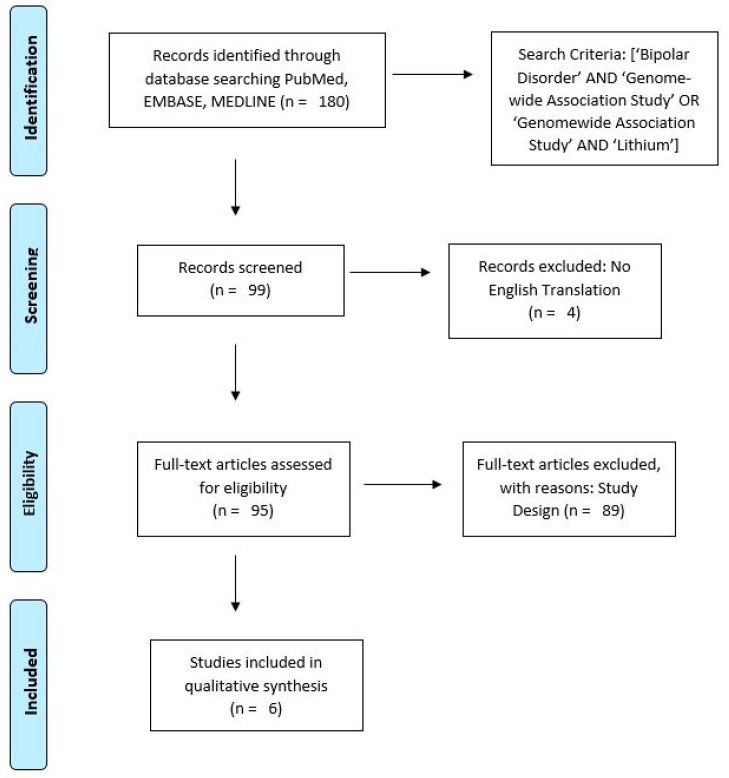
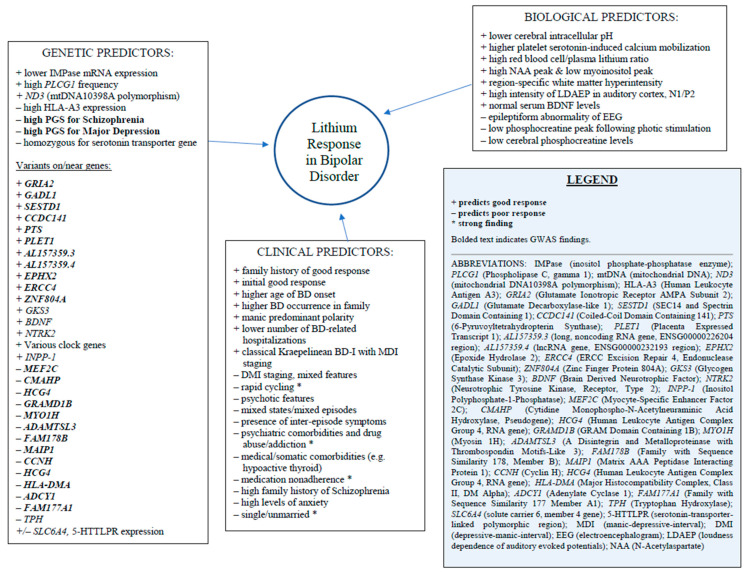
Despite being the most widely studied mood stabilizer, researchers have not confirmed a mechanism for lithium's therapeutic efficacy in Bipolar Disorder (BD). Pharmacogenomic applications may be clinically useful in the future for identifying lithium-responsive patients and facilitating personalized treatment. Six genome-wide association studies (GWAS) reviewed here present evidence of genetic variations related to lithium responsivity and side effect expression. Variants were found on genes regulating the glutamate system, including GAD-like gene 1 () and gene, a mutually-regulated target of lithium. In addition, single nucleotide polymorphisms (SNPs) discovered on may account for lithium's exceptional ability to permeate cell membranes and mediate autoimmune and renal effects. Studies also corroborated the importance of epigenetics and stress regulation on lithium response, finding variants on long, non-coding RNA genes and associations between response and genetic loading for psychiatric comorbidities. Overall, the precision medicine model of stratifying patients based on phenotype seems to derive genotypic support of a separate clinical subtype of lithium-responsive BD. Results have yet to be expounded upon and should therefore be interpreted with caution.
尽管锂盐是研究最广泛的心境稳定剂,但研究人员尚未证实其治疗双相情感障碍(BD)疗效的机制。药物基因组学应用未来可能在临床上有助于识别对锂盐有反应的患者并促进个性化治疗。本文综述的六项全基因组关联研究(GWAS)提供了与锂盐反应性和副作用表达相关的基因变异证据。在调节谷氨酸系统的基因上发现了变异,包括类谷氨酸脱羧酶基因1()和基因,后者是锂盐的一个相互调节靶点。此外,在上发现的单核苷酸多态性(SNP)可能解释了锂盐渗透细胞膜以及介导自身免疫和肾脏效应的特殊能力。研究还证实了表观遗传学和应激调节对锂盐反应的重要性,在长链非编码RNA基因上发现了变异,并发现反应与精神共病的基因负荷之间存在关联。总体而言,基于表型对患者进行分层的精准医学模式似乎得到了对锂盐反应性BD的一个单独临床亚型的基因型支持。研究结果尚未详细阐述,因此应谨慎解读。