Strobel Sophia B, Machiraju Devayani, Hülsmeyer Ingrid, Becker Jürgen C, Paschen Annette, Jäger Dirk, Wels Winfried S, Bachmann Michael, Hassel Jessica C
Department of Dermatology and National Center for Tumor Diseases, University Hospital Heidelberg, 69120 Heidelberg, Germany.
German Cancer Research Center (DKFZ), 69120 Heidelberg, Germany.
Life (Basel). 2021 Mar 24;11(4):269. doi: 10.3390/life11040269.
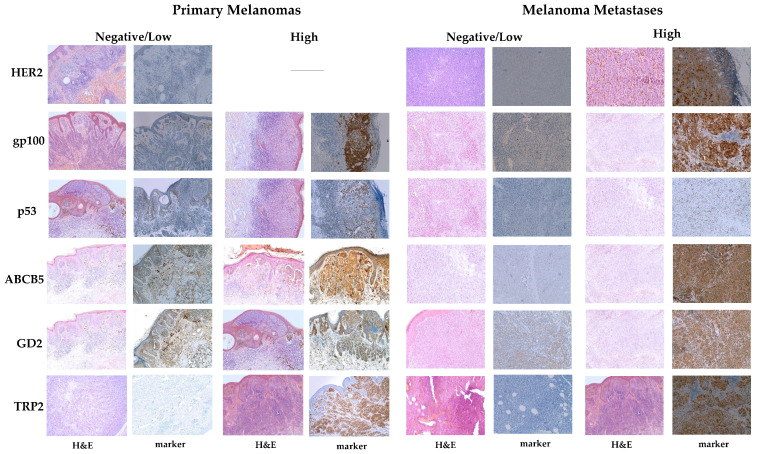
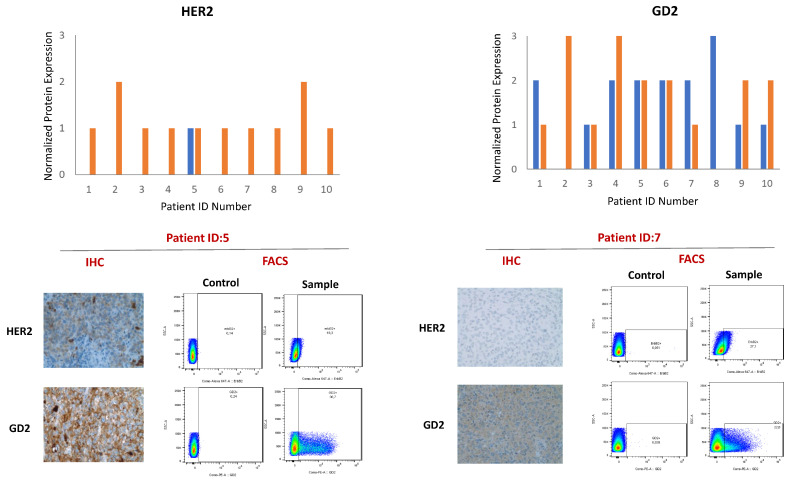
Tumor antigen-specific redirection of cytotoxic T cells (CTLs) or natural killer (NK) cells including chimeric antigen receptor (CAR-) and T cell receptor (TCR-) cell therapy is currently being evaluated in different tumor entities including melanoma. Expression of melanoma-specific antigen recognized by the respective CAR or TCR directly or presented by HLA molecules is an indispensable prerequisite for this innovative therapy. In this study, we investigated in 168 FFPE tumor specimens of patients with stage I-IV melanoma the protein expression of HER2, TRP2, ABCB5, gp100, p53, and GD2 by immunohistochemistry (IHC). These results were correlated with clinical parameters. Membrane expression of HER2 and GD2 was also investigated in ten melanoma cell lines by flow cytometry for which corresponding tumors were analyzed by IHC. Our results demonstrated that gp100 was the most frequently overexpressed protein (61%), followed by TRP2 (50%), GD2 (38%), p53 (37%), ABCB5 (17%), and HER2 (3%). TRP2 expression was higher in primary tumors compared to metastases ( = 0.005). Accordingly, TRP2 and ABCB5 expression was significantly associated with lower tumor thickness of the primary ( = 0.013 and = 0.025). There was no association between protein expression levels and survival in advanced melanoma patients. Flow cytometric analysis revealed abundant surface expression of GD2 and HER2 in all melanoma cell lines. The discordant HER2 expression in situ and in vitro suggests a tissue culture associated induction. In summary, our data support the use of gp100 and GD2 as a potential target for developing engineered TCR- or CAR-cell therapies, respectively, against melanoma.
细胞毒性T细胞(CTL)或自然杀伤(NK)细胞的肿瘤抗原特异性重定向,包括嵌合抗原受体(CAR)和T细胞受体(TCR)细胞疗法,目前正在包括黑色素瘤在内的不同肿瘤实体中进行评估。相应的CAR或TCR直接识别或由HLA分子呈递的黑色素瘤特异性抗原的表达是这种创新疗法不可或缺的先决条件。在本研究中,我们通过免疫组织化学(IHC)研究了168例I-IV期黑色素瘤患者的FFPE肿瘤标本中HER2、TRP2、ABCB5、gp100、p53和GD2的蛋白表达。这些结果与临床参数相关。还通过流式细胞术在10种黑色素瘤细胞系中研究了HER2和GD2的膜表达,并通过IHC对相应肿瘤进行了分析。我们的结果表明,gp100是最常过度表达的蛋白(61%),其次是TRP2(50%)、GD2(38%)、p53(37%)、ABCB5(17%)和HER2(3%)。与转移灶相比,TRP2在原发性肿瘤中的表达更高(P = 0.005)。因此,TRP2和ABCB5的表达与原发性肿瘤较低的肿瘤厚度显著相关(P = 0.013和P = 0.025)。晚期黑色素瘤患者的蛋白表达水平与生存率之间没有关联。流式细胞术分析显示,所有黑色素瘤细胞系中GD2和HER2均有丰富的表面表达。HER2在原位和体外的不一致表达提示与组织培养相关的诱导。总之,我们的数据支持将gp100和GD2分别用作开发针对黑色素瘤的工程化TCR或CAR细胞疗法的潜在靶点。