Belfroid Evelien, Roβkamp Dorothee, Fraser Graham, Swaan Corien, Timen Aura
National Institute for Public Health and the Environment (RIVM), Centre for Infectious Disease Control, Antonie van Leeuwenhoeklaan 9, 3721, MA, Bilthoven, The Netherlands.
Health Security Consultant (formerly ECDC), Oxford, UK.
BMC Public Health. 2020 Oct 1;20(1):1482. doi: 10.1186/s12889-020-09307-y.
European Member States, the European Commission and its agencies work together to enhance preparedness and response for serious cross-border threats to health such as Ebola. Yet, common understanding of public health emergency preparedness across EU/EEA countries is challenging, because preparedness is a relatively new field of activity and is inherently fraught with uncertainty. A set of practical, widely accepted and easy to use recommendations for generic preparedness that bundles the activities described in separate guidance documents supports countries in preparing for any possible health threat. The aim of this consensus procedure was to identify and seek consensus from national-level preparedness experts from EU/EEA countries on key recommendations of public health emergency preparedness.
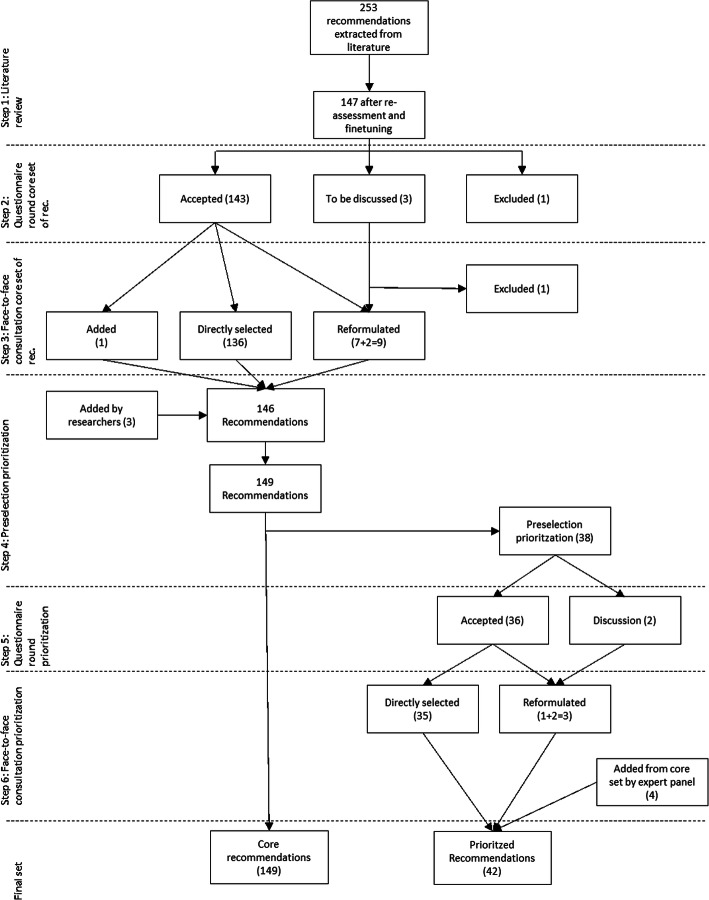
To identify key recommendations and to prioritize the recommendations we started with a literature consensus procedure, followed by a modified Delphi method for consultation of public health emergency preparedness leaders of EU/EEA countries. This consisted of six consecutive steps: a questionnaire to achieve consensus on a core set of recommendations, a face-to-face consultation, preselection of prioritized recommendations, a questionnaire to achieve consensus on the prioritized set and a face-to-face consensus meeting to further prioritize recommendations.
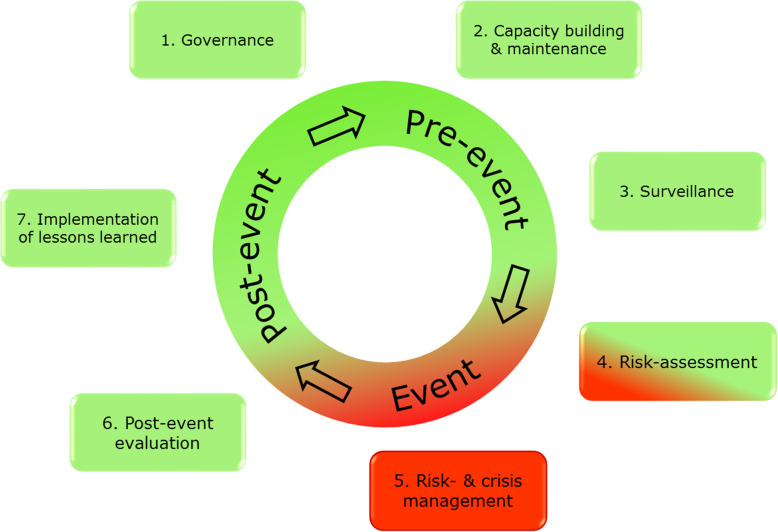
As a result, EU/EEA experts selected 149 recommendations as core preparedness principles and prioritized 42. The recommendations were grouped in the seven domains: governance (57), capacity building and maintenance (11), surveillance (19), risk-assessment (16), risk- and crisis management (35), post-event evaluation (6) and implementation of lessons learned (5).
This prioritised set of consensus principles can provide a foundation for countries aiming to evaluate and improve their preparedness for public health emergencies. The recommendations are practical, support generic preparedness planning, and can be used by all countries irrespective of their current level of preparedness.
欧洲成员国、欧盟委员会及其机构共同努力,以加强对埃博拉等严重跨境健康威胁的防范和应对能力。然而,欧盟/欧洲经济区国家对突发公共卫生事件防范的共同理解颇具挑战,因为防范是一个相对较新的活动领域,且本质上充满不确定性。一套实用、广泛接受且易于使用的一般性防范建议汇总了单独指导文件中描述的活动,有助于各国为任何可能的健康威胁做好准备。这一共识程序的目的是从欧盟/欧洲经济区国家的国家级防范专家中确定公共卫生应急防范的关键建议并寻求共识。
为了确定关键建议并对建议进行优先排序,我们首先采用文献共识程序,随后采用改进的德尔菲法咨询欧盟/欧洲经济区国家的突发公共卫生事件防范负责人。这包括六个连续步骤:一份问卷,以就一组核心建议达成共识;一次面对面咨询;对优先建议进行预选;一份问卷,以就优先建议集达成共识;以及一次面对面共识会议,以进一步对建议进行优先排序。
欧盟/欧洲经济区专家选出149条建议作为核心防范原则,并将42条建议列为优先事项。这些建议分为七个领域:治理(57条)、能力建设与维持(11条)、监测(19条)、风险评估(16条)、风险与危机管理(35条)、事件后评估(6条)以及经验教训的落实(5条)。
这组经过优先排序的共识原则可为旨在评估和改进其突发公共卫生事件防范能力的国家提供一个基础。这些建议具有实用性,支持一般性防范规划,所有国家无论其当前的防范水平如何均可使用。