School of Computer Science and Technology, Hangzhou Dianzi University, Hangzhou 310018, China.
Key Laboratory of Brain Machine Collaborative Intelligence of Zhejiang Province, Hangzhou 310018, China.
Sensors (Basel). 2021 Mar 29;21(7):2369. doi: 10.3390/s21072369.
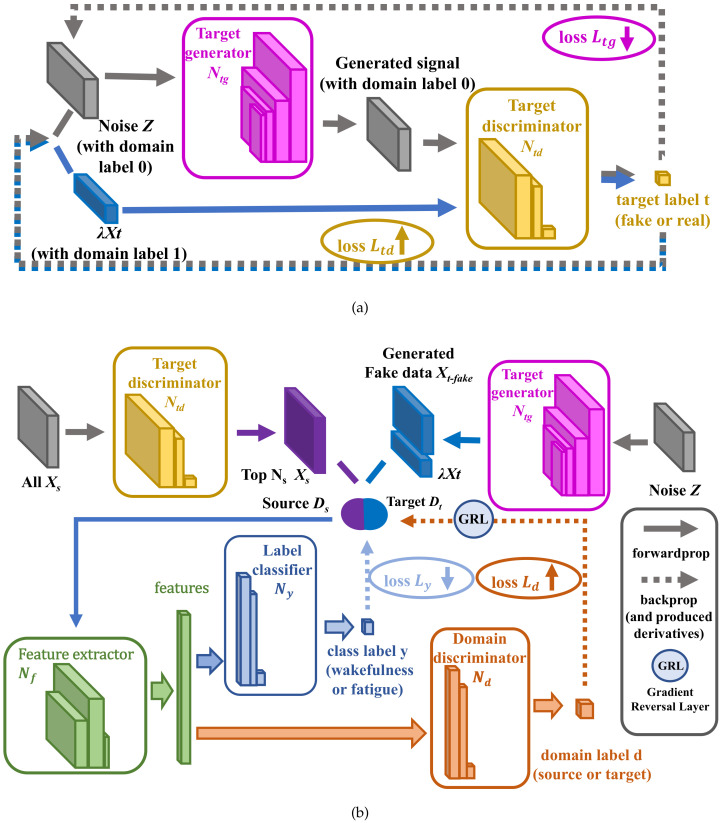
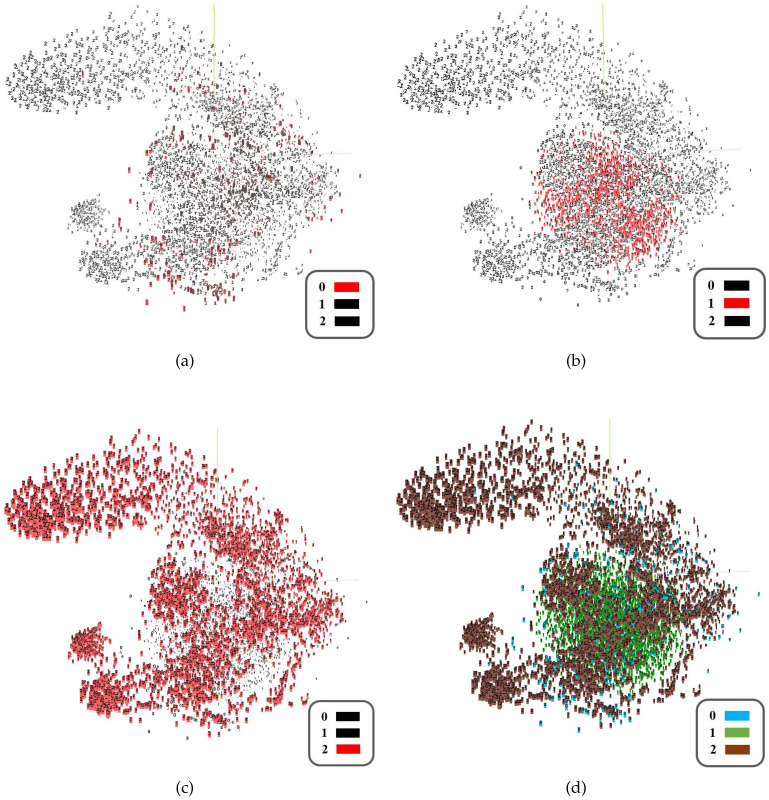
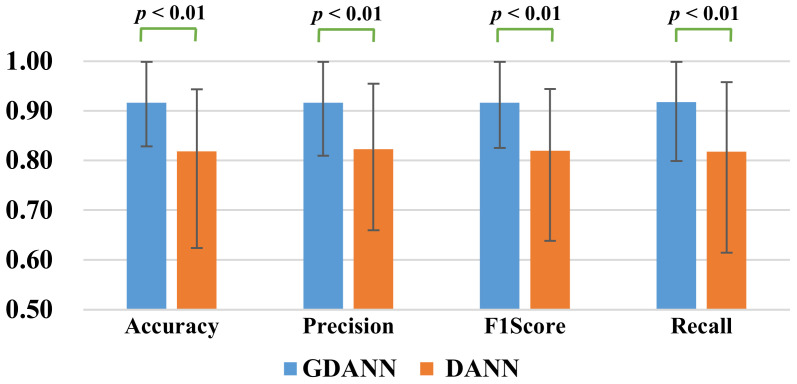
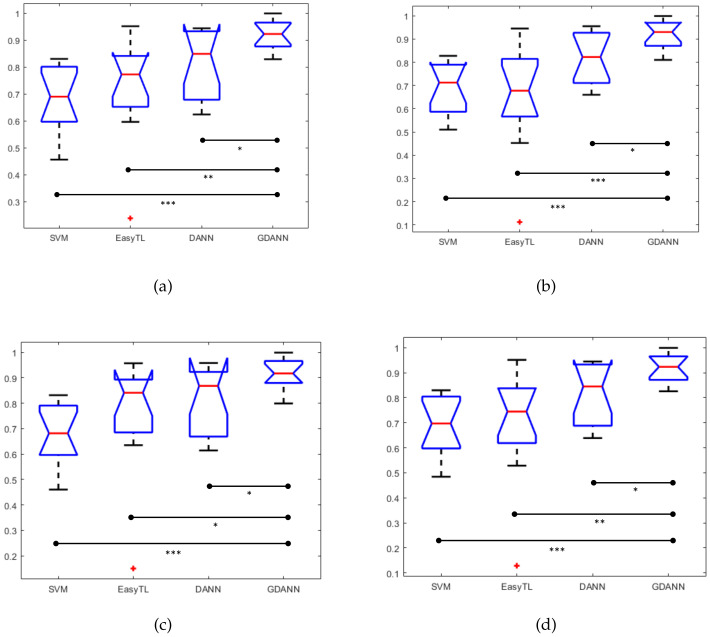
Fatigued driving is one of the main causes of traffic accidents. The electroencephalogram (EEG)-based mental state analysis method is an effective and objective way of detecting fatigue. However, as EEG shows significant differences across subjects, effectively "transfering" the EEG analysis model of the existing subjects to the EEG signals of other subjects is still a challenge. Domain-Adversarial Neural Network (DANN) has excellent performance in transfer learning, especially in the fields of document analysis and image recognition, but has not been applied directly in EEG-based cross-subject fatigue detection. In this paper, we present a DANN-based model, Generative-DANN (GDANN), which combines Generative Adversarial Networks (GAN) to enhance the ability by addressing the issue of different distribution of EEG across subjects. The comparative results show that in the analysis of cross-subject tasks, GDANN has a higher average accuracy of 91.63% in fatigue detection across subjects than those of traditional classification models, which is expected to have much broader application prospects in practical brain-computer interaction (BCI).
疲劳驾驶是交通事故的主要原因之一。基于脑电图(EEG)的精神状态分析方法是检测疲劳的一种有效且客观的方法。然而,由于 EEG 在不同个体之间存在显著差异,因此有效地将现有个体的 EEG 分析模型“转移”到其他个体的 EEG 信号仍然是一个挑战。对抗性神经网络(DANN)在迁移学习中具有出色的性能,特别是在文档分析和图像识别领域,但尚未直接应用于基于 EEG 的跨个体疲劳检测。在本文中,我们提出了一种基于 DANN 的模型,生成式对抗网络 DANN(Generative-DANN,GDANN),它结合了生成式对抗网络(GAN)来增强能力,以解决 EEG 在不同个体之间分布不同的问题。比较结果表明,在跨个体任务的分析中,GDANN 在跨个体疲劳检测中的平均准确率为 91.63%,高于传统分类模型,这有望在实际脑机交互(BCI)中具有更广泛的应用前景。