Lee Hye Soo, Lee Sun Mi, Park Sol Lee, Choi Tae-Rim, Song Hun-Suk, Kim Hyun-Joong, Bhatia Shashi Kant, Gurav Ranjit, Kim Yun-Gon, Kim June-Hyung, Choi Kwon-Young, Yang Yung-Hun
Department of Biological Engineering, College of Engineering, Konkuk University, Seoul 05029, Korea.
Institute for Ubiquitous Information Technology and Applications, Konkuk University, Seoul 05029, Korea.
Polymers (Basel). 2021 Mar 29;13(7):1084. doi: 10.3390/polym13071084.
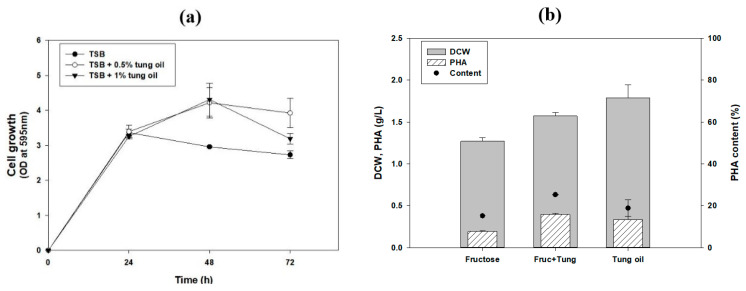
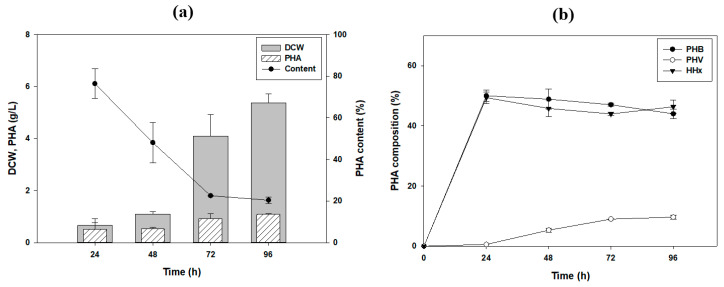
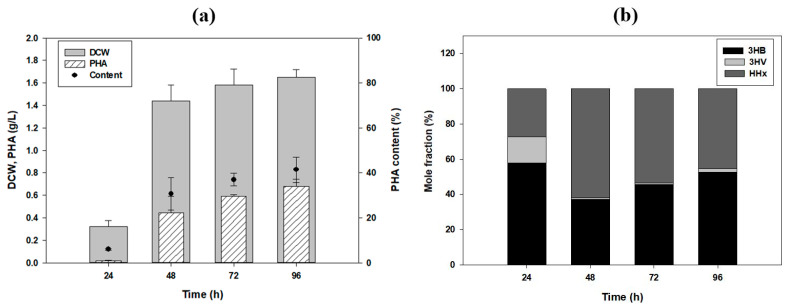
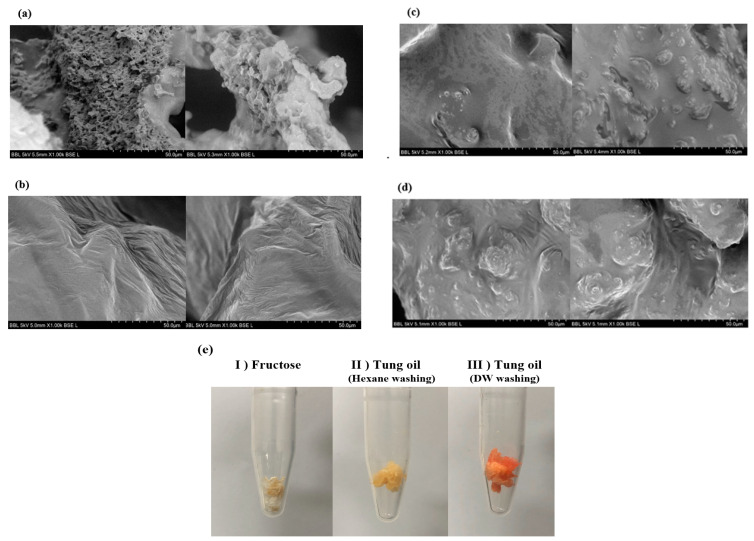
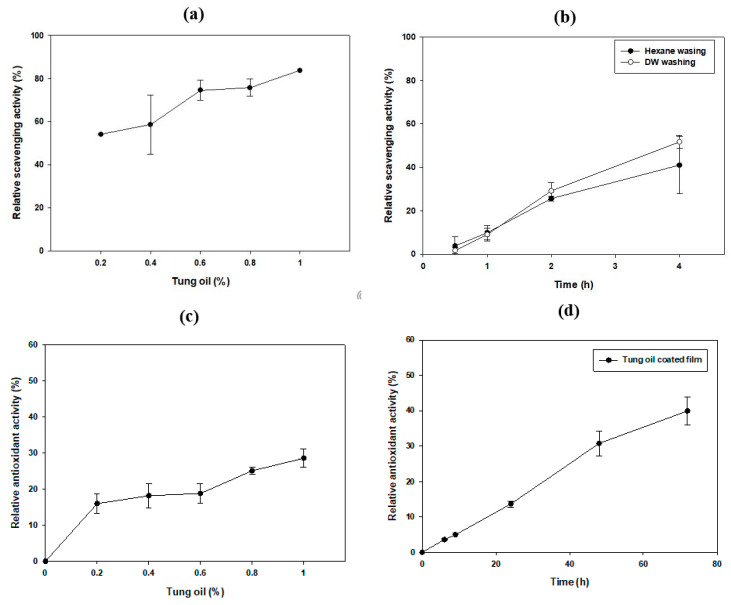
Polyhydroxyalkanoates (PHAs) are attractive new bioplastics for the replacement of plastics derived from fossil fuels. With their biodegradable properties, they have also recently been applied to the medical field. As poly(3-hydroxybutyrate) produced by wild-type has limitations with regard to its physical properties, it is advantageous to synthesize co- or terpolymers with medium-chain-length monomers. In this study, tung oil, which has antioxidant activity due to its 80% α-eleostearic acid content, was used as a carbon source and terpolymer P(53 mol% 3-hydroxybytyrate-co-2 mol% 3-hydroxyvalerate-co-45 mol% 3-hydroxyhexanoate) with a high proportion of 3-hydroxyhexanoate was produced in Re2133/pCB81. To avail the benefits of α-eleostearic acid in the tung oil-based medium, we performed partial harvesting of PHA by using a mild water wash to recover PHA and residual tung oil on the PHA film. This resulted in a film coated with residual tung oil, showing antioxidant activity. Here, we report the first application of tung oil as a substrate for PHA production, introducing a high proportion of hydroxyhexanoate monomer into the terpolymer. Additionally, the residual tung oil was used as an antioxidant coating, resulting in the production of bioactive PHA, expanding the applicability to the medical field.
聚羟基脂肪酸酯(PHA)是一种极具吸引力的新型生物塑料,可用于替代源自化石燃料的塑料。因其具有可生物降解的特性,近年来它们也被应用于医学领域。由于野生型产生的聚(3-羟基丁酸酯)在物理性能方面存在局限性,因此合成含有中链长度单体的共聚物或三元共聚物具有优势。在本研究中,由于含有80%的α-桐酸而具有抗氧化活性的桐油被用作碳源,并在Re2133/pCB81中生产出了含有高比例3-羟基己酸酯的三元共聚物P(53摩尔% 3-羟基丁酸酯-co-2摩尔% 3-羟基戊酸酯-co-45摩尔% 3-羟基己酸酯)。为了利用基于桐油的培养基中α-桐酸的益处,我们通过温和水洗进行PHA的部分收获,以回收PHA和PHA膜上的残留桐油。这产生了一种涂有残留桐油的膜,显示出抗氧化活性。在此,我们报道了桐油作为PHA生产底物的首次应用,将高比例的羟基己酸酯单体引入三元共聚物中。此外,残留桐油被用作抗氧化涂层,从而生产出具有生物活性的PHA,扩大了其在医学领域的适用性。