University Cancer Center Schleswig-Holstein (UCCSH), University Hospital Schleswig-Holstein, 24015 Kiel, Germany.
Institute for Hematopathology, Fangdieckstr. 75, 22547 Hamburg, Germany.
Int J Mol Sci. 2021 Mar 25;22(7):3374. doi: 10.3390/ijms22073374.
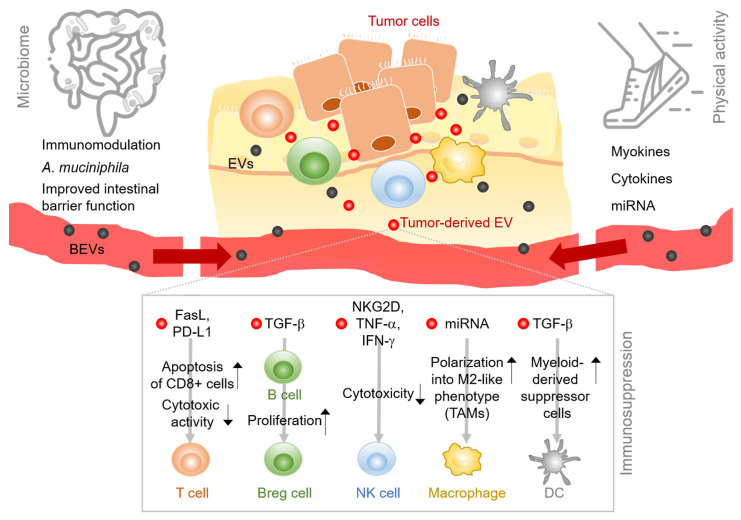
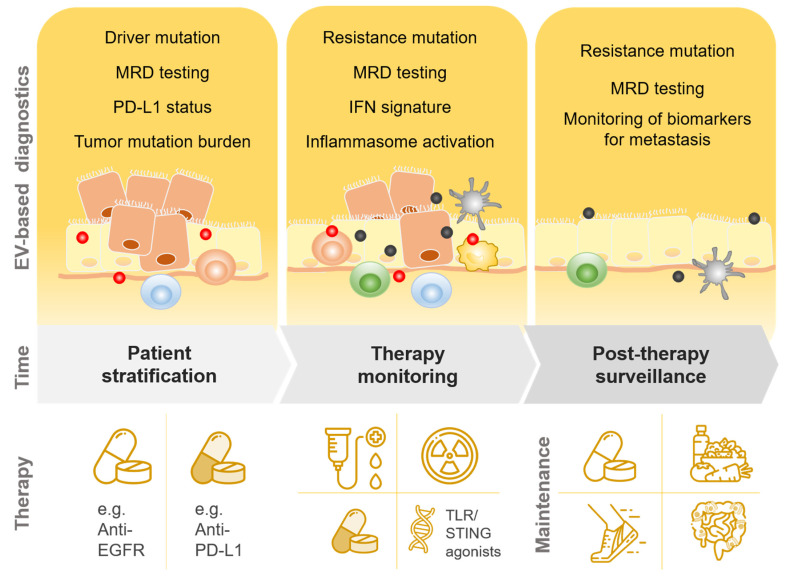
Extracellular vesicles (EVs) serve as trafficking vehicles and intercellular communication tools. Their cargo molecules directly reflect characteristics of their parental cell. This includes information on cell identity and specific cellular conditions, ranging from normal to pathological states. In cancer, the content of EVs derived from tumor cells is altered and can induce oncogenic reprogramming of target cells. As a result, tumor-derived EVs compromise antitumor immunity and promote cancer progression and spreading. However, this pro-oncogenic phenotype is constantly being challenged by EVs derived from the local tumor microenvironment and from remote sources. Here, we summarize the role of EVs in the tumor-immune cross-talk that includes, but is not limited to, immune cells in the tumor microenvironment. We discuss the potential of remotely released EVs from the microbiome and during physical activity to shape the tumor-immune cross-talk, directly or indirectly, and confer antitumor activity. We further discuss the role of proinflammatory EVs in the temporal development of the tumor-immune interactions and their potential use for cancer diagnostics.
细胞外囊泡 (EVs) 充当着运输工具和细胞间通讯工具。其携带的分子直接反映了其亲本细胞的特征。这包括关于细胞身份和特定细胞状态的信息,从正常到病理状态不等。在癌症中,源自肿瘤细胞的 EV 的内容发生改变,并可能诱导靶细胞发生致癌重编程。因此,肿瘤衍生的 EV 会损害抗肿瘤免疫并促进癌症进展和扩散。然而,这种致癌表型不断受到来自肿瘤微环境和远程来源的 EV 的挑战。在这里,我们总结了 EV 在肿瘤-免疫交叉对话中的作用,包括但不限于肿瘤微环境中的免疫细胞。我们讨论了来自微生物组和在体育活动中远程释放的 EV 的潜力,以直接或间接的方式塑造肿瘤-免疫交叉对话,并赋予抗肿瘤活性。我们还讨论了促炎 EV 在肿瘤免疫相互作用的时间发展中的作用及其在癌症诊断中的潜在用途。