School of Electronic Engineering, Beijing University of Posts and Telecommunications, Beijing 100876, China.
Queen Mary, University of London, London E1 4NS, UK.
Biosensors (Basel). 2021 Mar 4;11(3):69. doi: 10.3390/bios11030069.
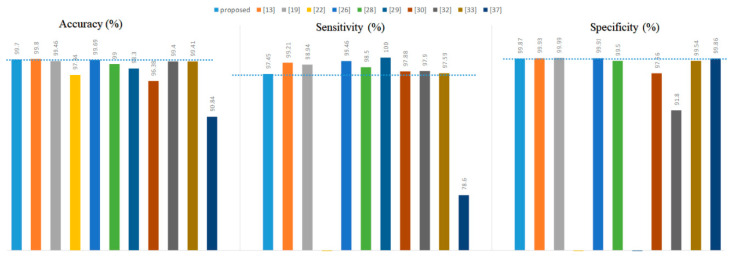
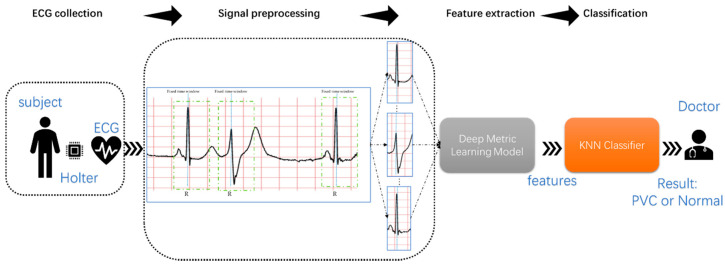
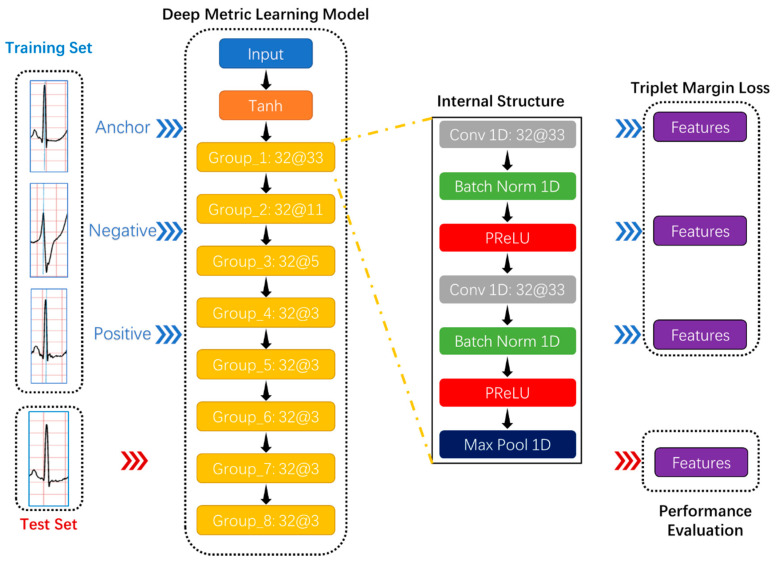
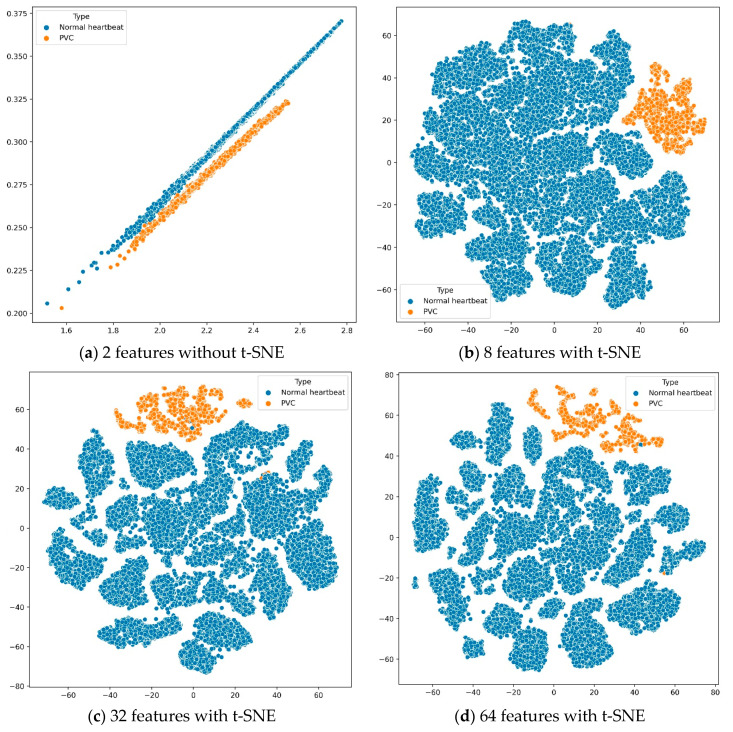
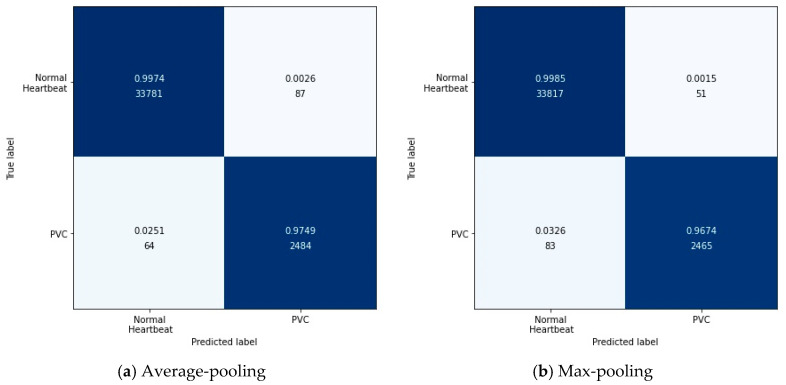
Premature ventricular contractions (PVCs), common in the general and patient population, are irregular heartbeats that indicate potential heart diseases. Clinically, long-term electrocardiograms (ECG) collected from the wearable device is a non-invasive and inexpensive tool widely used to diagnose PVCs by physicians. However, analyzing these long-term ECG is time-consuming and labor-intensive for cardiologists. Therefore, this paper proposed a simplistic but powerful approach to detect PVC from long-term ECG. The suggested method utilized deep metric learning to extract features, with compact intra-product variance and separated inter-product differences, from the heartbeat. Subsequently, the k-nearest neighbors (KNN) classifier calculated the distance between samples based on these features to detect PVC. Unlike previous systems used to detect PVC, the proposed process can intelligently and automatically extract features by supervised deep metric learning, which can avoid the bias caused by manual feature engineering. As a generally available set of standard test material, the MIT-BIH (Massachusetts Institute of Technology-Beth Israel Hospital) Arrhythmia Database is used to evaluate the proposed method, and the experiment takes 99.7% accuracy, 97.45% sensitivity, and 99.87% specificity. The simulation events show that it is reliable to use deep metric learning and KNN for PVC recognition. More importantly, the overall way does not rely on complicated and cumbersome preprocessing.
室性期前收缩(PVCs)在普通人群和患者中很常见,是不规则的心跳,表明可能存在心脏疾病。临床上,可从可穿戴设备长期收集的心电图(ECG)是一种广泛用于医生诊断 PVC 的非侵入性且廉价的工具。然而,对心脏病专家来说,分析这些长期 ECG 既耗时又费力。因此,本文提出了一种从长期 ECG 中检测 PVC 的简单而强大的方法。该方法利用深度度量学习从心跳中提取特征,这些特征具有紧凑的内积方差和分离的产品差异。随后,k-最近邻(KNN)分类器根据这些特征计算样本之间的距离,以检测 PVC。与以前用于检测 PVC 的系统不同,所提出的过程可以通过有监督的深度度量学习智能地自动提取特征,从而避免手动特征工程造成的偏差。麻省理工学院-贝斯以色列医院(Massachusetts Institute of Technology-Beth Israel Hospital)心律失常数据库作为通用的标准测试材料集,用于评估所提出的方法,实验的准确率为 99.7%,灵敏度为 97.45%,特异性为 99.87%。模拟事件表明,使用深度度量学习和 KNN 进行 PVC 识别是可靠的。更重要的是,整体方法不依赖于复杂且繁琐的预处理。