Petmezas Georgios, Stefanopoulos Leandros, Kilintzis Vassilis, Tzavelis Andreas, Rogers John A, Katsaggelos Aggelos K, Maglaveras Nicos
Lab of Computing, Medical Informatics and Biomedical-Imaging Technologies, The Medical School, Aristotle University of Thessaloniki, Thessaloniki, Greece.
Department of Biomedical Engineering, Northwestern University, Evanston, IL, United States.
JMIR Med Inform. 2022 Aug 15;10(8):e38454. doi: 10.2196/38454.
Electrocardiogram (ECG) is one of the most common noninvasive diagnostic tools that can provide useful information regarding a patient's health status. Deep learning (DL) is an area of intense exploration that leads the way in most attempts to create powerful diagnostic models based on physiological signals.
This study aimed to provide a systematic review of DL methods applied to ECG data for various clinical applications.
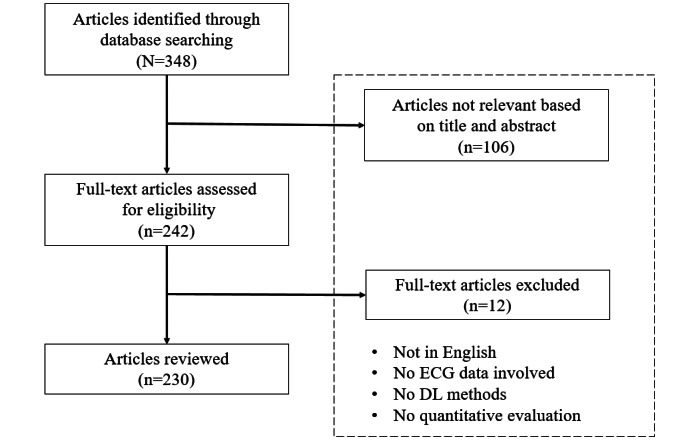
The PubMed search engine was systematically searched by combining "deep learning" and keywords such as "ecg," "ekg," "electrocardiogram," "electrocardiography," and "electrocardiology." Irrelevant articles were excluded from the study after screening titles and abstracts, and the remaining articles were further reviewed. The reasons for article exclusion were manuscripts written in any language other than English, absence of ECG data or DL methods involved in the study, and absence of a quantitative evaluation of the proposed approaches.
We identified 230 relevant articles published between January 2020 and December 2021 and grouped them into 6 distinct medical applications, namely, blood pressure estimation, cardiovascular disease diagnosis, ECG analysis, biometric recognition, sleep analysis, and other clinical analyses. We provide a complete account of the state-of-the-art DL strategies per the field of application, as well as major ECG data sources. We also present open research problems, such as the lack of attempts to address the issue of blood pressure variability in training data sets, and point out potential gaps in the design and implementation of DL models.
We expect that this review will provide insights into state-of-the-art DL methods applied to ECG data and point to future directions for research on DL to create robust models that can assist medical experts in clinical decision-making.
心电图(ECG)是最常见的非侵入性诊断工具之一,可提供有关患者健康状况的有用信息。深度学习(DL)是一个深入探索的领域,在大多数基于生理信号创建强大诊断模型的尝试中处于领先地位。
本研究旨在对应用于心电图数据的深度学习方法在各种临床应用中的情况进行系统综述。
通过结合“深度学习”与“心电图”“ekg”“心电图描记法”“心电图学”“心电学”等关键词,对PubMed搜索引擎进行系统检索。在筛选标题和摘要后,将不相关的文章排除在研究之外,并对其余文章进行进一步审查。排除文章的原因包括:非英文撰写的手稿、研究中未涉及心电图数据或深度学习方法,以及对所提出方法缺乏定量评估。
我们确定了2020年1月至2021年12月期间发表的230篇相关文章,并将它们分为6个不同的医学应用领域,即血压估计、心血管疾病诊断、心电图分析、生物特征识别、睡眠分析和其他临床分析。我们全面介绍了每个应用领域的最新深度学习策略以及主要的心电图数据源。我们还提出了开放性研究问题,例如在训练数据集中缺乏解决血压变异性问题的尝试,并指出深度学习模型设计和实施中的潜在差距。
我们期望本综述能深入了解应用于心电图数据的最新深度学习方法,并为深度学习研究指明未来方向,以创建能够协助医学专家进行临床决策的强大模型。